The Floor
Preprint proposes reflection-robust stereo visual-inertial odometry
A preprint describes a stereo visual-inertial odometry front end that estimates ground height and selectively rejects reflection-induced features below it. Its experiments on reflective indoor-floor sequences generally show improved trajectory accuracy in reflection-dominant environments.
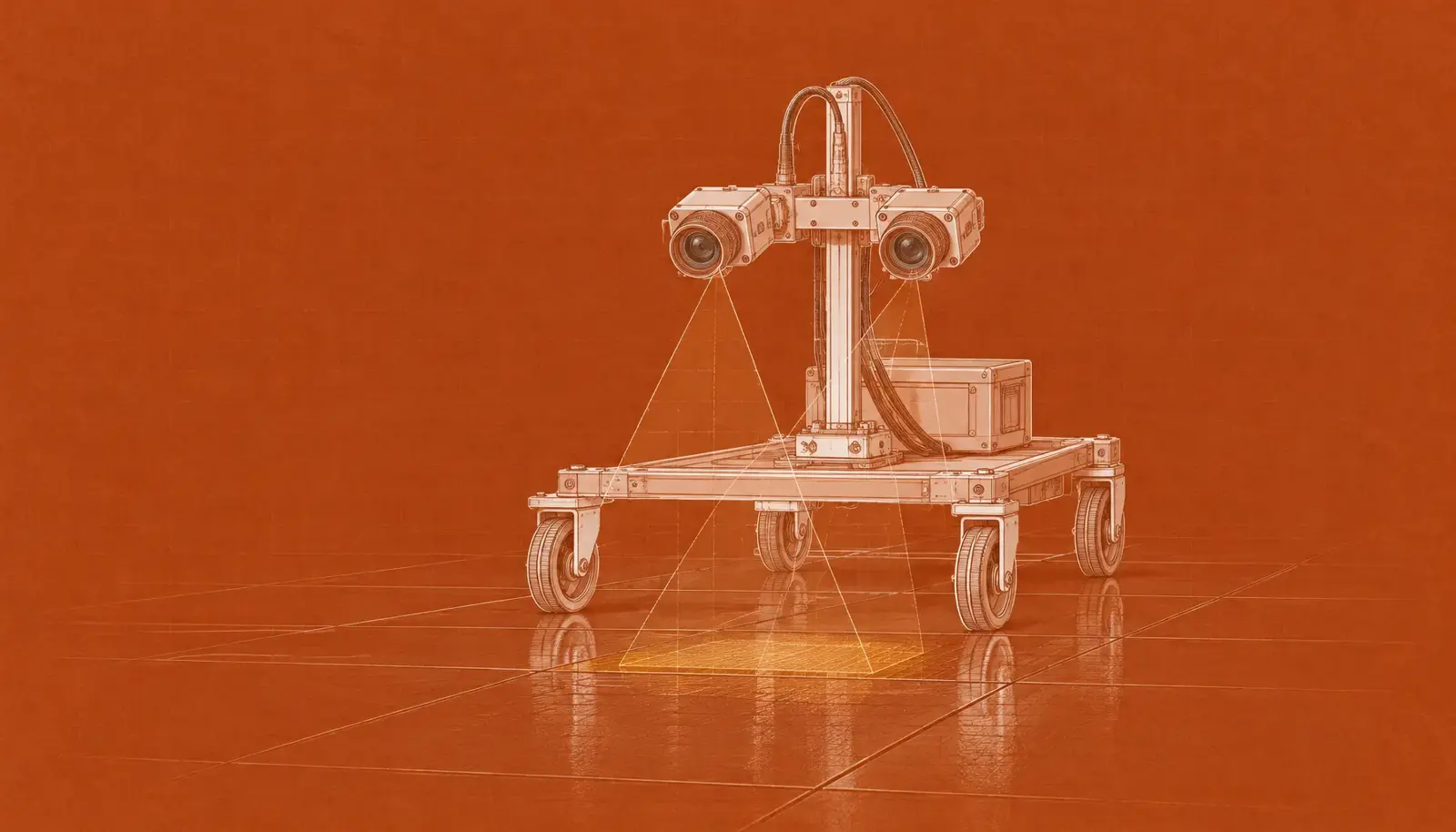
In reflective indoor-floor environments, specular patterns can be detected and triangulated as virtual features below the physical ground plane. These features can produce unreliable associations and inconsistent visual residuals for visual-inertial odometry (VIO), which estimates camera motion by combining visual observations with inertial measurements. A preprint by Uihyun Hwang, Sungjae Shin, Dongjae Kim and Hyun Myung proposes a reflection-aware front end for feature-based stereo VIO. The arXiv record says it was submitted on 4 November 2026.
The method targets virtual features without discarding every floor feature
The authors describe a trade-off in handling reflections: rejecting all features in the floor region could remove reflections, but would also discard physically valid features such as tile edges and surface texture. Those features can provide useful visual information, particularly when background features are sparse. The proposed method instead estimates ground height in real time and rejects feature candidates whose inferred 3D positions are below that estimate.
A floor-region mask limits geometric validation to areas prone to reflections. The paper says the mask is provided by a Golden Cudgel Network (GCNet) segmentation model. After feature tracking and stereo matching, the system separates floor-region features from background features. Background features bypass the ground-height filter and are retained; floor-region features are checked before the validated floor and background features are combined for the VIO estimator.
A Kalman filter updates the ground-height estimate
For each frame, the method uses floor-region features to form a ground-height measurement. It estimates feature height along gravity, selects a support set and aggregates the feature heights into a measurement. Stereo-height and pose uncertainty are used to determine the measurement uncertainty.
A scalar Kalman filter with Normalized Innovation Squared (NIS) gating refines the frame-level measurements into a stable ground-height estimate. The front end then applies an uncertainty-aware safety margin when deciding whether a feature lies far enough below the estimate to be rejected. This selective test is intended to remove virtual features while preserving valid features on the floor.
The paper contrasts this approach with simply fitting a dense ground plane: per-pixel depth processing with iterative RANSAC can be computationally expensive for a lightweight stereo VIO front end, it says, and when virtual features dominate floor observations, RANSAC inliers may be contaminated, biasing the fitted plane below the real ground. The proposed method instead maintains an adaptive scalar estimate from sparse stereo features.
Experiments report gains in reflection-dominant environments
Experiments on real reflective-floor indoor sequences generally show improved trajectory accuracy in reflection-dominant environments. The abstract also reports accurate ground-height estimates and recovery after actual ground-height changes. In a figure describing the Yonsei environment, the authors report that 71 features were extracted within the floor-mask region; the method rejected 56, or 78.9%, as below-ground virtual candidates while preserving valid on-floor features.
The arXiv record describes the preprint as six pages, with five figures and three tables, and notes that the work was presented at the 26th International Conference on Control, Automation, and Systems (ICCAS 2026) in Sapporo, Japan, and included in the conference proceedings.
Sources
- Original source · Preprint arXiv arXiv:2611.05938
Related stories
- Northwestern preprint proposes four-factor robot risk filter
- OdorSpaces benchmarks visual-olfactory navigation in 3D indoor scenes
- Preprint tests robot navigation with uncalibrated external cameras
- EMS-Nav uses functional regions to guide multi-scale robot navigation
- RPSI-Nav revises its own rules for robot navigation