The Floor
OdorSpaces benchmarks visual-olfactory navigation in 3D indoor scenes
OdorSpaces pairs physics-based simulations of odor movement with indoor scenes to test whether embodied agents can find invisible chemical sources using vision and smell. Its benchmark includes propane leaks and methanol pool fires, along with an initial multimodal navigation policy.
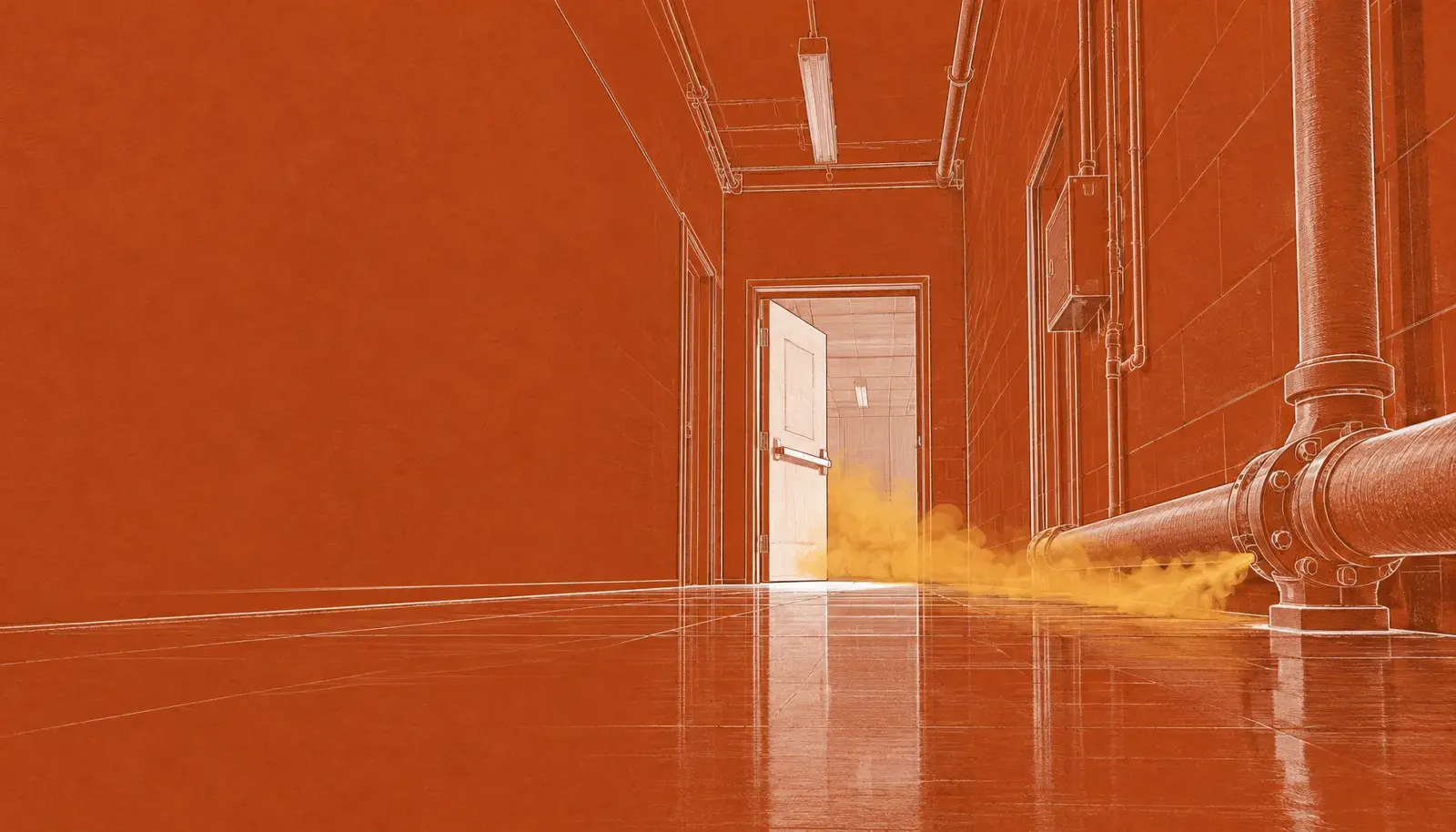
OdorSpaces benchmarks navigation toward invisible odor sources
A preprint by Changyeon Lee, Kelin Yu, Zheng Wei, Shuna Ni and Ruohan Gao introduces OdorSpaces, a physics-based simulation platform and benchmark for visual-olfactory embodied navigation. It focuses on finding sources of airborne chemicals in 3D indoor environments, where an agent uses visual observations alongside odor measurements rather than relying on sight alone.
Source arxiv.org
The benchmark covers two source-seeking scenarios: locating an invisible propane gas leak and finding an early-stage fire modeled as a methanol pool fire. Propane is denser than air and settles near the floor. In the fire scenario, heat-driven buoyancy carries combustion-generated carbon dioxide upward, and the paper uses its density as a surrogate olfactory cue. For the leak, propane is released horizontally from the sides of a cubic source object; for the fire, a methanol pool is placed beneath the object and ignited with small pilot flames.
Simulated odor fields meet indoor scenes
OdorSpaces uses Fire Dynamics Simulator (FDS) to generate time-varying, three-dimensional gas-density fields, then integrates them into Habitat-Sim environments. The platform draws on 17 scenes from Replica and 25 from Matterport3D. Each scene’s navigation mesh is discretized into a 0.5-meter grid for agent positions and candidate source locations, and the FDS field is aligned with the Habitat-Sim coordinate frame. The agent samples that changing field while navigating, rather than consulting a fixed odor map.
The authors describe odor-source navigation as a spatial and temporal problem. Measurements provide local evidence, but airborne chemicals move through a space and may produce weak, patchy or misleading readings. Directional cues can emerge over time, so an agent needs to combine measurements gathered during movement with visual information about the environment.
The paper says real-world training and comparison are difficult because odor transport depends on airflow, temperature, scene geometry, source properties and ventilation. It characterizes earlier work as often relying on small-scale or geometrically simplified environments, which are hard to scale to complex indoor spaces. FDS supplies the simulated gas fields, while Habitat-Sim provides the visual scenes and navigation functions.
Agents combine sensing and movement history
At each decision step, the agent receives an egocentric visual observation, local gas-density measurements and pose-history information. The olfactory sensor is idealized: it samples continuous-valued density from the simulated field at specified locations and times. This setup leaves hardware-specific sensor design outside the benchmark’s focus. Pose information comes from GPS and compass sensors and includes recent position and heading history.
The action space has four choices: move forward, turn left, turn right or stop. The agent must reach the odor source within a fixed time budget. The source itself is hidden from view, so the task requires active odor sensing instead of identification from an object’s appearance.
The initial policy encodes vision, odor measurements and pose history separately, combines those features, then passes them through recurrent memory. Policy and value heads use the recurrent output for action prediction and value estimation. The paper’s abstract says the policy outperforms a diverse set of baselines; its introduction describes the results as competitive against diverse baselines.
OdorSpaces brings together simulated odor fields, indoor visual environments and source-seeking tasks in one benchmark. Its scenarios test navigation toward a gas leak and a fire-related chemical source, while the initial policy offers a reference for studying how agents combine smell and vision as they move.
Sources
- Original source · Preprint arXiv arXiv:2611.05738
Related stories
- ForagerSim Tests Whether Robot Policies Can Build Useful Maps
- Northwestern preprint proposes four-factor robot risk filter
- Preprint proposes reflection-robust stereo visual-inertial odometry
- EMS-Nav uses functional regions to guide multi-scale robot navigation
- Preprint tests robot navigation with uncalibrated external cameras