The Floor
Ropedia’s DONIC Tracks Two Robot Hands With One Policy
Ropedia’s DONIC uses one policy to track human demonstrations with two dexterous robot hands. In simulation, it reports 86.79% success on unseen trajectories and 57.32% on held-out objects, with success requiring both hands to meet tracking thresholds.
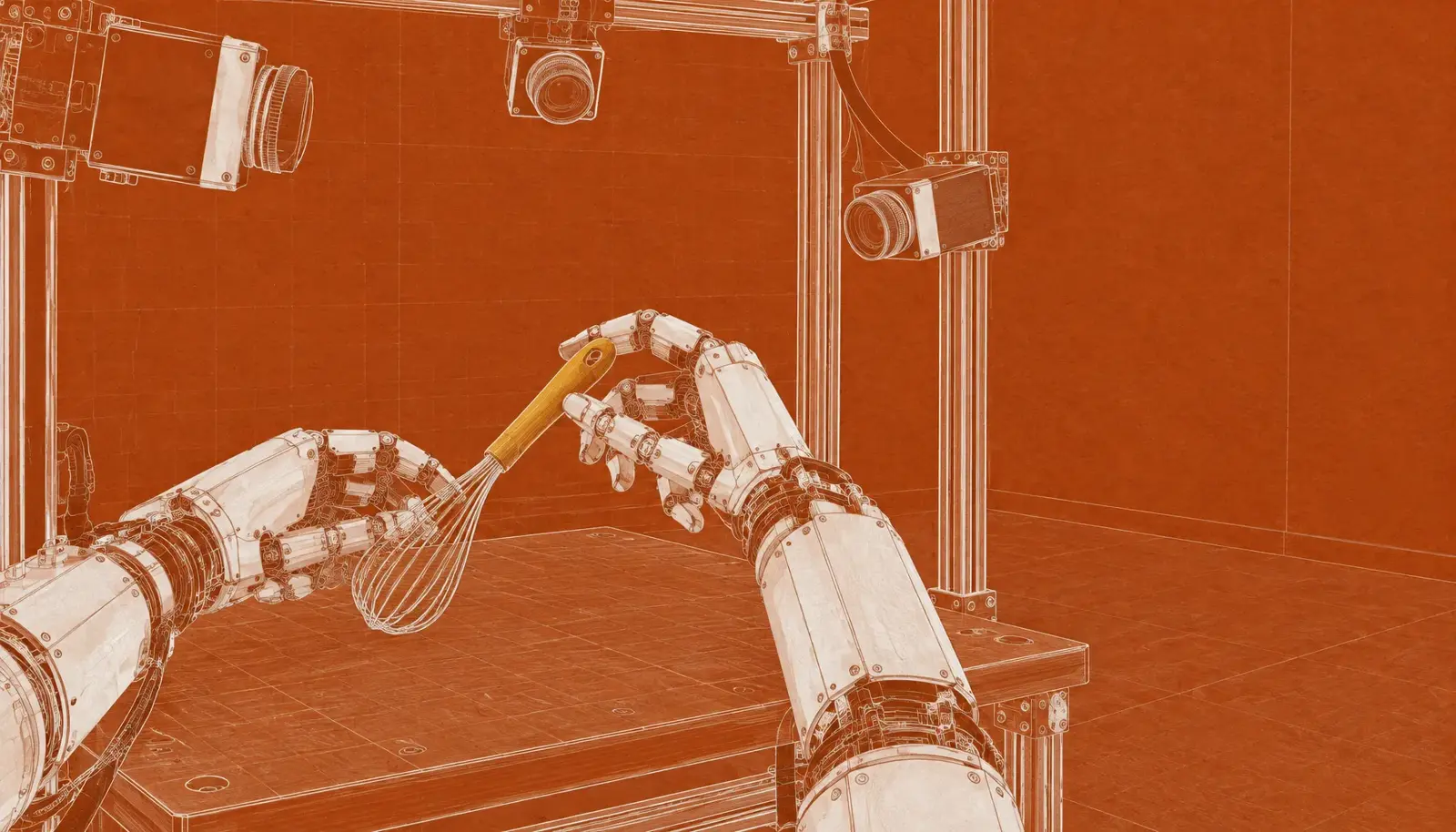
Ropedia’s DONIC reports 86.79% success when one policy tracks unfamiliar demonstrations with two robot hands—but that figure falls to 57.32% when the objects themselves are held out. The results, published in a paper submitted to arXiv on October 21, come from simulation, not a physical robot. The gap puts a boundary around the system’s main claim: one shared controller can follow varied two-hand references, but unfamiliar objects remain a harder test.
One policy, two held-out tests
DONIC receives a motion reference for both hands and the manipulated object, then controls the pair together. The reference specifies when each hand should contact the object, allowing one hand to hold while the other releases or repositions. The authors write, Together, these designs enable one single policy to learn coordinated manipulation across heterogeneous references. Mingze Sun et al., Ropedia
The team evaluates the same checkpoint on two splits it excluded from training and demonstration collection: 53 new trajectories involving familiar training objects, and 164 clips involving held-out objects. DONIC records an 86.79% success rate on the first split and 57.32% on the second. The stronger adapted baseline, Dexplore-bi, scores 9.43% and 11.59%, respectively.
Success is not a measure of autonomous task completion. It requires both hands to stay within the paper’s thresholds for object and wrist position, rotation, and finger-joint tracking, averaged across each trajectory. DONIC follows supplied, reconstructed motion references; the tests do not ask it to choose a task or invent a manipulation strategy.
BiHOI adds contact-rich demonstrations
The paper pairs the tracker with BiHOI, a dataset of 1,575 bimanual sequences involving 229 objects and 14.77 hours of interaction. A calibrated array of 32 RGB cameras records the tabletop workspace; the researchers reconstruct the hands and object, then retarget their motion to robot hands. In the BiHOI recordings, both hands touch the object in 65.91% of contact frames, compared with 38.57% for H2O and 34.74% for GigaHands in the paper’s comparison.
For the public-data model, the team selects 1,845 clips from GRAB, GigaHands, OakInk2, TACO and H2O. DONIC combines proximal policy optimization with behavioral cloning: executions that pass replay checks can return to a demonstration library and guide later training. Its reward keeps object-motion tracking active while supervising each hand according to the contact role specified in its reference.
More data lifts the held-out-object score
Adding all 1,575 BiHOI sequences expands the training pool to 3,420 clips. The resulting model posts 88.68% success on unseen trajectories and 59.76% on held-out objects, compared with 86.79% and 57.32% for the public-data model. The authors also report improved results across all seven tracked metrics on both splits.
The improvement is measurable, but the object split still leaves roughly four in ten clips below the joint success threshold. The paper’s own scope is narrower than deployment: its quantitative tests cover simulated, single-object interactions and reconstructed, retargeted references. The authors identify longer-horizon and multi-object tasks, independent benchmarks and transfer to physical bimanual systems as work still ahead.
Code and hardware evidence remain limited
Ropedia’s project repository lists the DONIC training and evaluation code, policy checkpoints and BiHOI dataset among planned releases. Its current page describes the training code as coming soon and says the weights and dataset are not distributed there. The repository does include a processing pipeline for BiHOI, with third-party components retaining their own licensing terms.
For now, DONIC’s strongest evidence is a controlled simulation comparison against two adapted tracking methods, using the same robot model, data pool and evaluation splits. It establishes that one policy can track a broader set of two-hand references than those baselines under the authors’ protocol. It does not establish that the same success rates carry over to physical hands or objects beyond the tested single-object interactions.
Sources
- Original source · Preprint DONIC: Generalist Dexterous Bimanual Tracking Control from Human Demonstrations arXiv:2610.29997
Other pages read
- GitHub github.com