The Floor
CAPTURER Grasps a Moving Target at 0.75 m/s
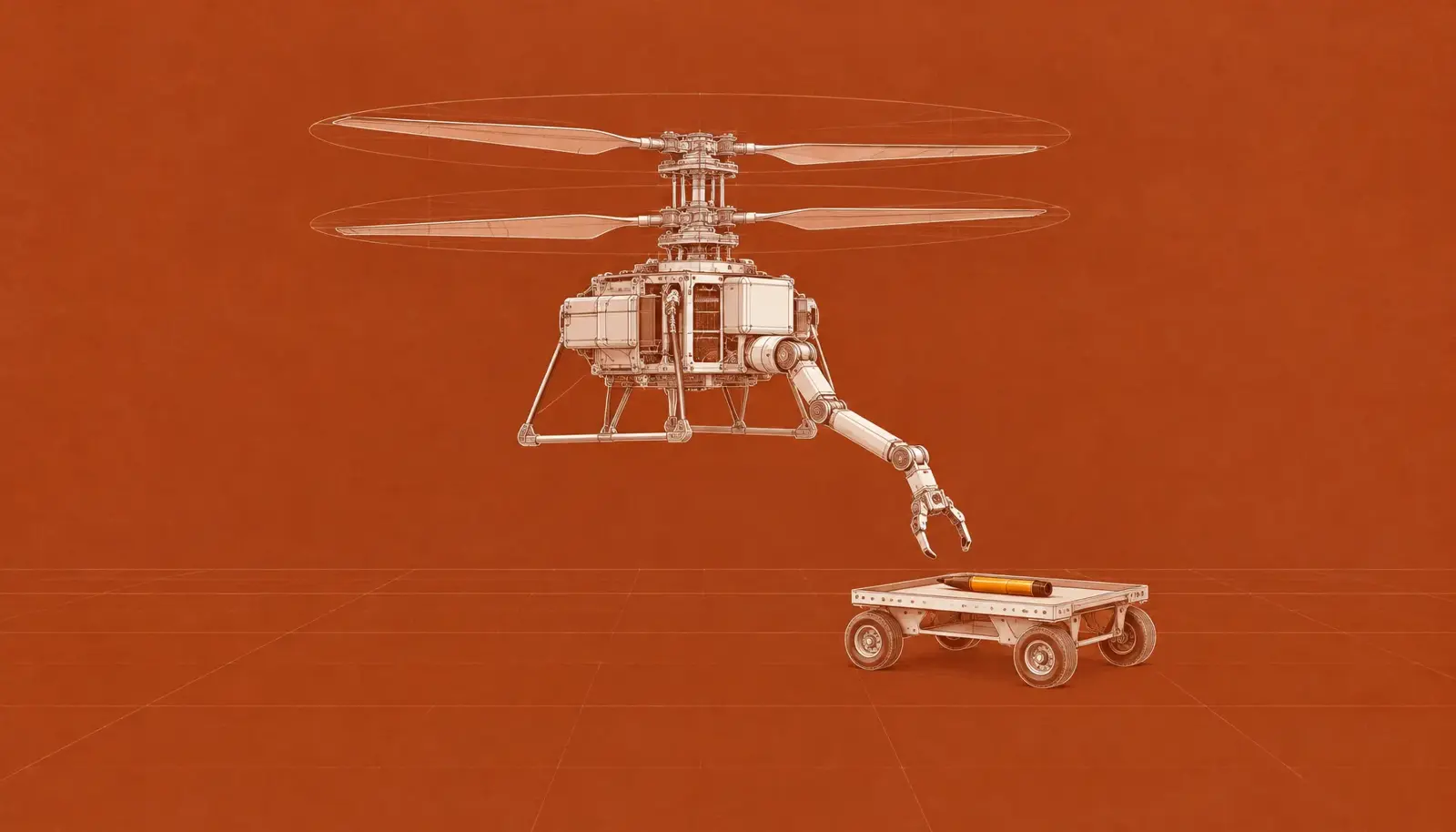
A Beihang University-led team reports that its CAPTURER aerial manipulator grasped a moving marker pen at target speeds up to 0.75 m/s. The team’s arXiv paper describes six successful trials at each of two speeds, using onboard vision and online motion planning.
“Across the conducted experiments, CAPTURER achieves a success rate of 6/6 at both 0.45 m/s and 0.75 m/s.”
Meng Wang, Jindou Jia, Sicheng Zhou, Zeshuai Chen, Kexin Guo, Xiang Yu and Lei Guo, authors of “CAPTURER: A Dexterous Aerial Manipulator for Dynamic and Precise Grasping across Diverse Environments”
A Beihang University-led research team says its CAPTURER aerial manipulator grasped a moving target in repeated tests at speeds up to 0.75 meters per second. The paper, submitted to arXiv on October 29, 2026, describes a coaxial quadrotor carrying a rigid-link arm and gripper, designed to coordinate flight and manipulation rather than hover over a stationary object.
A moving pen, a shrinking capture window
For the moving-target test, the researchers mounted a marker pen on a remotely controlled mobile vehicle and drove it toward the edge of the workspace. That boundary limited the time available to intercept the pen. The team tested two maximum target speeds, 0.45 and 0.75 m/s, and reports six successful grasps at each speed.
The vehicle’s path varied during manual operation, the paper says. At the faster setting, the time available to grasp the pen narrowed further. CAPTURER detected the target’s movement, generated updated flight and arm trajectories, and made a vertical retreat after capture near the workspace boundary.
Vision and planning work together
CAPTURER uses onboard cameras to estimate its state and detect the target. The system corrects accumulated localization drift and transforms target observations into a shared reference frame. When motion blur or sensor timing delays degrade visual measurements, it propagates the target’s estimated motion to maintain a usable position prediction.
An online planner coordinates the quadrotor and its serial manipulator, reallocating movement as the relative target state changes. The authors report that the planner replans at more than 25 hertz. A separate controller estimates and compensates for forces and torques created by arm motion, along with residual effects from model uncertainty and outside disturbances.
Separate results show faster flight
The paper also reports centimeter-level grasping of a marker pen 1.5 centimeters in diameter at aerial-platform speeds exceeding 1.5 m/s. That headline speed figure is distinct from the moving-target test, whose target-speed settings were 0.45 and 0.75 m/s. In another dynamic test, CAPTURER grasped a stationary object at a reported relative velocity of 0.63 m/s.
The moving-target results are hardware experiments, not a demonstration across arbitrary objects or settings. The authors say their perception pipeline depends on prior knowledge of target geometry and fiducial-based detection, limiting use with unknown or unstructured objects. They also identify the arm’s preferred interaction direction and limited local workspace as constraints.
Six successes per speed setting
The reported 6-for-6 result at each target speed is a small trial set, and the test used a pen carried by a manually operated vehicle in a spatially constrained area. It establishes that the integrated system completed those trials under the described conditions; it does not establish a general grasp-success rate for other targets, routes or environments. The paper’s main contribution is the combination of onboard target tracking, online coordination and disturbance compensation tested together on an aerial robot.
Sources
- Original source · Preprint CAPTURER: A Dexterous Aerial Manipulator for Dynamic and Precise Grasping across Diverse Environments arXiv:2610.39119