The Floor
LEAP Hand State Policy Reaches 95.2% of Unseen Pose Goals
A five-author team reports that a simulated-to-real LEAP hand policy reached 95.2% of tested pose goals within the paper’s coarse accuracy threshold. A learned safety filter reduced object drops, while a wrist-camera policy had weaker results on two objects.
“In 13.3 hours of real-robot evaluation over 4,800 unseen goals across 4 objects and diverse wrist orientations, the state-based policy reaches 95.2 % of goals within 2 cm and 0.4 rad, and the filter cuts its drops by 75 % while still reaching 91.5 % of goals.”
Ian Chuang, Hiya Shah, Vamsi Chilamkur, Iman Soltani and Claire Tomlin, the paper’s authors, write in “Pushing Dexterity and Safety for In-Hand Object Pose Reaching That Works Remarkably Well”.
A five-author team submitted the paper to arXiv on October 27, 2026, reporting a LEAP robotic hand that can move objects to successive target positions and orientations without releasing them. The result extends beyond the familiar demonstration of turning an object: targets vary in both position and orientation, and the hand must reach them at different wrist angles. The researchers trained their policies in simulation without human demonstrations, then transferred them to a physical hand.
From simulated grasps to changing targets
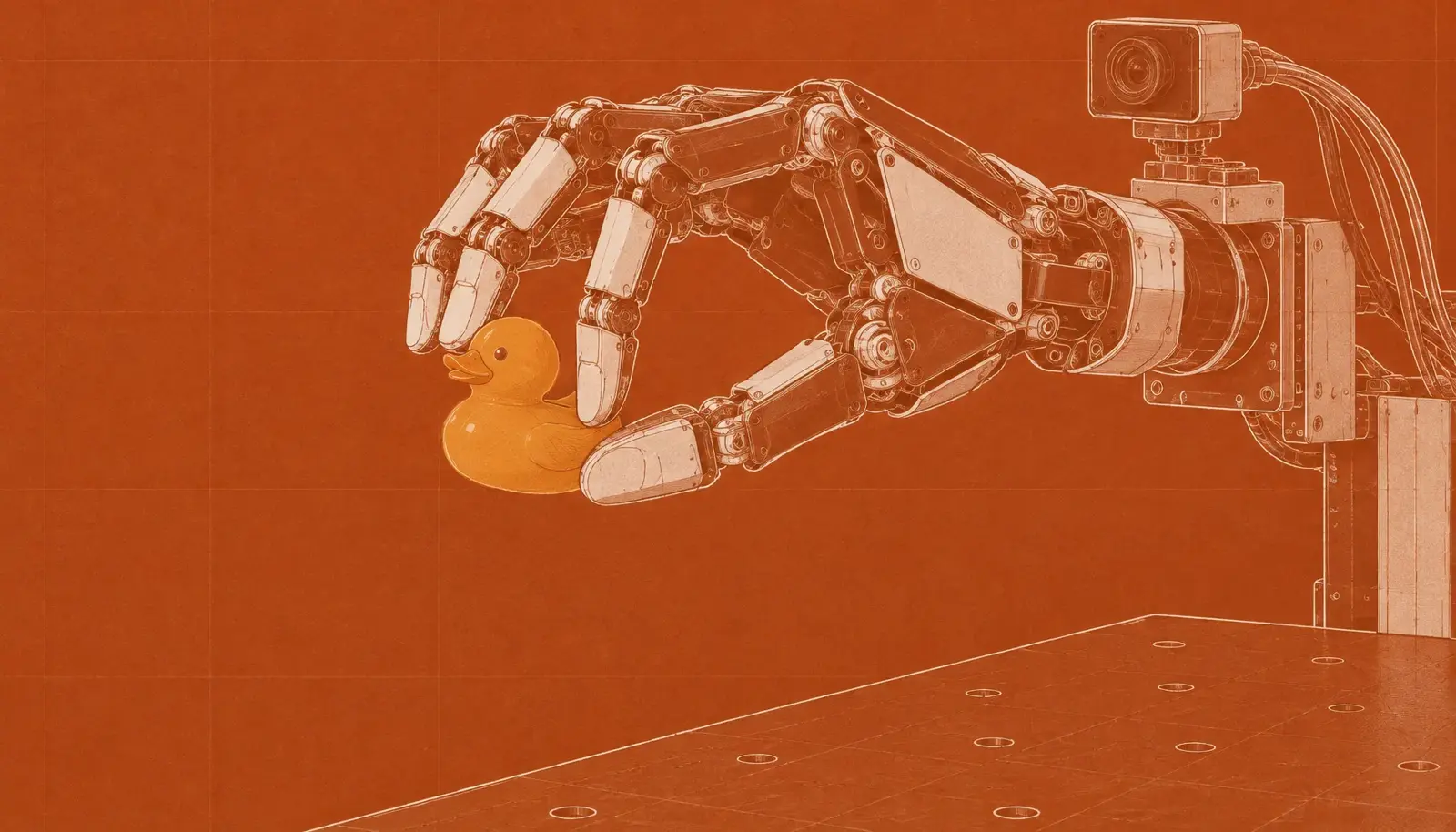
The system uses a 16-joint LEAP hand mounted on a UR5 arm. The arm sets the wrist orientation, but the learned pose-reaching policy controls the hand, not the arm. The team generated grasp data for four objects—a knife, wineglass, lightbulb and rubber duck—and used those grasps to choose training starts and reachable goals.
Rather than sample targets uniformly from every possible object pose, the researchers built a dataset of grasps suited to the hand. For each object, they generated 100,000 grasps, expanded these to 500,000, then removed grasps with hand-object collisions, leaving 422,000 to 453,000 usable grasps per object. An adaptive friction curriculum helped train the policy as simulated contact conditions changed.
The state policy receives the object’s pose from motion-capture measurements. The depth policy instead receives images from a stereo depth camera mounted on the wrist; it does not receive the motion-capture pose as a policy input. Motion capture was used in the main experiments to measure outcomes, including for the depth-policy runs. Both policies transfer from simulation to the real hand without additional real-world training, but the state policy’s higher success rate depends on motion-capture input.
What 95.2% measures
The main test covered 4,800 goals across 96 real-robot runs. Researchers tested four configurations—the state and depth policies, each with and without its safety filter—on four objects at six wrist orientations. Each run attempted 50 consecutive goals, with a 10-second window per goal. The goals came from a held-out evaluation dataset of 100,000 unseen grasps. The runs accounted for 13.3 hours of goal windows.
Without the safety filter, the state policy met the paper’s coarse threshold—within 2 centimeters and 0.4 radians—for 95.2% of its 1,200 goals. At the tighter threshold of 1 centimeter and 0.2 radians, it reached 75.6%. Those rates describe different levels of accuracy; the headline figure is the broader of the two.
Adding the filter reduced the state policy’s coarse success rate to 91.5%, but cut recorded drops from 16 to four across 1,200 goals in each condition. The filter adjusts the policy’s actions to reduce the chance of a fall, trading some goal completion for longer runs without dropping an object.
The camera-only policy has a harder test
The depth-camera policy reached 71.8% of its goals at the coarse threshold without the filter, and 66.7% with it. Results varied sharply by object: without the filter, it reached 95% of lightbulb goals and 88% of rubber-duck goals, but only 54% for the knife and 50% for the wineglass. The authors link the weaker knife and wineglass results to long-tailed errors in the camera-based pose estimates that did not appear in simulation.
The filter reduced depth-policy drops from 88 to 46 across the tested goals, although the wineglass remained a weak point: its drop count fell from 51 to 40. The filter is learned rather than based on a formal safety guarantee; the paper notes that learned filters trade such guarantees for a data-driven approach. Its action corrections also reduced success rates, making the choice between accuracy and fewer drops a deployment setting rather than a free gain.
Per-object policies limit the claim
The team also used the camera-only policy in scripted tasks, including turning a lightbulb into a socket until it lit. The arm motions and higher-level goals in those demonstrations were hard-coded, so the result shows a hand skill that can fit into a larger task—not a robot independently planning and completing household work.
The paper’s authors identify per-object training and the camera policy’s visual gap on the knife and wineglass as limitations. For now, the strongest figure belongs to the motion-capture-based policy and its defined goal tolerances: 95.2% coarse success on 1,200 goals, alongside a measurable reduction in drops when the learned filter is switched on.
Sources
- Original source · Preprint arXiv arXiv:2610.37652