The Floor
Hong and Zhang Use Human Motion Data to Train Dexterous Robots
A paper by Zhengdong Hong and Guofeng Zhang uses human-object interaction data to predict future hand and object states, then applies those predictions to reinforcement learning for dexterous robots. The authors report tests across three manipulation tasks in simulation and the real world, including skill deployment on different robot hands.
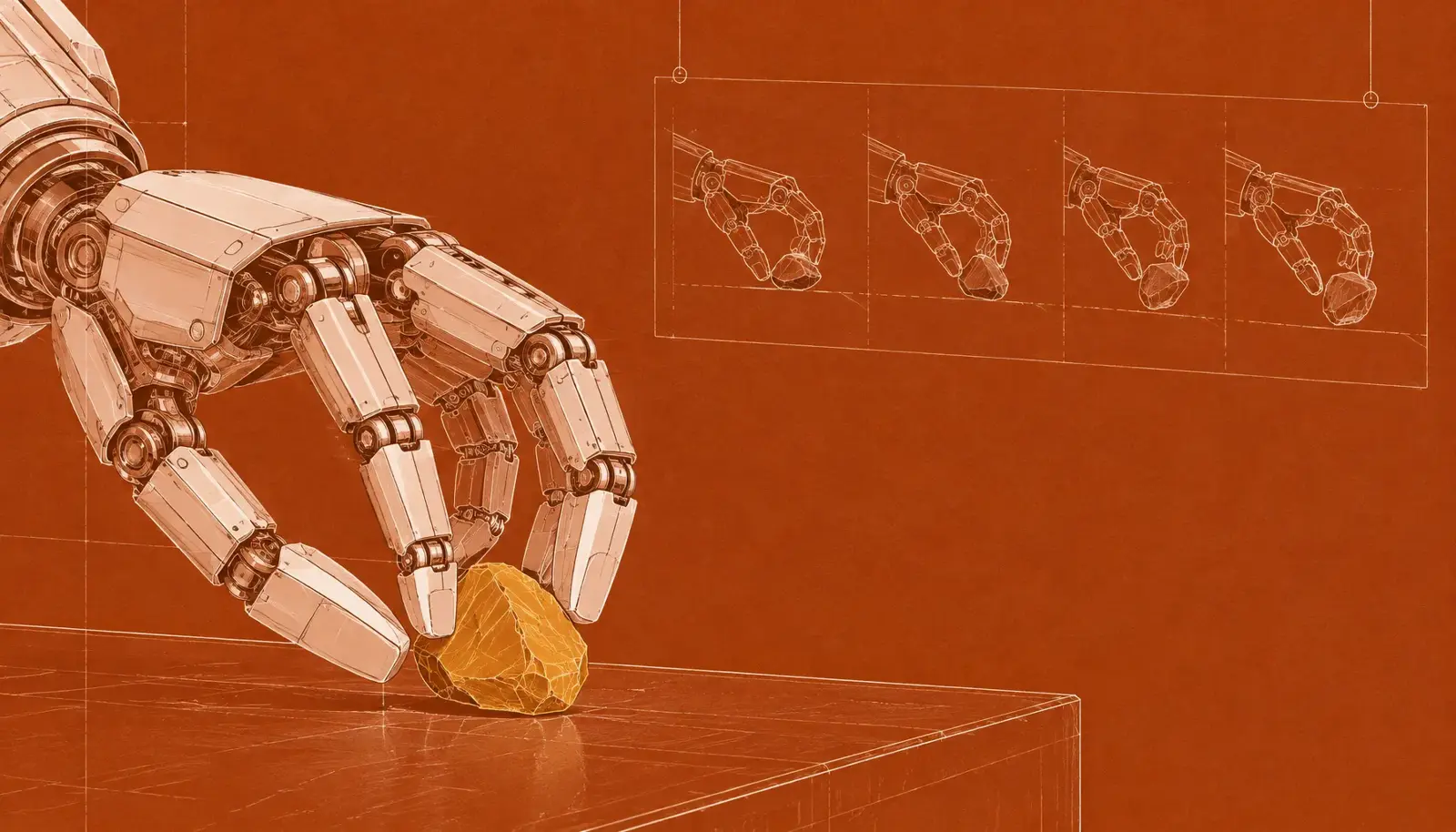
Human demonstrations can inform dexterous robot manipulation without requiring a robot to copy each human movement. A paper by Zhengdong Hong and Guofeng Zhang proposes using human-object interaction (HOI) datasets to predict future states of both the hand and the object. The authors frame the approach around a challenge in manipulating diverse objects: multi-fingered hands involve high-dimensional control and complex dynamics. Their method uses predicted object states as a reward for reinforcement learning.
Source arxiv.org
From human-object interactions to object states
The paper argues that HOI datasets contain information about tasks and embodied interactions that can guide robot learning. Rather than relying only on imitation of human demonstrations, the method learns to predict future hand-object states together. The authors’ premise is that the object’s expected state change can provide task-level guidance, because a robot can use that prediction while learning how to act, rather than attempting to reproduce a human hand’s movements directly.
The authors describe a pipeline that predicts future hand and object states autoregressively. It starts with observations of the initial robot-object configuration, which go into a motion predictor to generate a reference trajectory. A low-level policy is then trained with reinforcement learning, guided by that trajectory.
The object prediction serves as a general-purpose reward signal. The authors write: “The predicted future states of the object can serve as a general-purpose reward term for reinforcement learning, reducing reliance on task-specific reward engineering and enhancing generalization across tasks.” The stated aim is to make the learning approach applicable across tasks without designing a separate, hand-crafted reward for each one.
Training and transfer
The framework uses human interaction data to provide a prior, then relies on reinforcement learning to train the robot’s policy. In the paper’s account, this separates the source of task information from the physical movements used to carry out a task: human data supplies the hand-object prediction, while the robot learns its own actions through the training process. The authors say the approach does not need real-robot data for skill learning.
The paper also describes zero-shot transfer from simulation to physical robots. The learned policy is deployed directly on real-world robots, without a further real-robot training stage in the described pipeline. The authors say the learned priors can work across hand morphologies, and report deploying skills on different robot hands as a test of cross-embodiment compatibility.
Reported evaluation
The authors report experiments on three manipulation tasks in simulation and the real world. They say their approach outperforms existing state-of-the-art methods in success rate and generalizability on novel objects. The paper’s stated evaluation also covers different embodiments and object settings.
The paper presents the object-state prediction as the central element that connects human interaction data to robot learning. Its claim is that predicting hand and object futures together can provide guidance across different task settings, while reinforcement learning develops a policy suited to the robot. The authors characterize their experiments as evidence of performance across the three tasks and of skills transferring to different robot hands.
Publication details
The paper lists Zhengdong Hong and Guofeng Zhang as its authors and identifies their affiliation as the State Key Lab of CAD&CG at Zhejiang University. The arXiv record shows the preprint was submitted on 4 November 2026 and says it was accepted as an oral paper at AAAI 2026. It is listed in arXiv’s Robotics subject area.
Sources
- Original source · Preprint arXiv arXiv:2611.05979
Related stories
- LEAP Hand State Policy Reaches 95.2% of Unseen Pose Goals
- Researchers Present Multi-Agent Reinforcement Learning for Planar Tangram Assembly
- ExRL learns when to replan robot actions, researchers report
- Boston Dynamics Tests Wheeled Whole-Body Control on Atlas
- Amap Opens λ₀ Humanoid Model Built on 500 Hours of Human Data