The Floor
CMU’s Team Chiron Competes in DARPA Triage Challenge Finals
Carnegie Mellon University’s Team Chiron is competing in the Defense Advanced Research Projects Agency’s (DARPA) Triage Challenge finals with drones, ground robots, sensors and advanced artificial intelligence techniques. Its drones send initial reports to ground robots, which deploy to gather more information about patients.
The DARPA Triage Challenge finals started Nov. 5 and run through Nov. 13 at Disaster City
The finals of DARPA’s Triage Challenge began Nov. 5 at Disaster City, a disaster-response training facility near College Station, Texas, and will run through Nov. 13. Carnegie Mellon University’s Team Chiron is participating while developing autonomous robotic systems that can locate injured people and assess their conditions. The finals require teams to demonstrate how their systems perform in darkness, smoke, fire, varied terrain and rubble.
Source ri.cmu.edu
Team Chiron’s drones send initial reports to ground robots
Team Chiron’s drones fly above a disaster scene, use cameras to find patients and send initial reports to ground robots. Those robots deploy to gather more information, while cameras and other sensors help identify people, assess their conditions and locate them. Sensors can measure physiological indicators, including heart and breathing rates, and the robots and drones gather information without requiring physical contact.
Kimberly Elenberg, a principal project scientist in CMU’s Robotics Institute, said:
“Finding the injured and reading their vital signs from a distance is only the start. The goal is to turn everything the robots see into a picture of who needs care first, so medics can make better, faster decisions in the minutes that matter most.”
Kimberly Elenberg, a principal project scientist in CMU’s Robotics Institute
Team Chiron advanced through the challenge’s first two increasingly difficult events
Team Chiron advanced through the challenge’s first two events, each of which tested the technology under increasingly difficult conditions. In event 1, held in September 2024, the team used aerial and ground robots to navigate simulated disaster scenes and assess actors and mannequins representing injured people. The robots had to evaluate casualties from a distance, without touching them, and transmit their findings to a central command station.
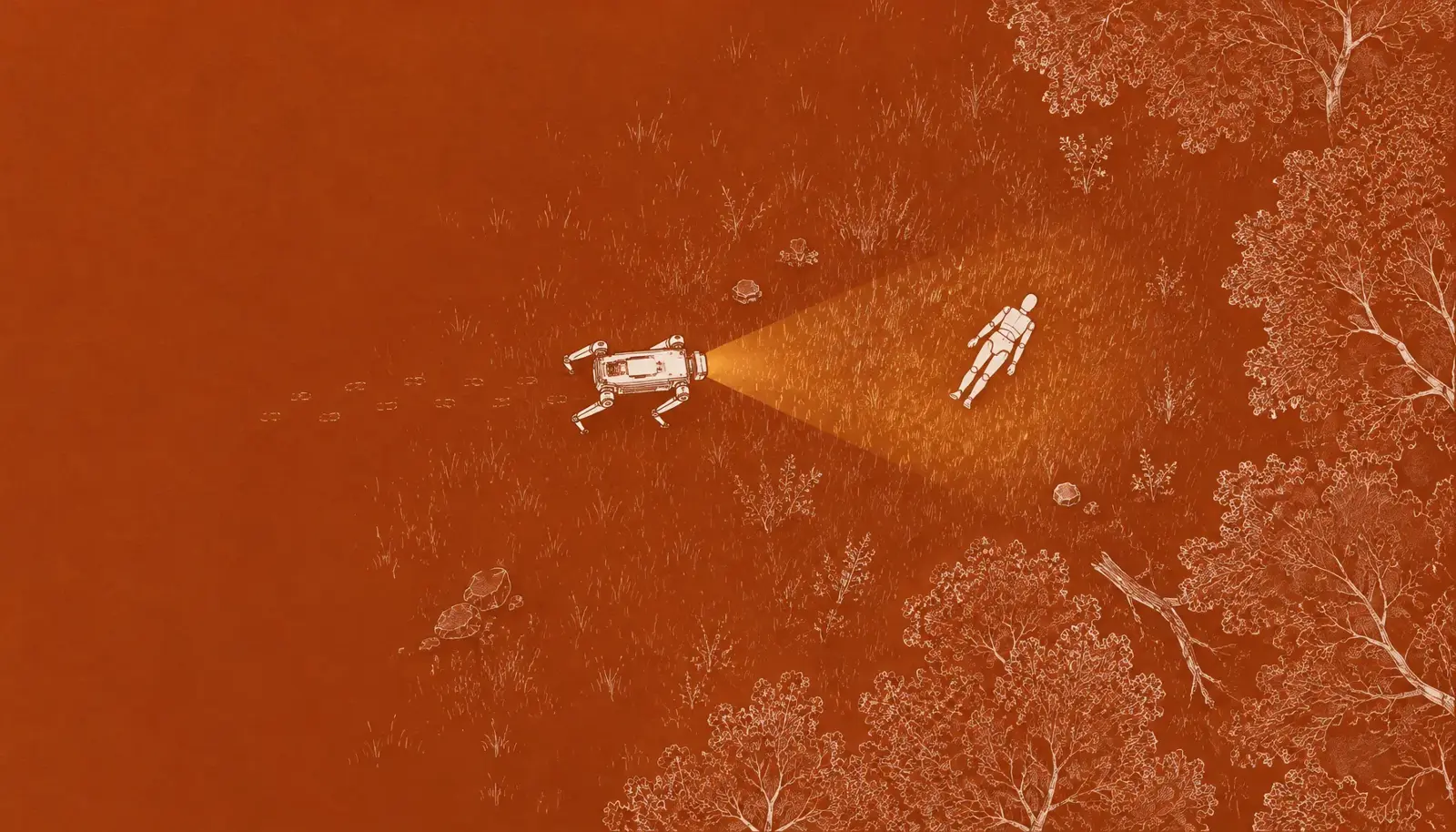
For event 2, in September 2025, the team further developed its autonomous systems to perform at night. Team members simulated casualties in a grassy field while quadruped robots searched for them in the dark. The robots assessed vitals such as heart rate, breathing rate and alertness, then relayed the information to a remote operator.
Event 2 challenged the system to navigate uneven terrain, operate in low light and communicate reliably despite intermittent connections. The robots needed to do more than find people: They had to gather useful information about their conditions and deliver it to the humans making decisions.
Team Chiron is a collaboration among CMU’s Kenneth C. Griffin School of Computer Science, the University of Pittsburgh and Lockheed Martin
Team Chiron is a collaboration among CMU’s Kenneth C. Griffin School of Computer Science, the University of Pittsburgh and Lockheed Martin. Lockheed Martin members participated in the team’s experiments and are helping demonstrate the system during the finals, contributing their expertise in operating the high-altitude drones used to survey disaster scenes. The team also brings a medical perspective through its collaboration with Dr. Lenny Weiss, an associate professor of emergency medicine at the University of Pittsburgh, which helps connect the engineering research with the realities of assessing and treating patients during emergencies.
John Galleotti, a senior systems scientist in CMU’s Robotics Institute, said: “Team Chiron is combining aerial drones, ground robots and AI to build a more complete picture of a disaster scene.” The technology is intended to support emergency medical personnel, not replace them. By surveying a scene and gathering preliminary information, autonomous systems could help responders identify where their attention is needed most, especially in dangerous or difficult-to-access environments.
Sources
- Original source Robotics Institute, Carnegie Mellon University ri.cmu.edu