The Floor
CMU Researchers Build Pixel, a Robot Platform That Can Be Assembled for Under $15,000
Carnegie Mellon researchers present Pixel, a wheeled mobile manipulator paired with demonstration interfaces, whole-body control and a shared policy-learning pipeline. The paper reports average task progress of 82.0% for policies trained on sensorized human demonstrations and 78.7% for policies trained on robot-teleoperated demonstrations.
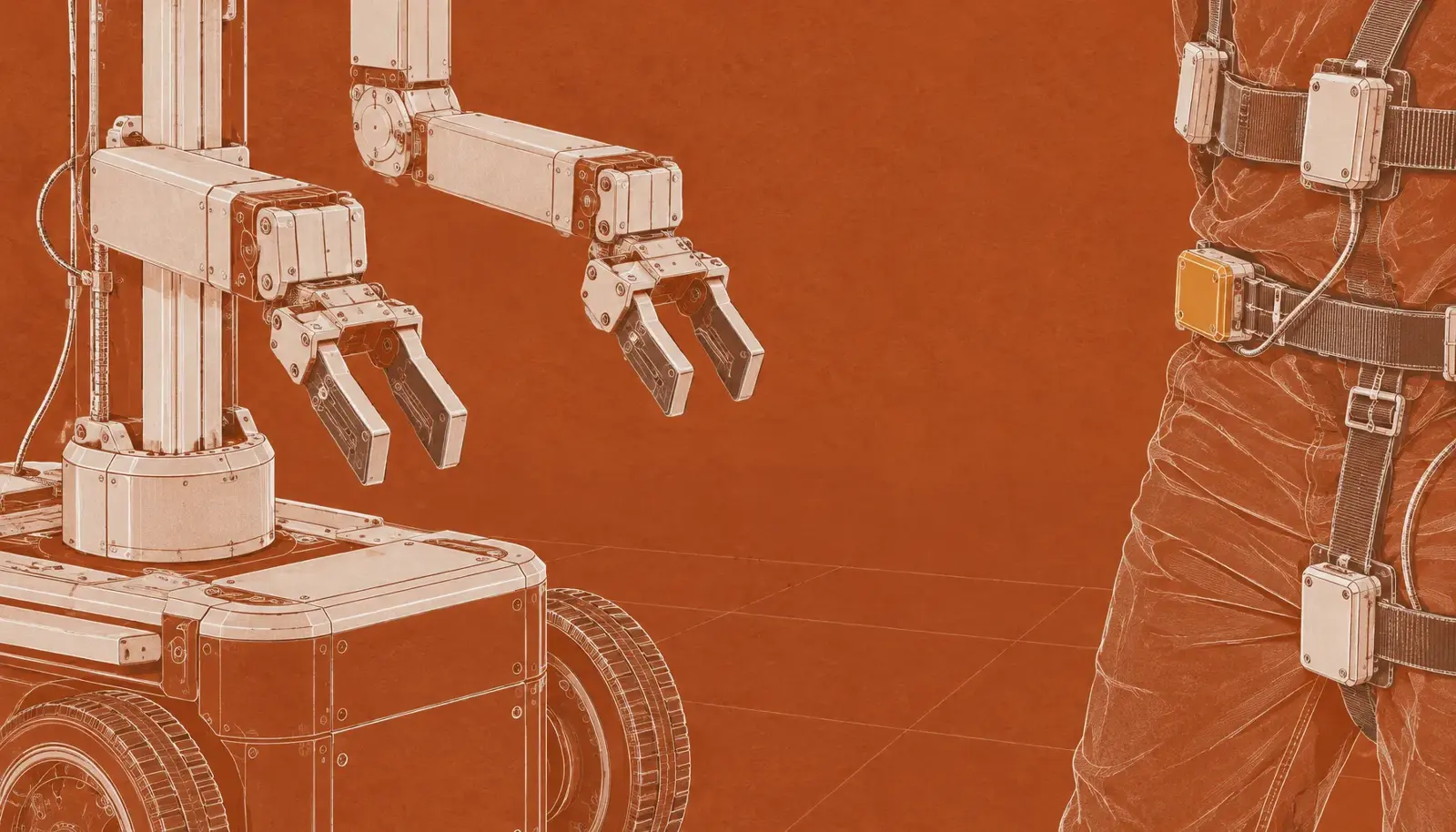
Carnegie Mellon University researchers describe Pixel as an answer to a design mismatch: robot hardware, demonstration collection, control and policy learning are often built separately, they write, limiting the finished system. Their paper, submitted to arXiv on November 2, 2026, combines those parts in a wheeled mobile manipulator and a shared learning pipeline.
Pixel trades legs for a mobile base
The complete hardware platform can be assembled for under $15,000. It has a human-proportioned, 17-degree-of-freedom upper body, a vertical lift and an articulating torso. Instead of legs, it uses a holonomic base; custom grippers take the place of dexterous hands. The authors say those choices simplify the machine, while giving up some terrain versatility, lower-body articulation and in-hand dexterity.
“Consistent with G1, we therefore replace legs with a holonomic mobile base and passively stable vertical lift, and use simple custom grippers in place of dexterous hands.”
Tony Tao, Jason Jingzhou Liu, Ruslan Salakhutdinov and Deepak Pathak, the paper’s authors
Pixel’s data pipeline accepts demonstrations from a leader-arm teleoperation station, a virtual-reality interface or people wearing a sensorized setup while doing tasks without the robot. These interfaces produce task-space targets, which a shared whole-body controller maps to coordinated robot motion while accounting for joint limits and self-collision avoidance. The goal is to keep demonstrations collected in different ways compatible with the robot’s actions.
Human demonstrations feed the same policy stack
The wearable system tracks a person’s head and grippers and reproduces the robot’s head- and wrist-camera viewpoints. Researchers use a common action representation for human and robot demonstrations, allowing them to train policies with either source. The paper’s hierarchical system pairs a language-conditioned low-level policy for learned skills with a vision-language model that breaks user requests into supported skills and monitors execution.
On three tasks trained from sensorized human demonstrations, the policies achieved 82.0% average task progress. Policies trained from robot-teleoperated demonstrations scored 78.7% across three other tasks. The paper also reports that, on the robot-teleoperation tasks, absolute joint-space actions reached 86.3% average progress, compared with 78.7% for relative-base end-effector actions; the authors chose the latter because it can represent both human and robot demonstrations.
The paper names limits in mobility and sensing
The authors describe the results as an evaluation of hardware, data collection and policy learning, with demonstrations requiring dexterity, active perception, navigation and whole-body coordination. They also identify limits: the wheeled platform cannot climb stairs or match the range of motion and manipulation ability of a full humanoid with dexterous hands.
The wearable interface records head and gripper motion, but not uninstrumented body movement or contacts such as bracing a door with an elbow, and it has no tactile sensing. The high-level agent also relies on a predefined skill library, so it cannot perform unsupported skills; the authors say its ability to compose learned skills has not been systematically evaluated. Those constraints set the boundaries of what Pixel’s reported system demonstrates.
Sources
- Original source · Preprint arXiv arXiv:2611.03648
Related stories
- CMU’s Team Chiron Competes in DARPA Triage Challenge Finals
- ExRL learns when to replan robot actions, researchers report
- Researchers test latent steering for safer robot path planning
- Robot memory model cuts planning latency in tests, researchers say
- RoboColosseum Tests Robot Policies in 5,699 Comparisons at 124 Sites