The Floor
Columbia Researchers Demonstrate Budding Modular Robots
Columbia researchers report hardware demonstrations in which three- and five-module robots collect spare modules and separate into parent-and-offspring pairs. The trials used human teleoperation, and the offspring have not yet been tested for a second generation.
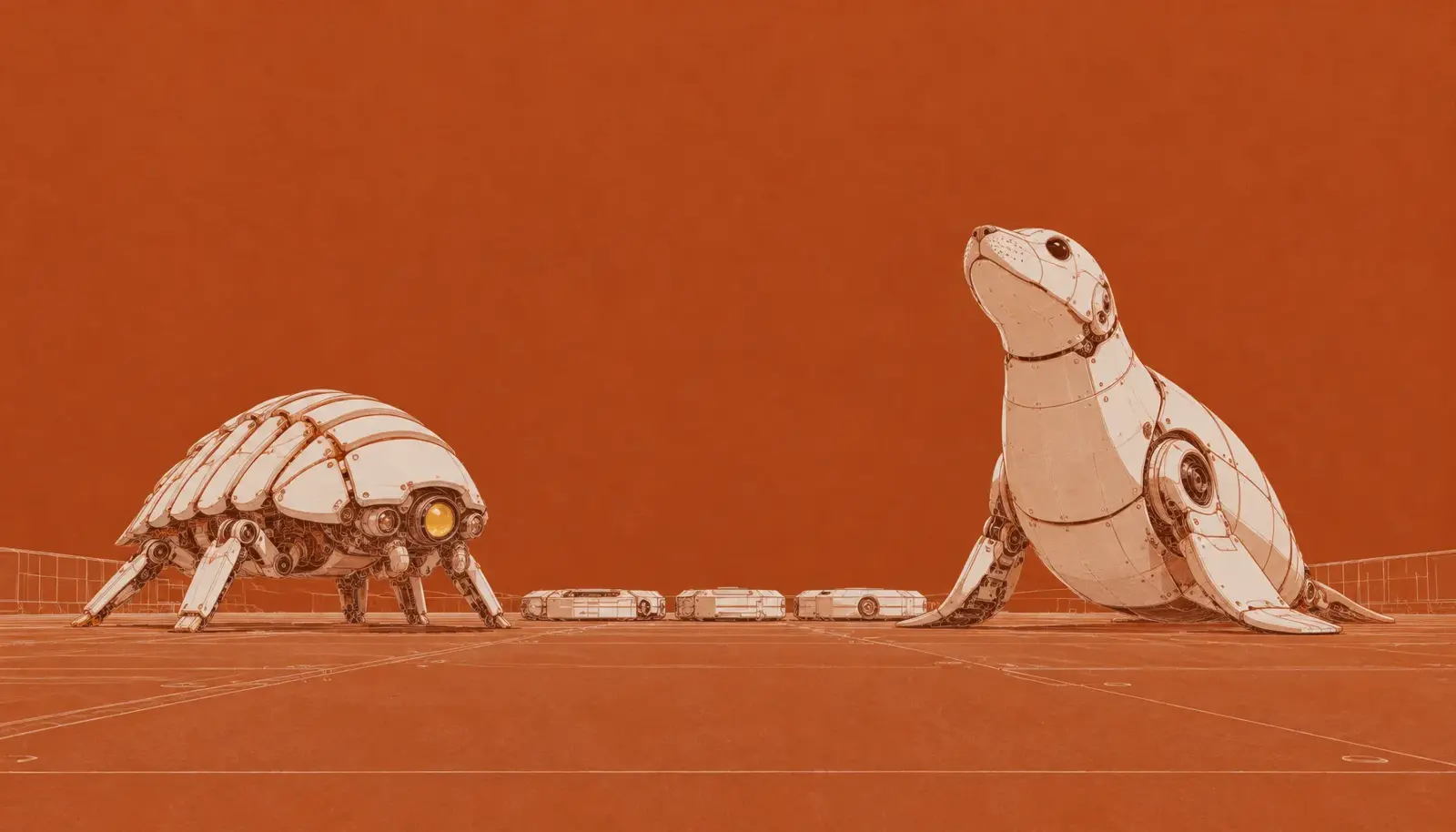
Five modules build a second seal
A five-module robot collects five loose modules, assembles them into a second five-module body, then separates from its copy. A three-module version completes the same sequence with three spare modules. The demonstrations, described in a paper submitted to arXiv on October 22, show physical reproduction with a modular robot, but not autonomous reproduction: a human operator steers the parent throughout collection and docking.
The researchers call the process budding because the parent keeps all its original modules while the offspring consists of newly acquired ones. The two robots briefly form a connected ten-module assembly in the five-module demonstration; a programmed motion sequence then breaks a selected magnetic connection. After separation, the offspring moves independently on operator commands.
“Because the parent retains all of its original modules, this is a budding-style form of physical reproduction.”
Siyuan Zhang, Junyan Liu, Wanglin He and Hod Lipson
One module makes a trilobite or a seal
The Columbia team’s design uses one standardized module for both forms. Each module has two rigid triangular segments joined by two servo-driven joints. The joints let it fold from a flat arrangement into a three-dimensional body, while magnetic interfaces at the ends allow modules to dock without a prescribed directional pairing.
Three modules make the “trilobite,” with a segmented body and short tail-like extension. Five make the “seal,” whose design includes a pair of rear flippers. The researchers use three discrete movement commands—forward, left and right—sent wirelessly to the modules. A browser-based control terminal relays the operator’s commands through a host microcontroller.
Human control remains part of the experiment
During collection, the operator watches the parent and scattered modules, then directs the robot toward each spare module in turn. The magnetic connection is judged by direct observation; the setup does not independently confirm that a bond formed using force or current sensing. Once collection is complete, the operator triggers the pre-programmed separation sequence.
That distinction limits what the demonstration establishes. The hardware completes collection, assembly, folding and separation, but the robot does not decide where to go or whether docking has succeeded. The paper identifies autonomous, sensor-guided collection and docking as work still to be done.
Two demonstrations, not a reliability study
The authors report one successful demonstration for each morphology, not a series of trials that can establish a success rate. They describe the results as preliminary and say a fuller quantitative evaluation is in preparation. Repeated testing would show how consistently the system can complete the sequence, especially when modules approach one another at different angles or docking is less clear to an observer.
Both separated robots have the same structure and hardware as their respective parents, so each is physically equipped to collect modules. The team has not tested whether an offspring can perform the sequence itself and produce another generation. For now, the reported endpoint is two independently moving robots, assembled through human-directed collection from spare modules.
Sources
- Original source · Preprint Robotic Budding: From Homogeneous Cells to Diverse Morphologies in Physical Self-Reproduction arXiv:2610.31929