The Floor
Flexible TeCoBot modules join to move and manipulate together
Colorado State University researchers have tested flexible robots that connect into chains, loops and other configurations for shared tasks. The demonstrations included autonomous docking trials, although the systems otherwise need a human pilot.
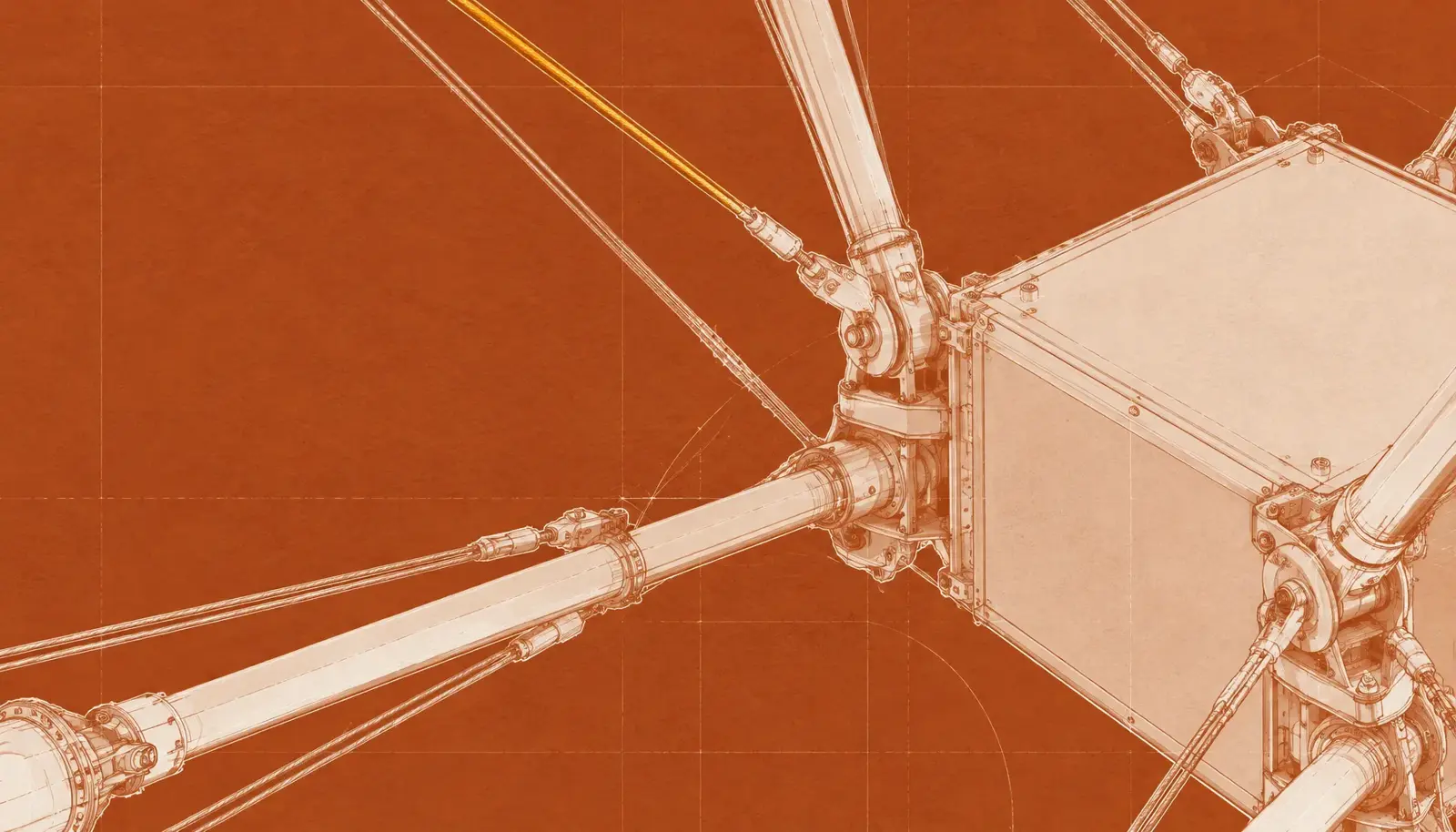
Flexible robot modules can connect into chains, loops and branches to move and handle objects together, according to a study by Colorado State University researchers. The TeCoBot system was described in Nature Machine Intelligence on November 11. The details below follow the study’s arXiv preprint (v2, September 2026), which may differ from the published version.
Each module combines a compliant tensegrity body with claw-based connectors. The researchers tested the robots individually and in groups, including demonstrations of manipulation, locomotion and tasks that combined both.
A body that bends and connects
In tensegrity, stiff rods are held in place by tensioned cables rather than being rigidly joined. The tube-like robots have gripping claws at both ends that can grasp objects or connect to other modules.
Each robot can also move and manipulate objects on its own. The researchers demonstrated a single module picking grapes and placing them in a jar by extending, collapsing and bending its body.
A separate demonstration showed six modes of movement for one robot: extension and compression along its length, inchworm motion, claw crawling, rolling, turning and pipe climbing. The preprint also reports outdoor tests of extension-compression movement and rolling across eight terrains.
Changing the group’s shape
In another demonstration, three robots changed between configurations including a chain, a loop with a branch, an H shape and a Y shape. The different arrangements were used to demonstrate cooperative movement and manipulation.
The researchers also demonstrated cooperative lifting, removing a cork and pouring from a test tube, tearing tissue, removing a container lid and reorienting a lettered cube. Two-robot configurations were used for manipulation inside a pipe and mobile manipulation, while a four-robot arrangement extended the workspace.
A table-cleaning demonstration used a study table 40 cm high, with a misplaced pen and scrap paper. Three robots placed the pen in a holder and moved the trash between height levels before disposing of it.
In a separate storage task, three robots handled a supply bin and placed items into or removed them from a compartment with drawers. They changed configurations and roles during the demonstration.
Control
Right now, these systems need to be piloted by a human, Mahmud Hasan Saikot, a doctoral student and co-first author, said in a Colorado State University account. The preprint describes one open-loop autonomous docking trial using pre-scripted motions and closed-loop docking using an onboard camera that detects visual markers on the stationary robot.
The researchers have made custom code, including the autonomous visual docking implementation, publicly available.
Sources
- Original source · Paper Nature Machine Intelligence nature.com
Other pages read
- Colorado State University, via Tech Xplore techxplore.com
- arXiv preprint arxiv.org
Related stories
- Researchers Demonstrate a Bistable Origami Robot for Multimodal Motion and Grasping in Nonuniform Magnetic Fields
- A Humanoid Planner Generates Feasible Movements Without Predefined Contact Sequences
- ExRL learns when to replan robot actions, researchers report
- UniLatent preprint tests robot-to-robot transfer in simulation and on arms
- VICTR Preprint Reports 23.8% Success on Unseen Out-of-Domain Real-World Robot Tasks