The Floor
A Humanoid Planner Generates Feasible Movements Without Predefined Contact Sequences
An arXiv preprint describes a trajectory planner for dynamic humanoid locomotion that determines contacts during optimization rather than requiring them to be set in advance. The method uses a smooth terrain model and nonlinear programming, with preliminary feasibility tests in simulation and on the ErgoCub robot.
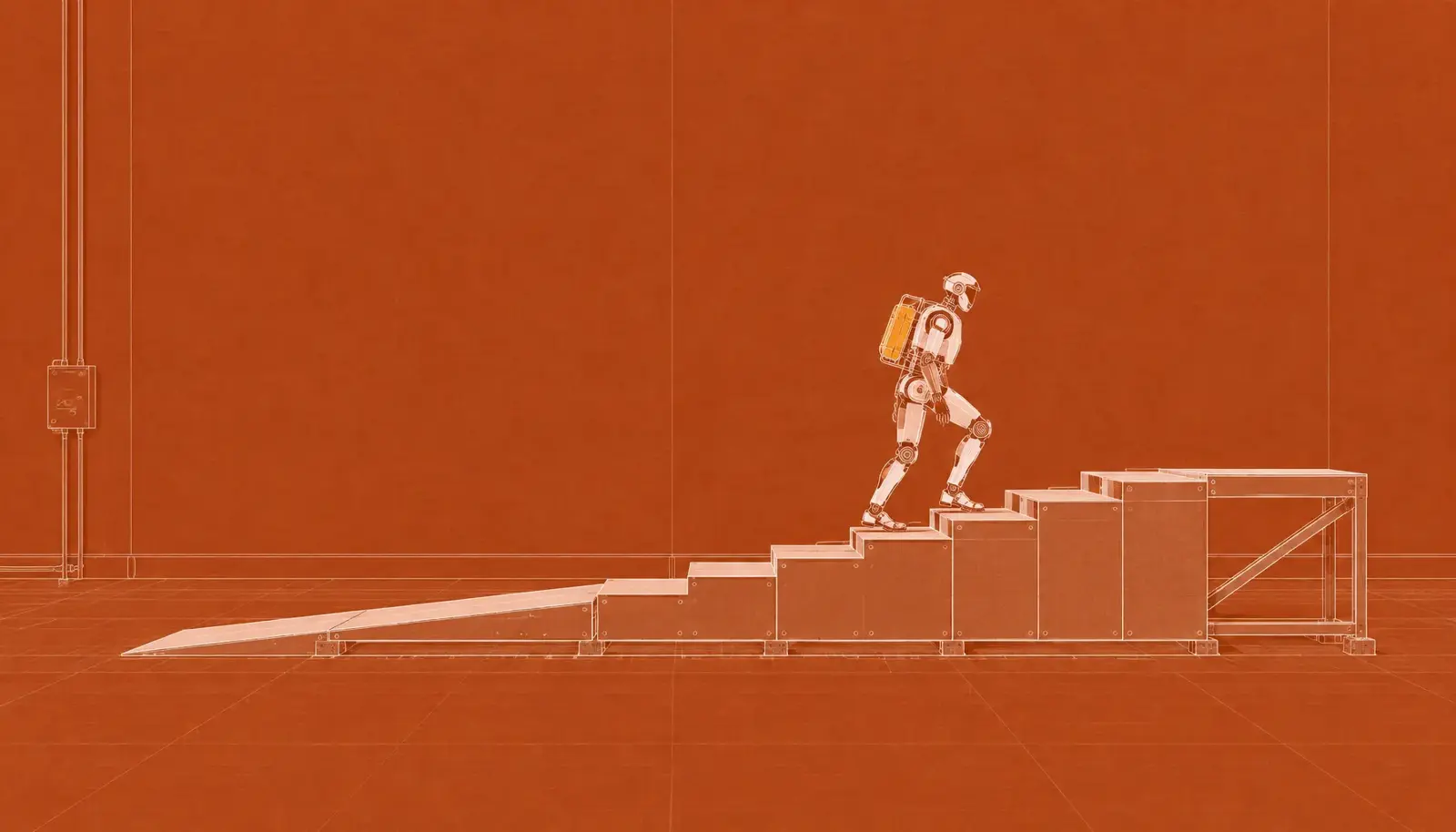
An arXiv preprint submitted on 3 November 2026 presents a trajectory planner for dynamic humanoid locomotion on complex, parameterizable terrain. Its contact-implicit whole-body optimization framework generates feasible movements without requiring contact sequences to be specified in advance.
Planning without predefined contact sequences
The planner considers the robot’s full dynamics and kinematics while optimizing its motion. Traditional trajectory-optimization approaches often fix contact locations and timings before planning. In contrast, this framework lets the optimization determine contacts, giving it a way to plan movement without a predefined sequence of steps or other contacts.
The work focuses on bipedal locomotion over steps, ramps and other terrain. The authors propose a mathematical model that represents ground geometry with a smooth, differentiable surface. The terrain model is designed to approximate shapes with discontinuities, such as steps, while remaining smooth enough for optimization methods that rely on derivatives. The paper says individual terrain elements can be combined by simple addition to create more complex shapes, such as stairs or inclined jumping platforms.
Rigid interaction between the robot and the ground is represented through contact constraints. The authors say this extends the method beyond flat, horizontal ground to arbitrary smooth surfaces. Their framework combines the differentiable terrain representation with a contact model based on complementarity conditions, which represent rigid contacts and allow transitions between contact and free motion.
Nonlinear optimization for whole-body motion
The authors formulate motion planning as an optimal-control problem and solve it using nonlinear programming. Their approach integrates whole-body dynamics with the terrain and contact models. The paper also lists mass-scaling of the system’s centroidal dynamics among its contributions, with the stated aim of improving efficiency and dynamic motion results.
The paper contrasts nonlinear programming with convex formulations, which typically rely on simplified or reduced models to preserve convexity. The authors write that such formulations cannot capture whole-body dynamics or highly dynamic trajectories on non-convex terrain. Nonlinear programming can accommodate system nonlinearities, allowing the planner to consider more detailed dynamic motions.
The approach also has limitations associated with nonlinear optimization. The paper notes that terrain shape and locomotion patterns can produce multiple local minima, making the initial guess important. Solving the nonlinear equations can be computationally intensive and prone to numerical instability, potentially increasing solution times and limiting online use. The paper describes a planning framework and feasibility tests; it does not report a real-time planning demonstration.
Tests include the ErgoCub robot
The authors report planning motions on various terrain topologies and exploring dynamic trajectory generation by placing high-level requirements in the cost function and the initial guess. They conducted preliminary feasibility tests over non-coplanar terrain in simulation and on the real humanoid robot ErgoCub.
The preprint lists Roberto Mauceri, Stefano Dafarra, Giulio Romualdi, Marco Gabiccini and Daniele Pucci as its authors. The reported tests assess whether trajectories generated by the approach are feasible in simulation and on the robot; the paper presents them as preliminary tests rather than evidence of an online system.
Sources
- Original source · Preprint arXiv arXiv:2611.05585
Related stories
- Researchers Demonstrate a Bistable Origami Robot for Multimodal Motion and Grasping in Nonuniform Magnetic Fields
- Flexible TeCoBot modules join to move and manipulate together
- Preprint: FORGE combines humanoid walking, foot placement and contact control
- Heave-Ho paper reports humanoid teams carrying loads without network links
- Preprint tests simulated planner for humanoid groups around people