The Floor
CoreWeave Packages Robotics Simulation for One-Command Runs
CoreWeave announced Physical AI Launchables on October 21, 2026, with tested workflows for robotics, autonomous-vehicle development and simulation. The catalog covers NVIDIA Isaac Sim, CARLA, MuJoCo, NVIDIA AlpaSim and NVIDIA Cosmos 3, with access managed through CoreWeave account teams.
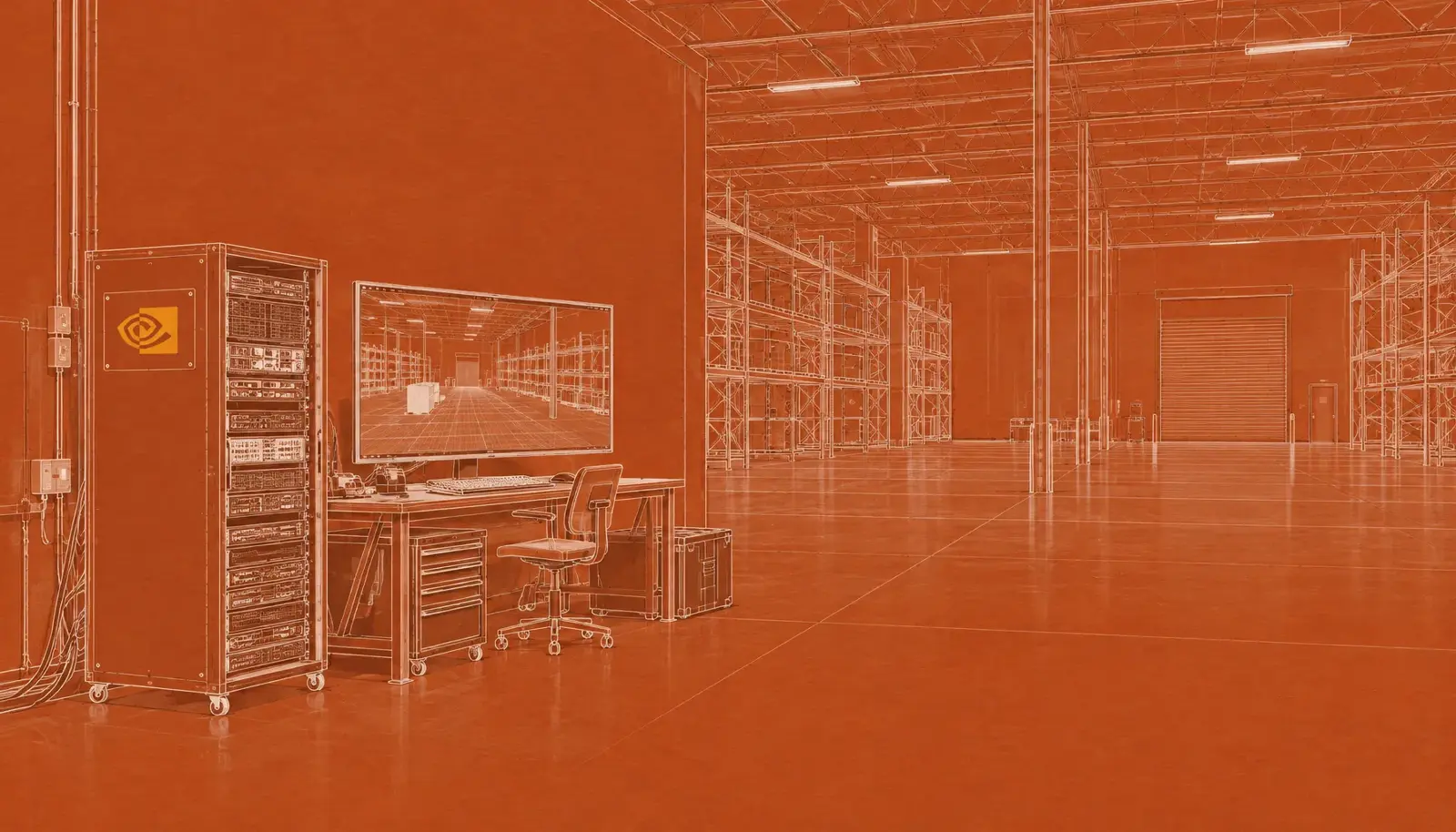
CoreWeave announced Physical AI Launchables on October 21 at NVIDIA GTC Berlin, packaging selected robotics and autonomous-vehicle workloads into tested cloud Templates that engineers can start with one command. The catalog targets the setup work before a simulation or training run: configuring the environment, storage and execution path. CoreWeave’s engineers build and test the configurations, while teams bring their own scenes and data.
Five tools, from Isaac Sim to MuJoCo
The launch catalog spans NVIDIA Isaac Sim, CARLA, MuJoCo, NVIDIA AlpaSim and NVIDIA Cosmos 3. Their use cases cover synthetic-data generation, driving-scenario evaluation and policy training, according to CoreWeave. Each tool also includes a blank Template: a tested environment for teams whose workload does not match one of the packaged examples.
Examples include Isaac Sim workflows for Franka-arm pick-and-place, labeled synthetic data from a forklift-and-pallet scene, and vehicle dynamics. CARLA includes a scenario-matrix workflow; MuJoCo offers GPU-parallel reinforcement-learning training and kitchen manipulation episodes. AlpaSim’s listed workflow evaluates NVIDIA’s Alpamayo driving model against reconstructed real scenes, while Cosmos 3 includes text-to-video generation for rare or costly scenarios.
One command does not decide whether a run succeeded
Templates accept command-line settings for items such as scenarios, duration, parallelism and the model under test. Each declares its inputs and outputs, along with resource and concurrency limits. Reports, metrics, media and diagnostics return through the same interface; the company says the response format is machine-readable so scripts and coding agents can launch runs, monitor them and retrieve results.
The product’s reporting separates execution completion from output delivery and evaluation scores. That distinction matters in a batch of simulations: a job can finish without every scenario producing its expected output, and a complete set of outputs does not by itself establish that a policy meets a team’s criteria. The Templates package the run and its checks, but engineers still choose what counts as a passing result.
CoreWeave adds agent skills and keeps the tools in place
Launchables includes CoreWeave-developed agent skills for Claude Code, Codex and other coding agents. The skills can adjust settings and issue the same commands available to engineers; agents can inspect run results separately from job status. The release also includes NVIDIA Cosmos Data Factory skills for video, image and text augmentation, auto-labeling, data curation and retrieval, with additional Data Factory Templates planned.
“Physical AI Launchables gives them a tested starting point for the tools they already use, so more of their time goes to the work only they can do.”
Richard Ahlfeld, senior vice president of physical AI at CoreWeave
CoreWeave presents Launchables as a layer around software teams already use, not a replacement for those tools. It also names Cadence, Convergent Science, Encord, nTop, PhysicsX and Voxel51 as partners working to run their products on its infrastructure. The catalog is available now, but access is account-managed and begins with a conversation with a CoreWeave account team.
The packaged setup has defined limits
Templates standardize a starting configuration; they do not eliminate engineering work. Teams can change settings or edit application code, point workflows at their own data, and share modified Templates. CoreWeave will maintain Templates as runtimes, drivers and licenses change, and requalify them when dependencies move.
Most Templates run on NVIDIA RTX PRO 6000 Blackwell Server Edition, while the hardware choice depends on the workload, according to the company’s product page. The current catalog handles one workload at a time; CoreWeave lists a control plane for multi-step workflows as a future roadmap item. For now, the offer is narrower: tested environments for five software stacks, launched through one interface and available to customers through their account teams.
Sources
- Original source CoreWeave Newsroom coreweave.com
Other pages read
- CoreWeave Blog coreweave.com
- CoreWeave coreweave.com