The Floor
HD Hyundai Robotics Shows a 7-Kilogram-Per-Arm Physical AI Robot
HD Hyundai Robotics presented an intelligent dual-arm robot in Daegu and to North American customers in Las Vegas, with a 7-kilogram payload capacity per arm. The company is developing it for kitting and other manufacturing tasks, with sensing upgrades and expanded mobility planned.
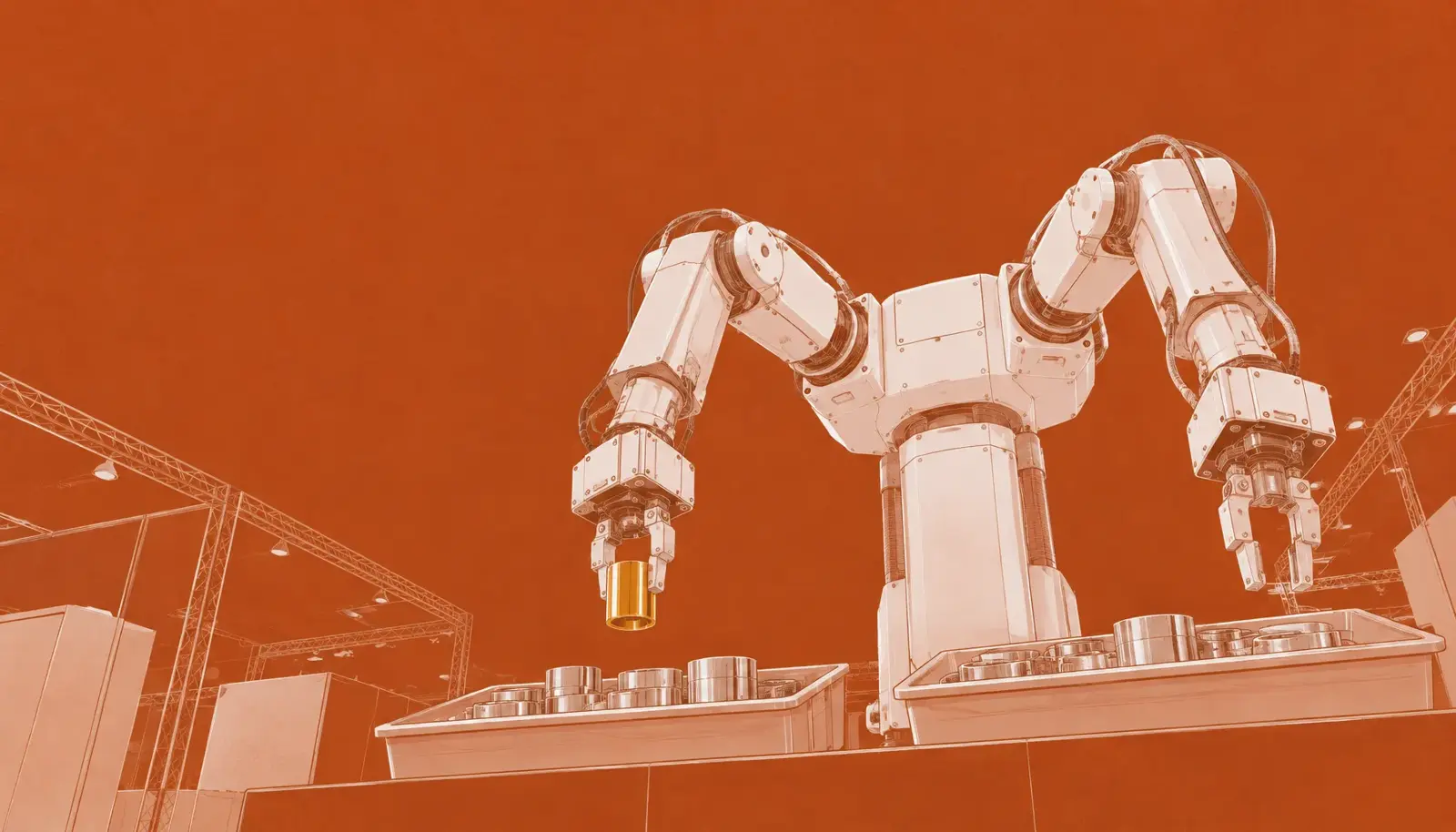
Each arm of HD Hyundai Robotics’ new dual-arm robot can carry up to 7 kilograms and reach 630 millimeters. The company presented the in-development platform at the Future Innovation Technology Expo in Daegu on October 21 and showed it to North American customers at FABTECH 2026 in Las Vegas the same day. Its first step into physical AI for manufacturing emphasizes two-handed manipulation rather than walking.
Source en.sedaily.com
A torso built around two hands
The robot has a human-like upper body, two arms and five-fingered hands. HD Hyundai Robotics chose that form to target manual work that conventional industrial robots struggle to automate, rather than starting with a mobile humanoid. Precision work with two arms and hands must come first for a model suited to frontline manufacturing, the company says. The design gives the robot a defined role: manipulating parts and performing tasks at a workstation.
The company is developing its in-house Robot Foundation Model, or RFM, to let the robot perceive its surroundings and generate actions without an operator programming every step and position. The model is intended to help the robot understand and perform tasks. The company’s announcement does not detail the model’s training data or performance measures, or how much of the trade-show demonstration ran autonomously.
Kitting comes before welding
HD Hyundai Robotics plans to begin with kitting: sorting and preparing components for assembly. It intends to expand the robot’s use to other manufacturing processes, including welding and painting, and carry the task intelligence developed on the dual-arm platform into its existing industrial and collaborative robots. In the company’s description, the platform is a way to learn and validate task intelligence before applying it to other products.
The company also showed other manufacturing automation technologies at the event, including its HDC collaborative robot series, a CADless welding solution and a force-control solution. Those displays accompanied its physical AI strategy, which focuses on extending automation to manual work as well as presenting solutions based on existing industrial and collaborative robots.
An HD Hyundai Robotics official described the development as a starting point for industrial applications:
“The development of the intelligent dual-arm robot is an important starting point for applying physical AI technology to industrial sites and expanding the areas where robots can be used,” an HD Hyundai Robotics official said.
Touch sensing and movement remain work in progress
HD Hyundai Robotics plans to improve contact detection using force and tactile sensing. The company acquired an equity stake in AIDIN Robotics through a 13 billion won investment on September 11. The companies would initially jointly develop a five-finger robotic hand for shipbuilding and heavy-industry applications, combining precision sensing with a hand designed to grasp a range of workpieces.
The robot’s mobility is also a future step, not a feature of the platform shown. HD Hyundai Robotics plans to integrate a wheeled mobile platform first and pursue bipedal walking technology over the longer term. For now, its stated starting point is kitting, with the company planning to extend the robot’s work to other manufacturing processes. Its broader plan is to use the platform to develop task intelligence and apply that work to the industrial and collaborative robots already in its product lineup.
Sources
- Original source Seoul Economic Daily en.sedaily.com
Other pages read
- HD Hyundai Robotics · page 1 hd-hyundairobotics.com
- HD Hyundai Robotics · page 2 hd-hyundairobotics.com
- HD Hyundai Robotics · page 3 hd-hyundairobotics.com