The Floor
CS-Pi Reaches 81% Safe Success on a Simulated 7-DoF Shelf Pick-and-Place
CS-Pi reaches 81% safe success on a 7-DoF shelf pick-and-place, compared with 55% for projection. In a zero-shot Franka deployment, it reaches 55% on hardware, against 40% for projection.
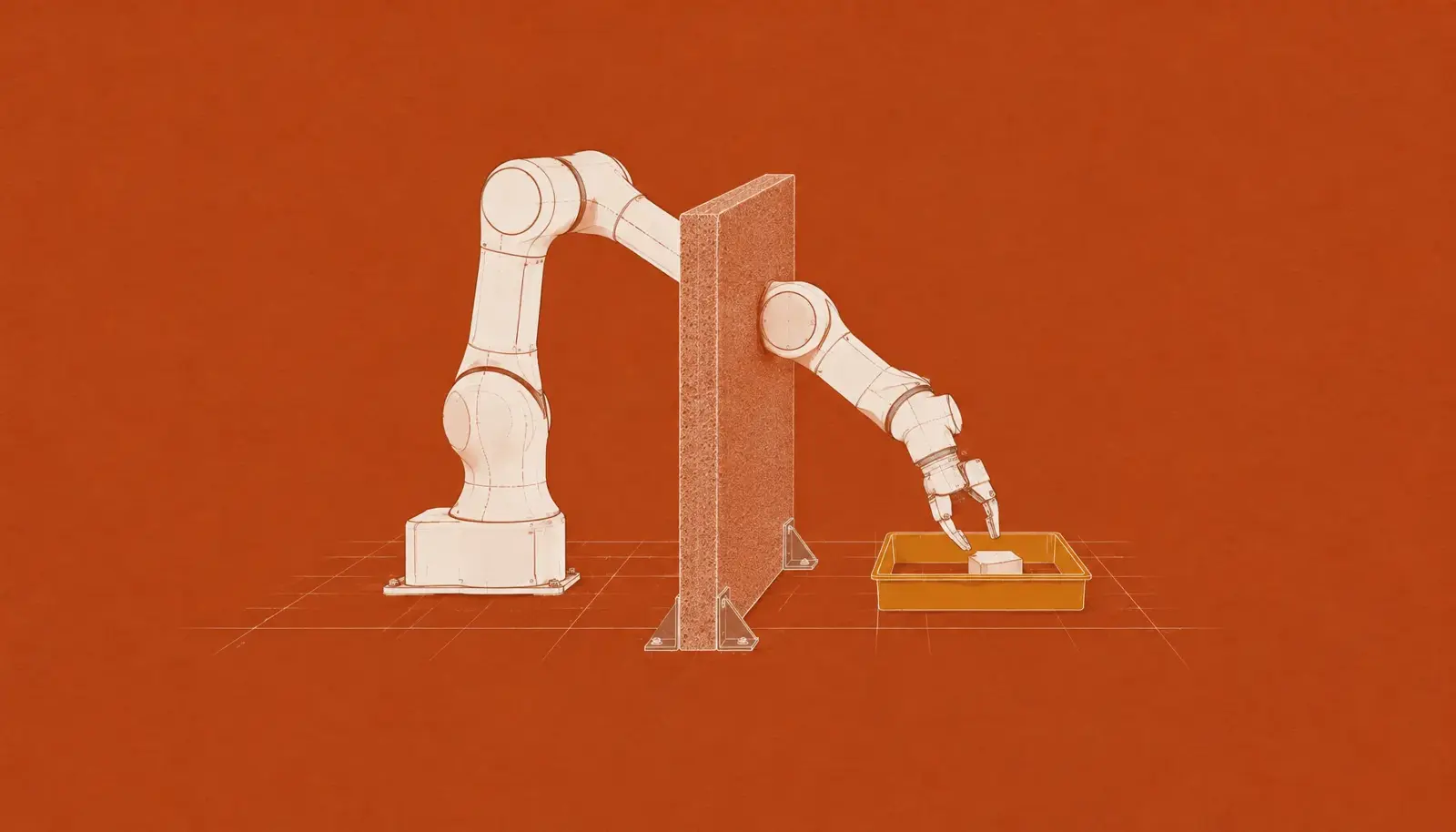
CS-Pi reaches 81% safe success on a simulated 7-DoF shelf pick-and-place, against 55% for projection; in a zero-shot Franka deployment, it reaches 55% on hardware, against 40% for projection. A flow-matching policy deployed in the field must often satisfy a constraint that was absent from its demonstrations, such as avoiding an obstacle it has never seen. Retraining for every new constraint is impractical, so the constraint must be enforced at inference time.
Gradient guidance, the most common approach, can pass straight through an obstacle when the policy is uncertain between passing left and right
Gradient guidance, the most common approach, steers noisy states, so it must evaluate its cost on the policy’s running estimate of the clean action. When the policy is uncertain between passing left or right of an obstacle, this estimate is their average and can pass straight through it. The authors write that they want actions that are both safe, satisfying the constraint, and plausible, remaining likely under the policy.
Rejection keeps outputs plausible, while projection is efficient
Rejection redraws actions until one is safe: every output is plausible, but the wait is intractable when safe actions are rare. Projection moves an action to the nearest safe one: it is efficient, but the result need not be plausible. CS-Pi combines the two within flow-matching sampling, keeping projection’s efficiency and rejection’s plausibility.
CS-Pi projects, adds noise and samples again
CS-Pi is a draw-project-renoise sampler. CS-Pi projects each draw to the nearest safe action, adds noise back scaled to how far the projection moved it, and re-runs the unmodified policy until a draw is safe. Replacing only the projection step extends CS-Pi to continuous costs.
Tests include a zero-shot Franka deployment
The evaluation spans a 2D diagnostic, a 7-DoF shelf pick-and-place, an orientation preference and a zero-shot Franka deployment. The paper was submitted on 5 Nov 2026 and accepted to CoRL 2026. The authors listed on the paper are Soumojit Bhattacharya, Oliver Kroemer and Shubham Tulsiani.
Sources
- Original source · Preprint CS-Pi: Constraint-Satisfying Flow Policy Sampling arXiv:2611.08654
Related stories
- Paper reports 3.8 ms refinement for robot policies in simulation
- Library of Hands more than doubles simulated success, preprint reports
- VICTR Preprint Reports 23.8% Success on Unseen Out-of-Domain Real-World Robot Tasks
- NTT says physics-based model improved robot shelf-loading test
- Preprint finds retrieval rivals some VLAs on simulated robot tasks