The Floor
DIVAL reshapes motion fields to match a robot’s starting heading
A preprint introduces a planner that locally reshapes a vector field to match a nonholonomic robot’s initial heading. The authors report simulation results and tests on a ground vehicle across 12 trials.
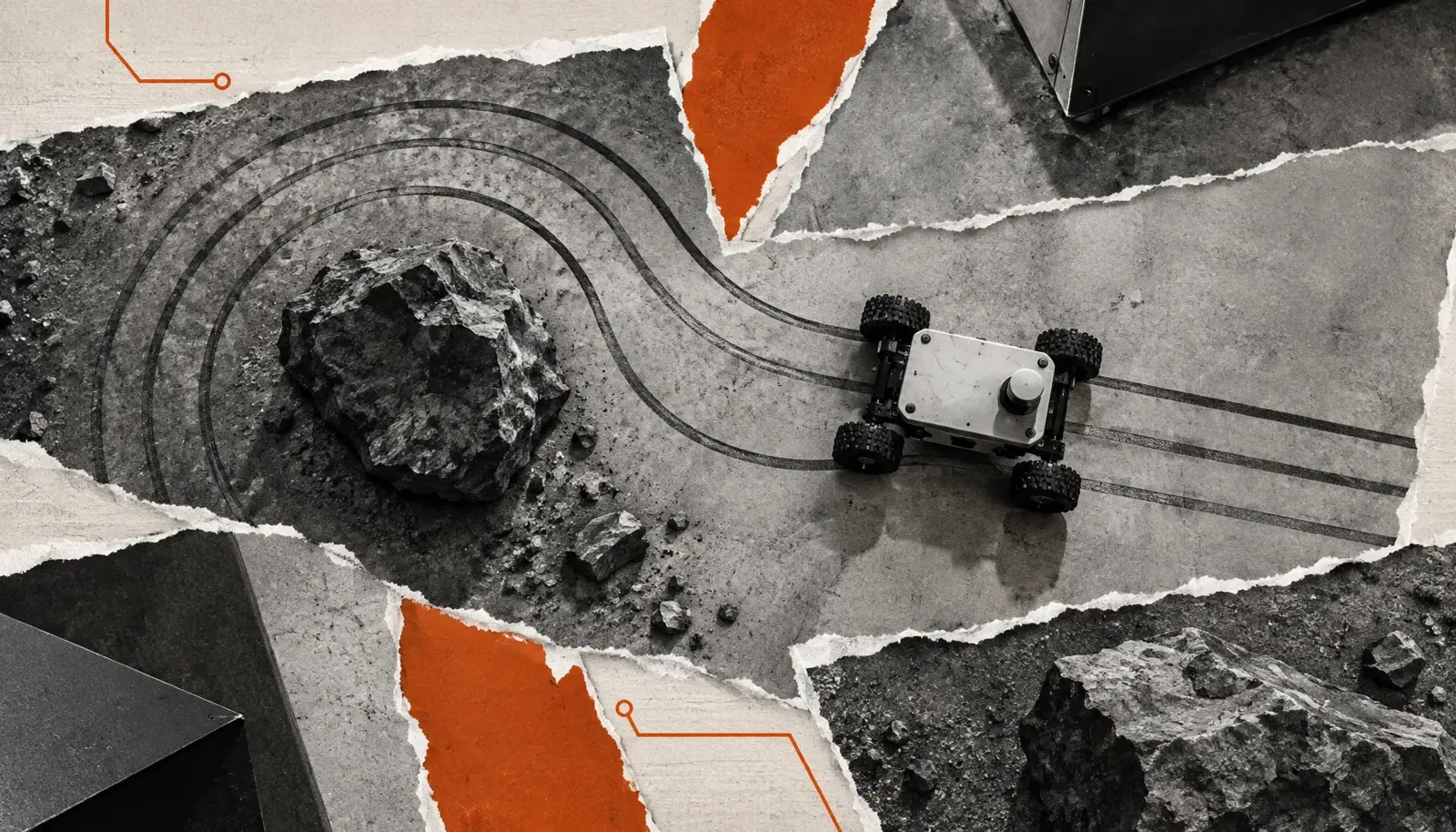
A local change to the planned route
DIVAL reshapes a robot’s starting route so it points in the direction the machine is already facing, addressing a mismatch that can make nonholonomic robots drift from a planned path. The method is described in a preprint submitted to arXiv on November 11, 2026, by Yike Qiao, Xiaodong He, An Zhuo, Zhiyong Sun, Weimin Bao and Zhongkui Li.
Conventional vector-field planners first set a direction for each position in the workspace, then use a controller to turn the robot toward that direction. Because a nonholonomic robot cannot move sideways or instantly change its heading, it may stray from the intended curve while turning, potentially hitting an obstacle. The authors propose locally deforming the workspace around the robot’s initial position, which reshapes the vector field to align with the robot’s heading at the start.
The deformation fades outside a selected region, leaving the original vector field unchanged there. The paper says the approach is designed to preserve the field’s obstacle avoidance, convergence toward a target and smooth control signals. It also describes control laws intended to keep the robot aligned with the reshaped field during motion, including when disturbances cause deviations from the planned trajectory.
Simulation comparisons
The preprint evaluates DIVAL against three vector-field-tracking baselines: an attractive and repulsive vector field, a collision avoidance and path following vector field, and a navigation vector field. The simulations cover two-dimensional and three-dimensional cases. The researchers applied DIVAL to each baseline’s nominal field and compared its outcomes with the original tracking methods.
In a Monte Carlo study, each method was assessed using 1,000 randomly sampled initial configurations for each field. The authors report that the fully parameterized DIVAL variant achieved a 100% success rate across those trials for all three fields; a successful trial required avoiding collision and reaching the target within prescribed tolerances before the simulation time limit. They also report lower median control-effort measures than the highest-gain baselines with comparable success rates. Those are results from the paper’s simulations, not a general guarantee for other robots or environments.
Tests on a ground vehicle
The hardware evaluation used an AgileX LIMO uncrewed ground vehicle, with an OptiTrack motion-capture system providing odometry measurements. The test workspace contained six static obstacles, modeled as disks with a radius of 0.3 meters to account for the vehicle’s footprint. Researchers ran three trials from different initial configurations for each of four target positions, for 12 trials total.
Each trial ended when the vehicle came within 0.2 meters of its target. The paper reports that the vehicle reached the targets without collision across the tested configurations, despite real-world disturbances.
Research status
The arXiv record lists the 19-page paper as under review. Its reported simulation and hardware results are the authors’ findings in that preprint.
Sources
- Original source · Preprint DIVAL: Diffeomorphic Vector-Field Alignment for Nonholonomic Motion Planning arXiv:2611.14918
Related stories
- Robot memory model cuts planning latency in tests, researchers say
- Preprint puts robot control policies inside 3D route planning
- Preprint finds hand-written planners beat UniAD in some tests
- Preprint Sets Deadlines for Robots Awaiting Language-Model Plans
- Preprint reports faster planning with SI-MPPI in map simulations