The Floor
Researchers Train Loco-Manipulation Policies for Spot and G1
A study presents a phase-conditioned reinforcement-learning method for multi-stage robot tasks, demonstrated on a Unitree G1 humanoid and a Boston Dynamics Spot quadruped. Its experiments include tire maneuvering, box pushing, and box lifting and carrying, with separate low-level controllers for the two platforms.
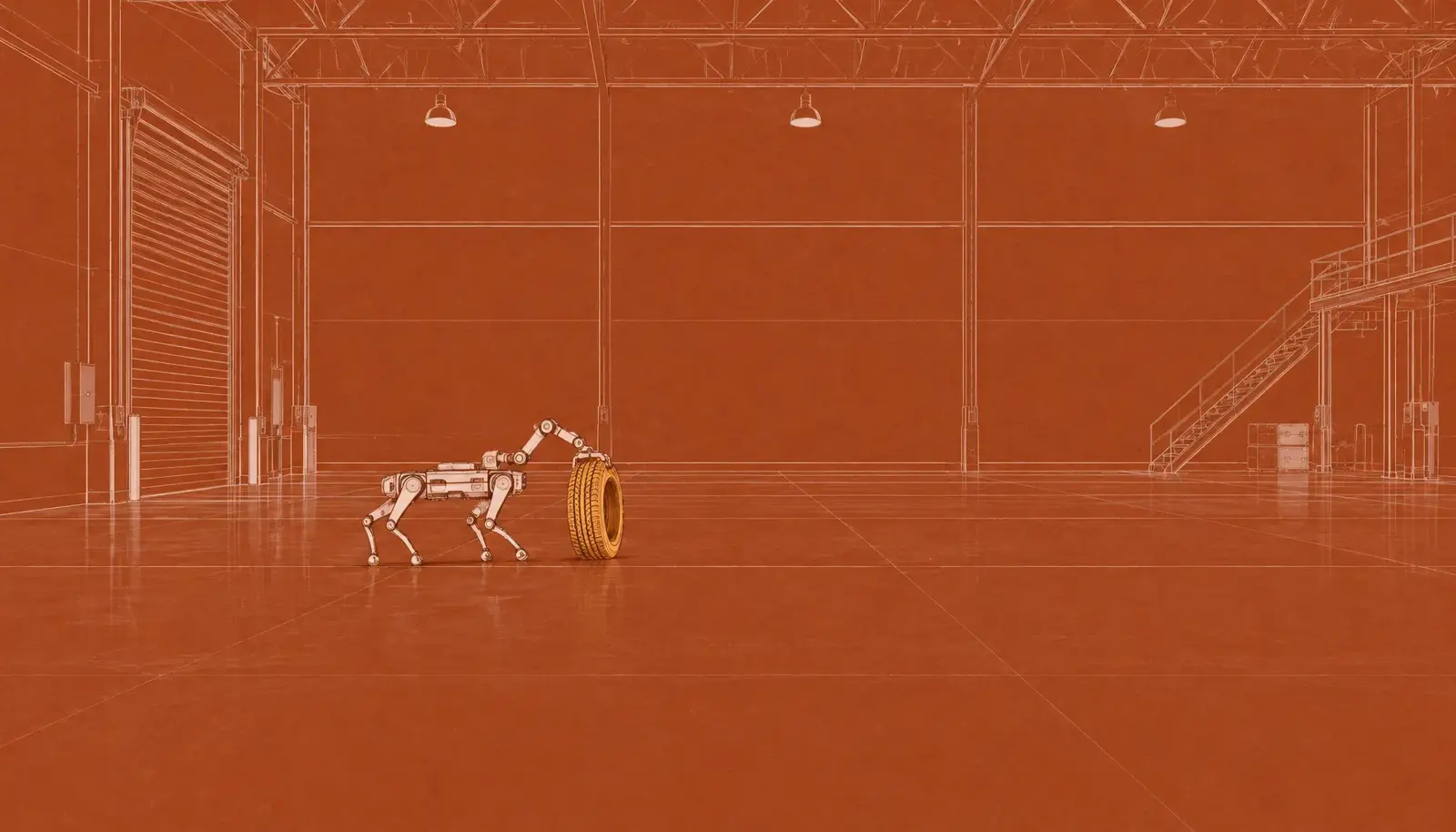
One learning framework, two very different machines
Many long-horizon robot manipulation systems lean on human motion data and humanoid hardware; a new study instead trains policies through simulated interaction and tests the approach on both a Unitree G1 humanoid and a Boston Dynamics Spot quadruped equipped with a manipulator arm. A robot must coordinate movement with changing body positions and object contact, not simply complete a brief pick-and-place maneuver. The paper does not show one set of learned weights moving unchanged between the two robots. It presents a shared phase-conditioned training method over a hierarchical control architecture, with platform-specific low-level controllers.
Source arxiv.org
Submitted to arXiv on October 26, 2026, the paper, “Learning Multi-Phase Robot Loco-Manipulation via Phase-Conditioned Policy Optimization,” lists authors affiliated with ETH Zurich’s Robotic Systems Lab and the Robotics and AI Institute. Its central proposal is to give reinforcement learning an explicit account of task stages—such as approaching an object, crouching, grasping, lifting and carrying—while training a policy for each multi-stage task.
Task stages guide training, not the deployed actor
The researchers build their method around proximal policy optimization, or PPO. During training, an environment state machine assigns the robot to a phase when local success conditions are met; phase-specific rewards encourage the behavior needed at that point. An auxiliary prediction head encourages the policy to learn the task’s progression, while a phase-conditioned critic estimates value with separate adjustments for different stages.
The design aims to address a familiar training failure: a robot may find an easier way to earn reward, such as dragging or kicking an object, rather than learning the intended sequence of lifting and carrying it. The team also resets some training episodes directly into later stages, including states where the robot already holds a box, then gradually reduces those resets as training proceeds. That curriculum gives the policy practice with later parts of a task before it has mastered the full sequence from the beginning.
“At test time, phases are no longer used, and the actor operates entirely without observing them or being constrained by them, executing the sequence autonomously.”
The paper’s authors—Simone Manni, Annika Wollschläger, Dario Bellicoso, Abel Gawel, Marco Hutter, Simon Le Cleac’h and Jan Brüdigam—write.
That distinction separates training structure from deployment: phase labels and transition rules guide learning, but the actor does not receive the phase as an input when running the sequence. The task still needs explicit phase definitions and reward tuning, however, so the method does not remove human design from the process.
Spot rolls a tire; G1 lifts and carries boxes
The Spot experiment has four phases: approach a tire, bring it upright, roll it, then tilt it down. G1 handles a broader set of box tasks, from pushing one or two boxes to lifting and carrying a box through seven stages, including crouching, clamping, lifting, carrying and offloading. Those demonstrations use distinct tasks on the two platforms, rather than a single cross-platform task replicated on both.
All policies are trained in the GPU-accelerated mjlab simulator. For hardware tests, the researchers use external motion capture to track the robots and objects, and randomize object mass, size and friction during training. They also show that G1 can push or lift a box without a motion-capture system, using onboard state estimation and ArUco marker detection to locate the object.
Real-world transfer required specific adjustments for the G1’s bimanual box-carrying task. The team added actuator-delay randomization of up to 25 milliseconds during training after arm oscillations destabilized grasps on hardware. To keep a box clamped for longer periods without overheating shoulder motors, they limited commanded joint-position deviations; the paper reports holds of up to five minutes under that constraint.
Ablations reveal the value and limits of phase guidance
Removing the auxiliary phase-prediction head lowered reported success from 89% to 44% on Spot’s tire task and from 92% to 14% on G1’s two-box-pushing task. The figures are reported as averages across three random seeds, and the authors say removing phase prediction also slowed convergence. Training without resets into later phases caused the more complex box-pushing task to collapse, according to the paper’s ablation analysis.
The authors also spell out the approach’s constraints. Longer tasks and larger numbers of phases may strain the policy and value network, while each task requires manual phase segmentation and additional reward tuning. Changing the box shape can require updating reset keyframes, and the researchers identify simulator contact modeling as another obstacle to reliable hardware transfer. The paper’s results show demonstrations across two robot types; they do not establish that one unchanged policy can control both.
Sources
- Original source · Preprint arXiv arXiv:2610.36270
Related stories
- WholeBodyMem Lifts Unitree G1 Memory-Task Success to 88.3%
- Humanoid Controller Uses Its Torso to Reposition Objects in 45 of 50 Trials
- Preprint uses human video priors to train bimanual robot policies
- Hong and Zhang Use Human Motion Data to Train Dexterous Robots
- Researchers Present Multi-Agent Reinforcement Learning for Planar Tangram Assembly