The Floor
FabricBench tests robot cloth handling across six simulated tasks
Researchers have proposed FabricBench, a benchmark for evaluating two-arm robot policies on fabric manipulation. Their preprint reports difficulty with T-shirt folding and heavily deformed starting configurations.
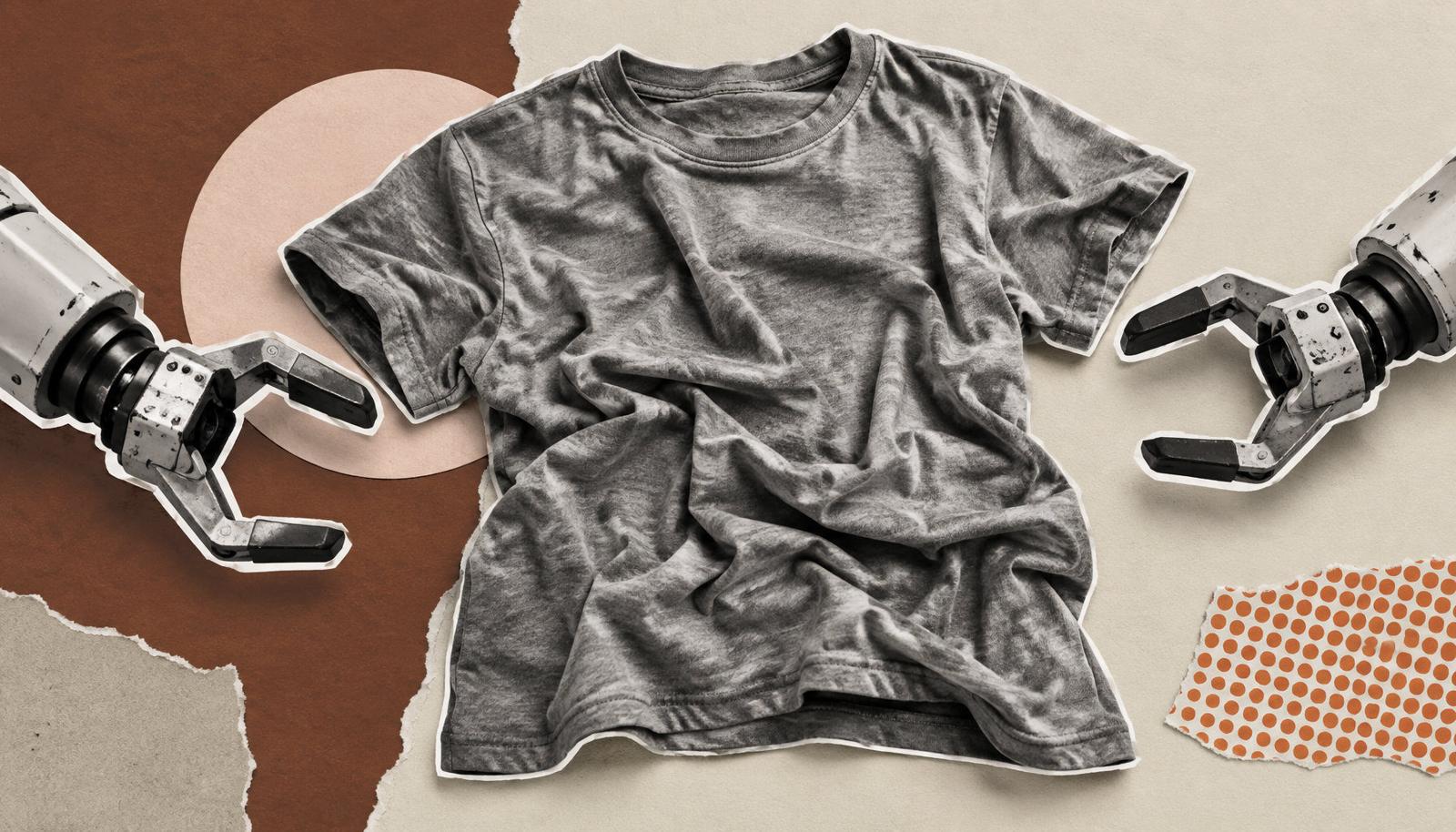
A new benchmark tests two-arm robot policies on six fabric-handling tasks, from lifting silk to folding a T-shirt. In a preprint submitted on November 23, the researchers behind FabricBench report that the best policy averaged 77% success in simulation, while none exceeded 36% on T-shirt folding.
The work combines a simulated task suite with a cloth solver designed to model contact between fabric, robot grippers and rigid objects. It also compares simulated results with tests of one policy on a physical dual-arm robot.
Tasks and evaluation
FabricBench covers folding and flattening a T-shirt, flattening and lifting silk, carrying a bag and packing a snack. The packing task combines placing a rigid object in a fabric container with transporting the loaded bag.
The simulated platform uses a dual-arm Piper robot with an overhead camera and two wrist cameras. Tasks are scored on whether they reach a target outcome rather than whether the robot follows a prescribed trajectory; a separate score gives partial credit for progress.
The team plans to release 10,000 expanded assets, along with the simulator, demonstrations and evaluation code. Asset variants separately change geometry, appearance and physical parameters.
Folds test the policies
Each policy was given the same 200 demonstrations per task, and the standard simulation evaluation used 50 episodes per policy and task. The six policies included vision-language-action and world action models.
The highest average success rate was 77% for π0.5, followed by 70% for LingBot-VA, according to the researchers. Both reached 36% on T-shirt folding, the highest success rate recorded for that task.
The team also tested whether policies trained on a standard starting configuration could flatten cloth under changes to its appearance or initial deformation. For the most deformed T-shirt configurations, success ranged from 6% to 14% across policies; no policy exceeded 2% on the most deformed silk configurations.
For T-shirt flattening, the reported drops under increasing initial deformation were larger than those under the tested appearance changes. The paper notes that the configuration test uses three discrete, task-specific levels rather than sampling the full range of possible cloth configurations.
Contact in simulation
The simulator builds on an open-source solver in Newton and models grasping and release through contact forces rather than artificial attachment. Its bidirectional coupling is designed to let a bag support an object and transmit the object's weight to the grippers.
The researchers replayed a recorded dual-arm T-shirt grasp at 15 placements, three times each, in each simulator configuration. Their contact model completed grasp, hold and release in all 45 trials, compared with no complete successes for the tested Isaac Sim, Newton VBD and released Newton Style3D configurations.
In the reported comparison, Isaac Sim's tested cloth configuration did not form a bimanual grasp. Newton VBD and the released Style3D configuration held the shirt but did not release it in the trials.
Physical robot comparison
The researchers also tested the π0.5 checkpoints, trained only on simulated demonstrations, on a real dual-arm robot without further task training. They ran 20 trials for each task using the same task-level success criteria as in simulation.
The simulation and real-robot results largely preserved the ordering of task difficulty across the six tasks, with a reported Spearman correlation of 0.94. The paper cautions that the correlation measures agreement in ordering, not in absolute success rates: for T-shirt folding, the reported rates were 36% in simulation and 35% on the robot.
Sources
- Original source · Preprint FabricBench: A Standardized Policy Benchmark for Bimanual Fabric Manipulation with a Contact-Driven Deformable Simulator arXiv:2611.31577
Related stories
- ManipScope preprint finds weak instruction following in robot tests
- RoboClock preprint tests robot timing across 60 simulated tasks
- Preprint reports fewer simulated contacts using robot interrupts
- Monte Carlo planner beats baselines in simulated robot tasks
- Robot calibration method probes hidden shifts before tasks