The Floor
FASTFUNNELS preprint proposes agile multi-robot navigation
A preprint proposes FASTFUNNELS, a method that uses a changing elliptical region to guide robots through narrow spaces. In simulated tests, it recorded an 89% completion rate at 7.73 m/s across scenarios involving one to six robots.
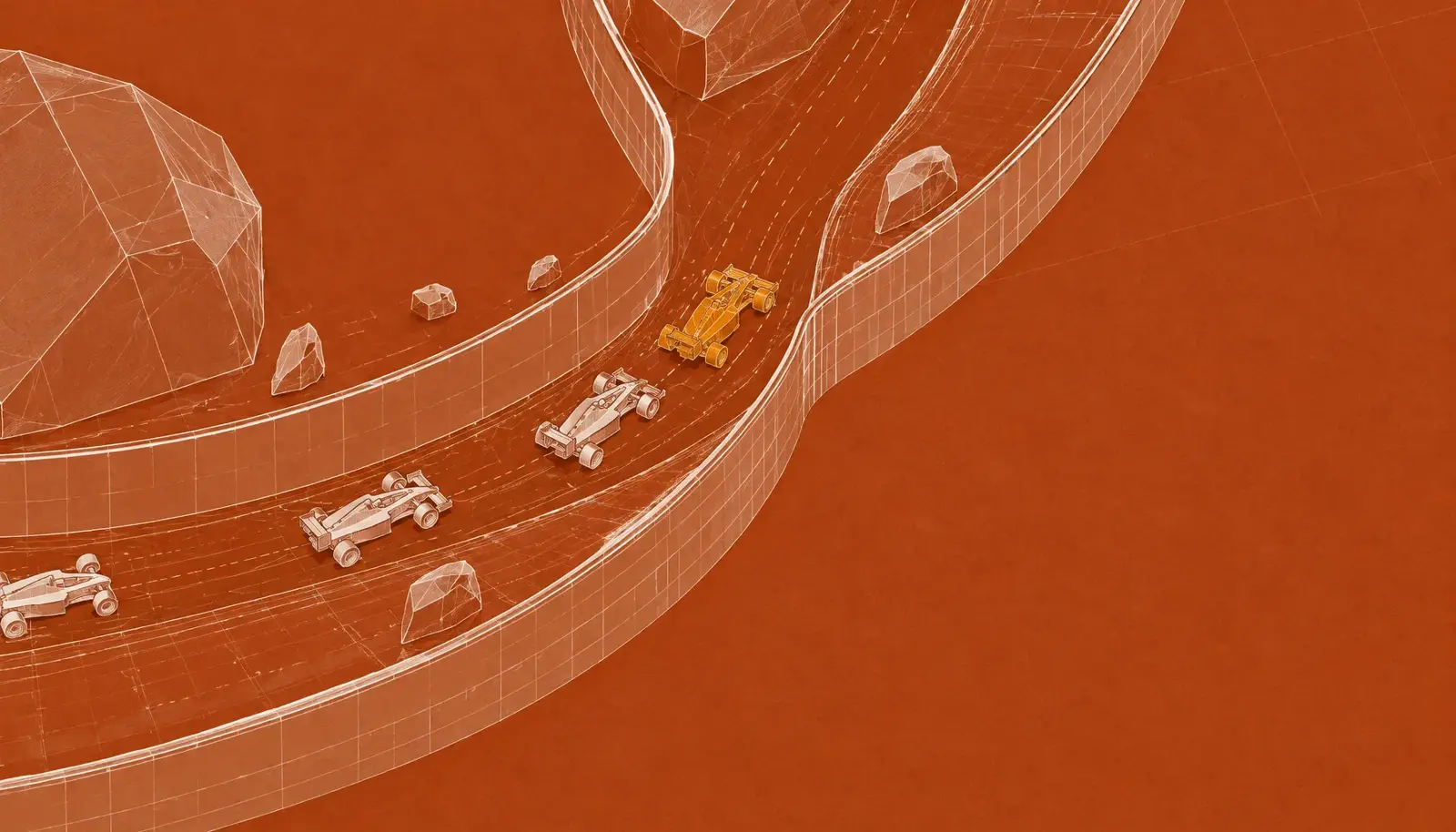
A moving formation for tight spaces
A preprint by Vignesh Rajagopal and Rohan Chandra proposes FASTFUNNELS, a method for coordinating multiple robots through cluttered, narrow spaces while maintaining speed. The work was submitted to arXiv on November 6, 2026, and reports simulated tests plus a deployment on two 1/7-scale Traxxas UDR cars in a 15m indoor corridor with three obstacles.
The authors focus on the difficulty of balancing speed and collision avoidance for car-like robots. They say existing approaches can slow near a bottleneck to avoid collisions, or fail to swerve in time when moving quickly. FASTFUNNELS is a formation-control approach for robots with Ackermann steering, in which the vehicles coordinate their movement through constrained spaces.
The paper contrasts the method with formation-control techniques that use rigid shapes and prescribed transitions. Those transitions, the authors write, depend on the starting conditions, the environment and vehicle dynamics, and can be impractical to maintain at high speed. They give a narrow gap as an example: a group may need to arrange itself into a square, change into a line to pass through, then form a square again.
A shape that adapts as it moves
FASTFUNNELS instead uses a hierarchical algorithm. At the higher level, a reinforcement-learning policy generates an elliptical patch that changes shape and orientation in real time, stretching or squeezing as it moves around obstacles and through tight spaces. The authors compare this adapting shape to a water droplet flowing through a space.
At the lower level, distributed model predictive control, or DMPC, controls the robots so they remain inside the patch while avoiding collisions with one another. The patch is described as a “soft forcing function”: it guides the group’s movement without requiring it to hold a fixed formation.
The method’s two levels therefore have different roles in the paper’s design: the policy sets the changing region for the group, while DMPC controls the individual robots within it. The authors present this as an alternative to planning a sequence of fixed formation shapes and transitions for passage through a constrained space.
Results in simulated racing scenarios
The authors evaluated FASTFUNNELS on simulated F1TENTH racing cars in 14 scenarios, with between one and six robots. Each scenario’s results were averaged over 20 trials. The preprint reports an 89% completion rate at 7.73 m/s for FASTFUNNELS.
For the baselines, the paper reports that they either failed to complete the track or succeeded only at speeds from 0.07 to 1.79 m/s, with an approximately 40% completion rate.
Sources
- Original source · Preprint FASTFUNNELS: Agile Multi Robot Navigation in Narrow Spaces via Adaptive Dynamic Funnels arXiv:2611.09005
Related stories
- Preprint reports up to 3.75× robot capacity for VLA serving
- Preprint uses haptic probes to identify soft-tissue layers
- Preprint finds hand-written planners beat UniAD in some tests
- Under evaluated conditions, a second viewpoint lowers mean per-joint position error from about 97 to 65 mm
- StrataSLAM is released for multi-floor mapping in ROS 2