The Floor
Preprint uses haptic probes to identify soft-tissue layers
A robot controller probes tissue for muscle or bone-backed support before applying its task force. In tests on three human subjects, the authors report improved force tracking and pressure distribution against two comparison modes.
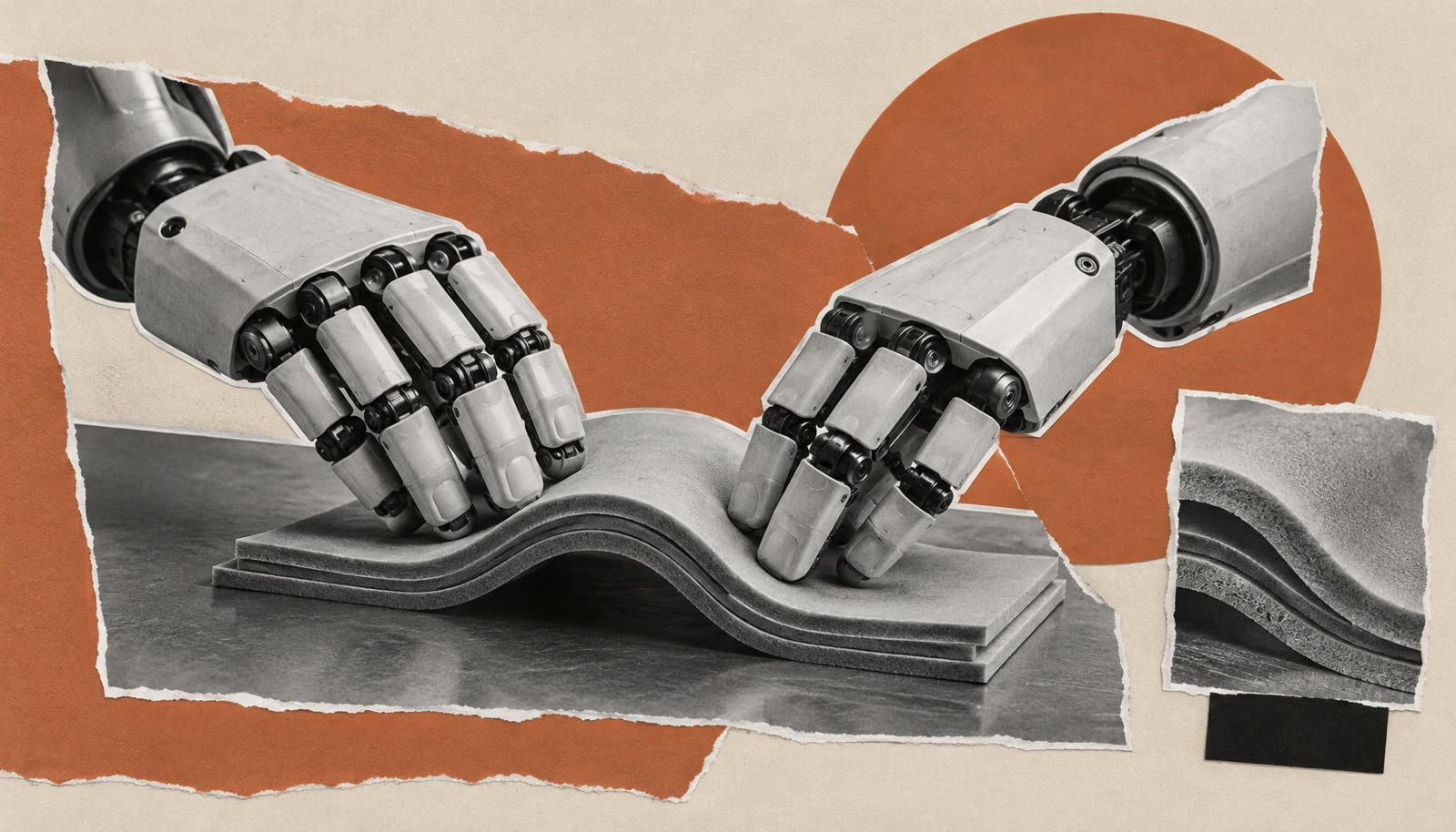
Probing before task force
A robot controller can probe for muscle or bone-backed tissue before applying its working force, then adjust how it spreads contact across the tissue, according to a new preprint by eight researchers. The paper, submitted to arXiv on November 17, 2026, describes a dual-arm system that uses a brief, low-amplitude excitation under light contact to distinguish the two tissue regimes.
The controller compares the measured response with a baseline recorded at anatomically identified sites on the same subject, rather than applying one stiffness threshold across people. The probe runs before task loading, not before all contact: the tool first makes light contact, probes the tissue, and then commits to the control setting for that segment.
Force spread across contact
A tactile array on each fingertip measures contact area, and the controller allocates force across engaged fingers to equalize pressure while keeping the total force near its target. The selected tissue regime sets an allowable pressure and the area needed to apply the target force; if available contact area is insufficient, the controller can recruit another finger.
The paper describes a partitioned energy budget for probing, task forces and controller switches, intended to keep the probe from being suppressed by the safety monitor. If a finger cannot be recruited, the method reduces the target force rather than exceeding the pressure bound.
Tests on shoulder contact
The researchers tested fingertip pressing and kneading on the shoulders of three human subjects with a dual-arm system and three-fingered hands. The evaluation compared the proposed conditioned controller with a fixed-compliance baseline and a reactive mode that adapts from loading signals without probing ahead of task force. Each mode used the same commanded joint trajectory, and the paper reports eight hand-traverses per mode.
Across the loaded samples, the authors report a median force-tracking error of 2.22 newtons for their method, compared with 3.37 newtons for the reactive mode and 4.04 newtons for the baseline. Where the pressure bound applied, the authors report a pressure-uniformity measure of 1.161 for the conditioned mode, versus 1.380 for the reactive mode and 1.252 for the baseline.
Limits noted in the paper
The paper reports a 95th-percentile peak pressure of 62 kilopascals for the proposed method, against 68 kilopascals for the baseline and 228 kilopascals for the reactive mode. At matched resultant force above 5 newtons, the authors report that the conditioned controller held 182 square millimeters of contact area, compared with 163 square millimeters for the baseline.
The method does not avoid all exposure to a tissue change: the authors say boundary detection remains reactive, so a new regime is briefly loaded under the previous settings. The paper regulates average pressure over each fingertip patch rather than peak pressure at individual sensor points, and notes that active muscle contraction voids the pressure bound's reading as a safety statement.
Sources
- Original source · Preprint Haptic Probing for Subsurface-Aware Force Distribution on Layered Soft Tissue arXiv:2611.22195
Related stories
- FORTH preprint pairs robot learning losses with force measurements
- Preprint finds hand-written planners beat UniAD in some tests
- FASTFUNNELS preprint proposes agile multi-robot navigation
- Preprint reports up to 3.75× robot capacity for VLA serving
- Under evaluated conditions, a second viewpoint lowers mean per-joint position error from about 97 to 65 mm