The Floor
HIDRA Splits Language and Context to Learn Without Replay
HIDRA uses language instructions to shortlist robot-skill experts, then uses visual and physical context to refine the selection. In simulated LIBERO benchmarks, the paper reports higher AUC scores than the compared replay-free and replay-based methods, while also testing mixed task sequences and paraphrased instructions.
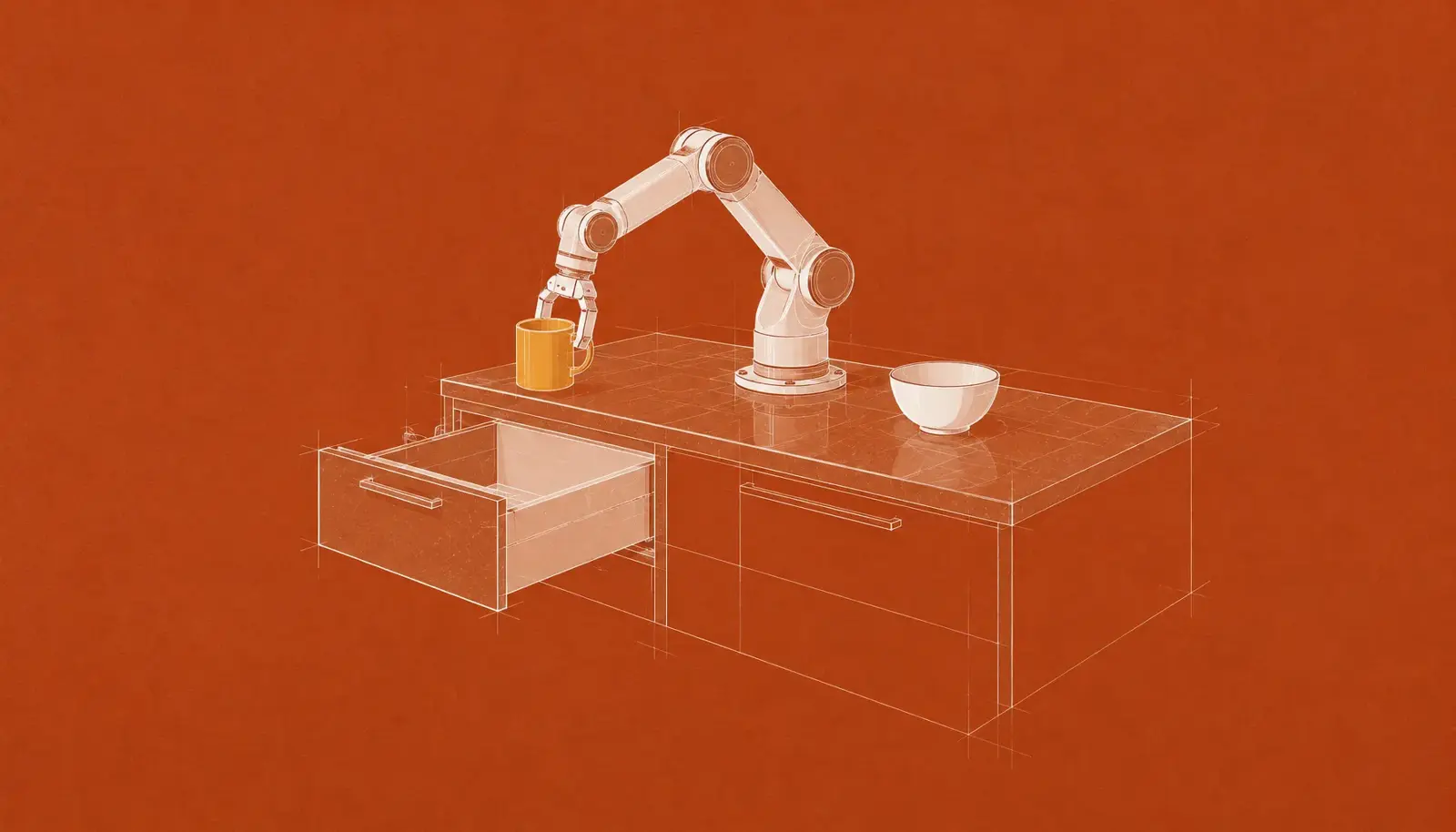
Robot-learning systems often replay old demonstrations to preserve skills as they acquire new ones; HIDRA aims to avoid that storage burden, but must still keep its expert selection from drifting as tasks accumulate. In a paper posted to arXiv on October 26, 2026, researchers propose a two-stage routing method that first uses language instructions to find a relevant expert and then uses the robot’s current visual and physical context to refine the choice. On simulated LIBERO benchmarks, they report higher AUC scores than the compared replay-free and replay-based methods.
Language chooses the shortlist; context makes the call
HIDRA stands for Hierarchical Dual-Routing Attention. Its authors—Fanqi Yu, Matteo Tiezzi, Cigdem Beyan, Tommaso Apicella and Vittorio Murino—target a problem they call routing interference: as a robot learns sequentially, changes to its representations can lead a single router to select the wrong skill expert. Without access to old demonstrations, those mistakes cannot be corrected by replaying the earlier examples.
The method separates two decisions that a conventional router might make from one blended representation. First, an instruction-level query identifies an anchor expert and limits which earlier experts can be considered for reuse. A second query, built from visual observations and robot-state information, ranks candidates within that restricted set. The authors also regularize the experts’ context keys to keep representations for each task compact and reduce overlap between tasks.
“Our approach consistently outperforms both replay-free and replay-based baselines, improving AUC and forward transfer while maintaining low forgetting, with stronger gains under high interference and language variation.”
The paper’s authors write.
LIBERO scores top replay-based results
The evaluation uses four LIBERO suites—OBJECT, GOAL, SPATIAL and LIBERO-10—and a mixed-task benchmark in two settings. The standard lifelong-learning phase introduces 10 tasks per benchmark, with 50 demonstrations for each task; the authors train for one epoch per task rather than revisiting the data across multiple passes. They average results over three random seeds and evaluate each policy on 20 trials per seed.
HIDRA’s area-under-the-curve (AUC) score, which summarizes task performance across the learning sequence, reaches 91.5 on LIBERO-OBJECT, compared with 82.2 for DMPEL using all past data. On LIBERO-SPATIAL, HIDRA scores 58.7 versus 47.0 for that replay-based baseline. The comparison is closer on GOAL—66.7 versus 64.3—and LIBERO-10—58.1 versus 53.8.
The paper reports approximate Welch’s t-test comparisons of AUC across three seeds. Against DMPEL with full replay, HIDRA’s differences are statistically significant on OBJECT and SPATIAL, but not on GOAL or LIBERO-10. On LIBERO-MIX, which interleaves tasks sampled from all four suites, the paper evaluates Inc4, introducing four tasks per step, and Inc1, introducing tasks sequentially. HIDRA records an AUC of 67.0 in Inc4 against 59.9 for DMPEL with full replay. Separately, LIBERO-INS tests paraphrased language instructions; HIDRA records an AUC of 27.6, compared with 27.1 for DMPEL with full replay.
Spatial reasoning remains a weak point
The benchmark results do not establish that HIDRA works on a physical robot. The experiments use LIBERO simulation, and the paper says evaluation on real robotic platforms would further assess its performance. The authors also report lower performance on LIBERO-SPATIAL, where fine-grained spatial distinctions put greater weight on context than instruction semantics.
Nor does the routing design provide an unconditional guarantee that old skills will remain selected as the expert library grows. The paper says new instruction keys can, in principle, replace an earlier anchor; in its LIBERO-OBJECT analysis, the authors report zero retroactive anchor switches as the library expanded. They describe this as empirical stability, not a formal guarantee. HIDRA’s test is therefore specific: on the reported simulations, its instruction-first shortlist and context-based refinement outperform the compared methods on aggregate, while real-robot performance remains untested.
Sources
- Original source · Preprint arXiv arXiv:2610.36374
Related stories
- SARAM Cuts Robot-Learning Storage to 3.8 MB per Task
- Preprint finds retrieval rivals some VLAs on simulated robot tasks
- Bimanual CTR Raises Worst-State Success from 56% to 76%
- Hsu and Stone Introduce ELA Preprint for Learning Robot Policies from Video Demonstrations
- UniLatent preprint tests robot-to-robot transfer in simulation and on arms