The Floor
Humanoid pivots a 14.9 kg box forward in five research trials
A learned controller moved a heavy box forward with repeated lean and yaw reversals in tests with a Unitree G1 humanoid. All five trials ended when a base-tilt safety trigger activated, after which the robot fell.
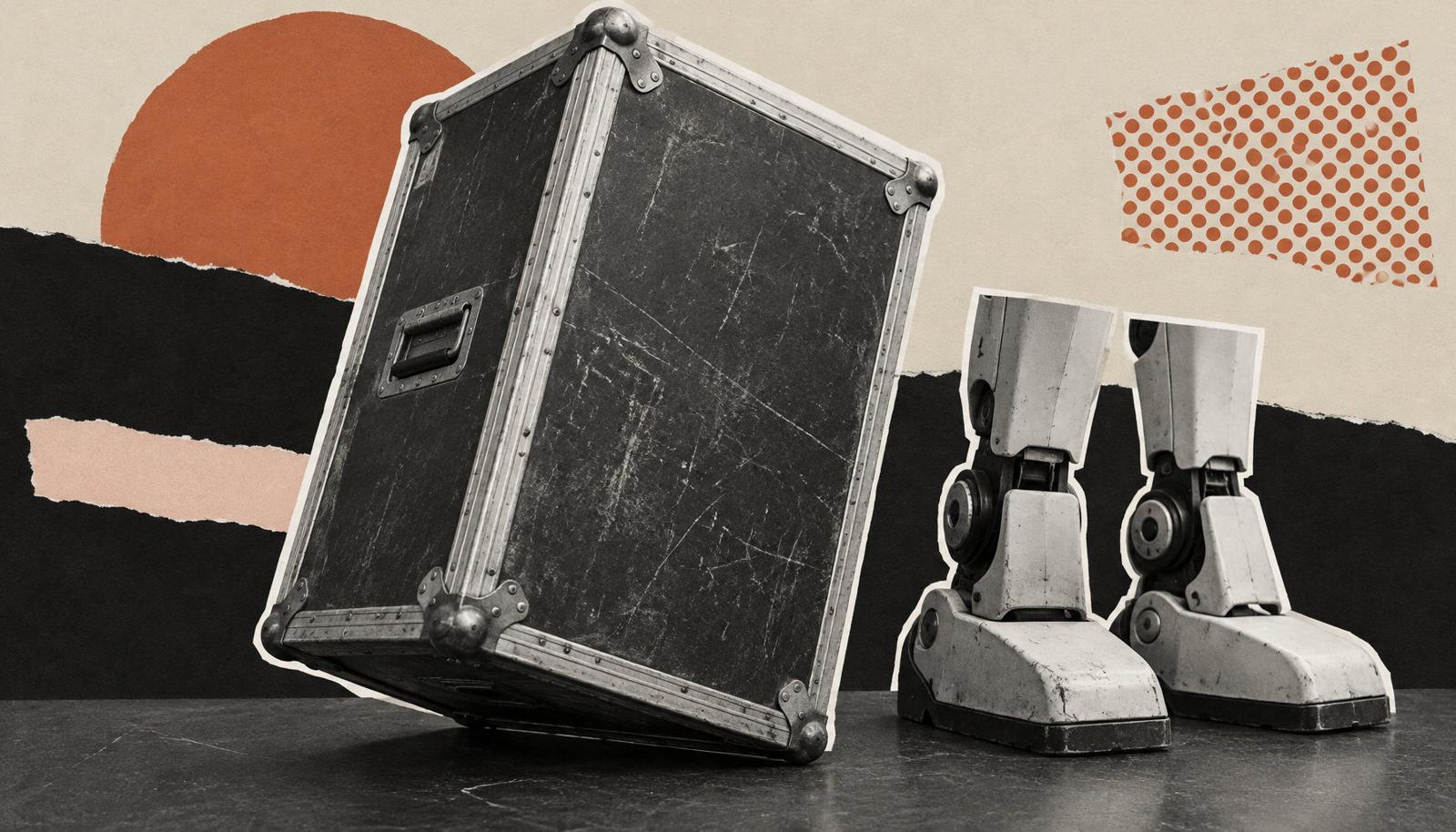
A Unitree G1 humanoid moved a 14.9 kg box forward by more than 1 m in each of five physical trials, reproducing repeated lean and yaw reversals, researchers report in a preprint. Every trial ended when a base-tilt safety trigger activated; the robot then fell, and the box toppled during the ending of two trials.
Source arxiv.org
The work uses a reinforcement-learning controller to coordinate the robot’s movement, balance and handling of the box. The preprint was submitted on November 25 by University of Tokyo researchers Rikuto Hidaka, Tsung-Yuan Chen and Kento Kawaharazuka.
Rocking rather than lifting
In pivot walking, an object is tilted onto a bottom corner and rotated, then rocked toward the opposite corner as it moves forward. Most of its weight remains supported by the ground while the robot presses on its sides with both hands.
The researchers used a 29-degree-of-freedom G1 EDU humanoid. The physical object was a modified G1 shipping case, with its casters removed, handle covers flattened and rubber sheets added at the hand-contact regions.
Previous humanoid pivoting systems used planned sequences that separated object rotation from robot stepping, with the object nearly stationary between rotations, the paper says. The new approach instead trains a single policy to produce the coordinated motion without a planned settling phase.
From simulation to hardware
Training began with the robot learning to balance while maintaining side contact with a tilted box. The team then introduced rewards for the desired rocking motion and adapted the gait to heavier boxes.
During the main training stage, the policy used a reference that advanced with the box’s measured progress. When the box stopped, the reference stopped too; when it moved backward, the reference reversed.
The hardware version was trained further without box-state observations and followed an internal periodic clock instead. It used onboard robot measurements, while markers on the box were used offline to estimate gait timing and relative progress, not as inputs to the deployed controller.
In simulation, a version of the policy that observed the box accumulated an average of 4.12 m of forward travel in 20 seconds with a 14.9 kg box, according to the paper. It completed all 128 evaluated episodes without termination; the episodes varied the initial box orientation, rather than the training seed or physical parameters.
The reported simulated travel was accumulated positive travel and could exceed net displacement. The researchers also tested six training routes using a basic transport objective without the pivoting rewards; none produced repeated alternating yaw swings under the settings tested.
Safety stops in every trial
The hardware experiment was designed to evaluate transfer of the gait, not delivery or set-down.
All five trials ended 12–22 seconds after gait onset when the robot’s base tilt exceeded the safety threshold and the controller switched to Passive. The box did not fall during the preceding gait, but toppled in two of the triggered endings.
The team did not log joint and inertial measurement data and could not identify what caused the base tilt to grow. Sustained delivery, direct measurement of alternating support corners and a controlled stop remain undemonstrated, the paper says.
Sources
- Original source · Preprint Learning a Whole-Body Pivot-Walking Gait for Heavy-Box Transport with a Humanoid arXiv:2611.33828
Related stories
- Researchers report safe robot planning without retraining
- WISER-RL preprint reports robot learning from one demonstration
- Einsia open-sources 10,807 robot simulation environments
- DexLink preprint reports robot skills without object-specific demos
- Russia sends Teledroid robot toward space station for tests