The Floor
Hyundai Demonstrates Apartment Parking Robots in Siheung
Hyundai Motor Group demonstrated apartment parking robots at a Siheung residential complex, including a wall-pad car retrieval that took about three minutes. The pilot tested three parking scenarios, while the group said it still plans to develop operating standards and consider regulatory changes.
A three-minute retrieval, with rules still to settle
A resident’s wall-pad request can bring a parked car to a pickup area in about three minutes, Hyundai Motor Group says. The group demonstrated that service on October 29 at Hillstate The Wave City, an apartment complex in Siheung, South Korea, while also acknowledging that operating standards and regulatory changes remain part of the work ahead.
The demonstration marked a public progress report on a pilot involving Hyundai Motor, parts maker Hyundai WIA and builder Hyundai Engineering & Construction. Hyundai describes it as South Korea’s first test of parking robots in an operating residential complex, in a parking area with at least 50 spaces. The company’s announcement does not describe a wider residential rollout.
The gap between a smooth demonstration and routine service is the story’s central tension. Hyundai showed how the robots might handle everyday garage problems, but still needs to develop technical and operating standards for wider use and will discuss regulatory changes with relevant agencies.
Three garage problems, one robot service
Hyundai staged three situations: vehicle arrivals and departures happening at the same time, moving a car that blocks another vehicle, and temporarily bringing a car out before returning it to its space. In the first scenario, a resident requested a vehicle through the apartment’s wall-mounted home-control panel, and the parking robot moved it to the departure area in about three minutes.
The temporary-removal test addressed a small but familiar need: a driver might request a car and then decide not to leave, or need to retrieve an item from inside it. The robot moved the vehicle out and returned it to its parking bay. In the double-parking scenario, the system repositioned vehicles to reduce the space needed to move them.
Hyundai also connected the robots to parts of the complex’s existing infrastructure, including its vehicle-entry barrier, apartment wall panels and an AI-based vehicle inspection system. The setup tested the possibility of combining vehicle intake, storage, inspection and retrieval into one service. The release does not provide a success rate, average wait across multiple requests or operating-cost figure.
Two robot sets serve a 53-space test zone
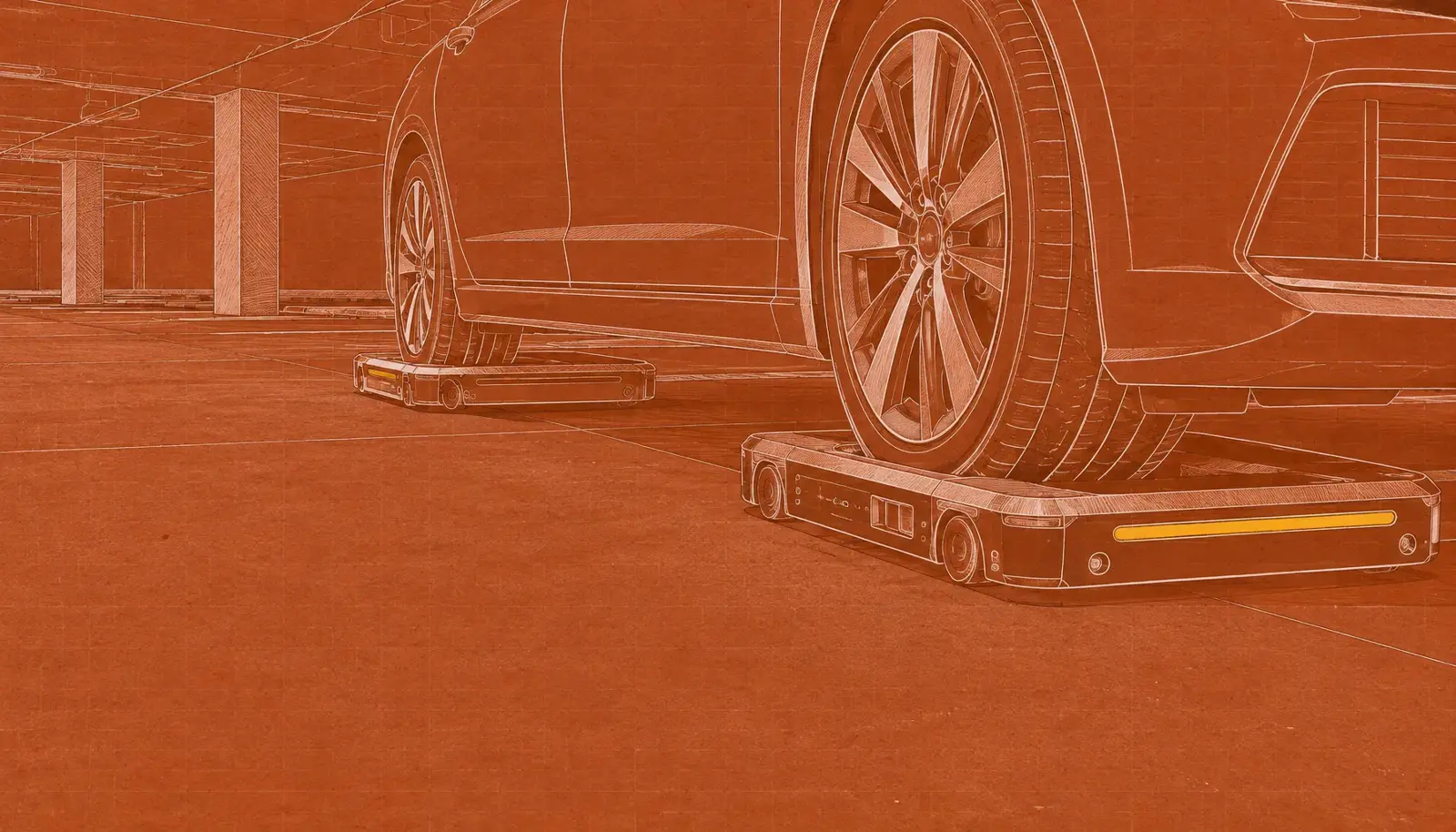
The earlier project announcement specified a dedicated 53-space zone on the complex’s basement level and two sets of Hyundai WIA parking robots. Each set uses a pair of low-profile units that slide beneath a vehicle, lift its wheels and carry it to a parking space. The robots use LiDAR to locate wheel size and position, and are designed to move SUVs weighing up to 3.4 tonnes.
The demonstration update adds a system-level figure: Hyundai’s Smart Parking Control System, which plans routes and assigns vehicles, has reached version 2.0 and can control as many as 200 parking robots at once. That is the stated capacity of the control system, not the number of robots deployed at the apartment complex. The demonstration release does not say that 200 units are operating there.
Hyundai’s next test is broader than the garage
Hyundai will use experience from the residential pilot to set technical and operating standards, and is considering other settings such as transport hubs, commercial properties and offices. It also plans to work with public agencies on rules needed for stable operation and expansion. In its earlier project announcement, the group said it planned to measure vehicle handling time, user wait time, parking success rate, robot utilization and changes in parking-space efficiency during the pilot.
Jung Ho-geun, vice president of Hyundai Motor’s Future Strategy Division, described the demonstration as a step toward using robotics and mobility technology in real urban settings. He said the group wants parking areas to connect people, mobility services, robots and city infrastructure. At Hillstate The Wave City, the concrete result on display was narrower: a wall-pad request followed by a car moved to the departure area in roughly three minutes.
“이번 실증은 주차로봇 기술의 가능성을 확인하는 동시에 로보틱스와 모빌리티 기술을 실제 도시공간에 적용하는 과정이라는 데 의미가 있다”며 “앞으로 주차공간이 사람과 모빌리티, 로봇, 도시 인프라가 연결되는 스마트도시의 거점으로 발전할 수 있도록 관련 가능성을 구현해 내겠다”고 말했다.
Jung Ho-geun, vice president of Hyundai Motor’s Future Strategy Division
Sources
- Original source Hyundai Motor Group · Hyundai Motor Group apartment parking robot demonstration hyundaimotorgroup.co.kr
Other pages read
- Hyundai Motor Group · Hyundai Motor Group parking robot pilot hyundaimotorgroup.com
Related stories
- South Korea Plans About 1,700 Public-Sector AI Robots for 2027
- Wonik Robotics commits 100 billion won to Wanju production hub
- South Korea proposes funding for robot sensors, actuators and batteries
- AEON Opens Kawaguchi XD With Automated Store Sorting and Stacking
- Starship Plans Software Changes After Tallinn Bus Crash