The Floor
KAIST’s RAIWAY Biped Rolls Over Rough Ground Without Contact Sensors
KAIST researchers introduced RAIWAY, a two-wheeled biped that uses proprioceptive data to adapt its rolling control without contact sensors or external perception. The robot climbed a 16-centimeter step in 20 of 20 trials, but managed only three successful ascents of a rough 15-centimeter granite staircase in 10 attempts.
“At deployment, the controller infers this representation online from proprioception, requiring no contact sensing.”
Kyungmin Nam et al., “RAIWAY: A Large-Wheeled Bipedal Robot with Contact-Informed Blind Locomotion”
KAIST researchers describe a robot that learns from wheel–terrain contacts in simulation, then estimates those interactions from its own motion sensors while moving outdoors. RAIWAY crossed gravel, rocky ground and studded slopes, and climbed staircases with risers as high as 15 centimeters. The paper appeared on arXiv on October 23, 2026, and says it was accepted to IEEE Robotics and Automation Letters.
RAIWAY’s 20-inch wheels keep it rolling
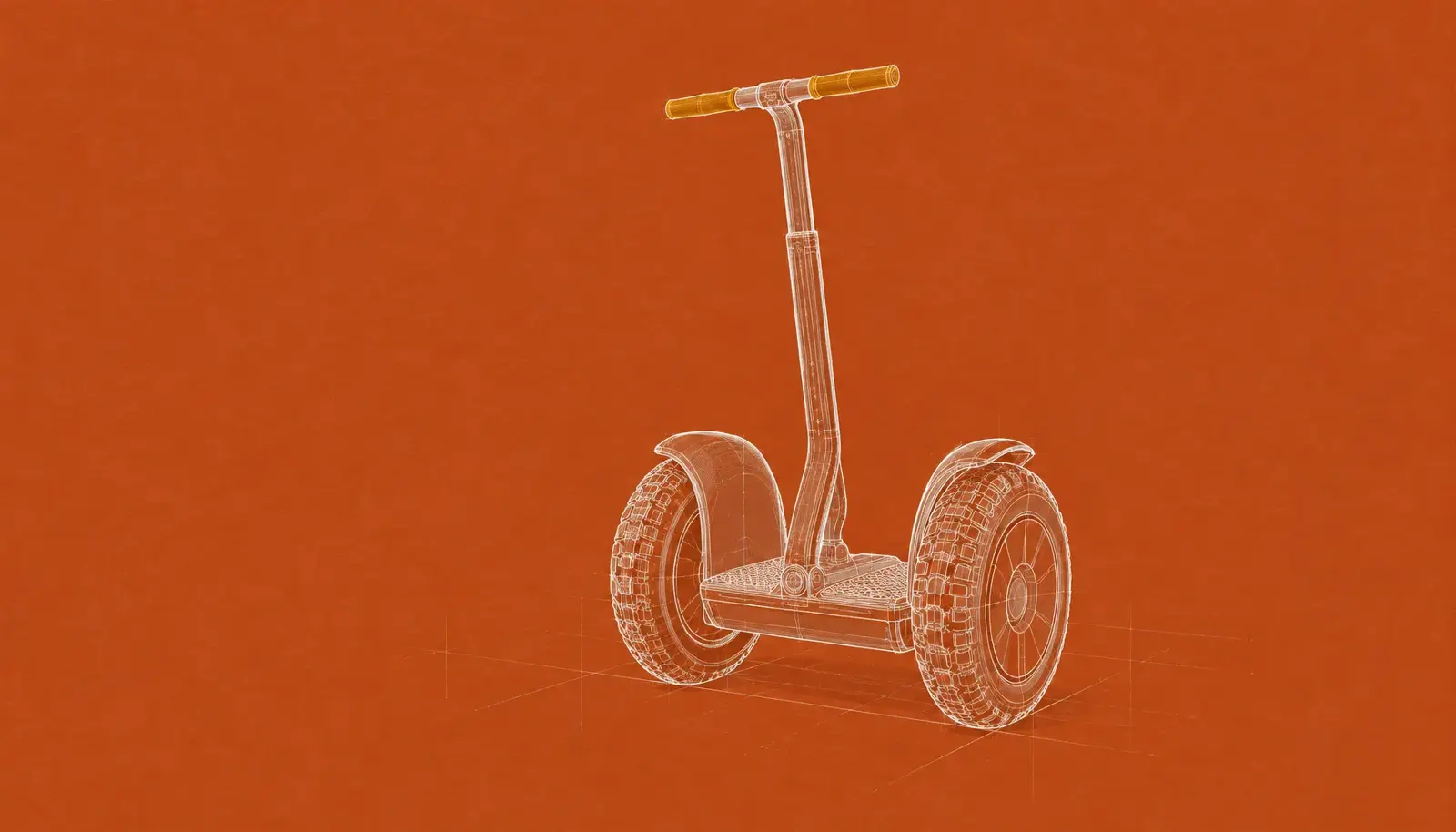
The prototype stands 1.14 meters tall and weighs about 28 kilograms with its battery. Its two legs each have two pitch joints and a wheel joint; differential steering turns the robot without hip roll or yaw joints. Twenty-inch off-road bicycle tires let it roll over moderate obstacles rather than switching to a dedicated stepping motion.
Closed-cell foam inserts replace pneumatic inflation in the tires. The authors say the inserts give more consistent compliance during impacts, avoiding the rebound associated with high pressure and rim strikes associated with low pressure. An onboard computer, an inertial measurement unit and joint encoders supply the robot’s operating signals; “blind” here means the controller uses no external perception or contact sensors, not that the robot has no sensors.
Simulation supplies the contact data
In simulation, the researchers record where each wheel touches the terrain and the impulses at those contacts. They filter and organize those events into a fixed-size representation, which a teacher network distills into a latent signal. At deployment, a student module estimates that signal from a history of the robot’s proprioceptive observations and commands.
The method addresses a problem specific to rolling: the important interaction happens at a small, shifting patch of tire, and depends on tire compliance as well as terrain shape. The team’s policy runs at 100 hertz, while simulated contact data arrive at 400 hertz during training. A single learned policy handled the tested outdoor environments without terrain-specific switching or retuning.
The 16-centimeter step was easier than the granite stairs
In 20 trials on an indoor wooden step 16 centimeters high, RAIWAY completed all 20 ascents. The plain actor–critic baseline succeeded in five of 20 trials, while a baseline with a concurrent state estimator succeeded in 14. On a rocky route tested over five trials, RAIWAY completed an average of 95 percent of the route; the estimator baseline averaged 39 percent.
Outdoor results varied with the obstacle. The robot completed 11 consecutive round trips on a 14-centimeter staircase, ascending at a mean 0.28 meters per second. On the 15-centimeter granite staircase, it reached the top in only three of 10 attempts, although successful ascents averaged 0.42 meters per second.
Rounded stair edges exposed a sim-to-real gap
The paper links the granite-stair failures to rounded edges and uneven surfaces: the tire tread could catch on the sharp edge of the wooden test step, but the granite offered no equivalent purchase. Both wheels sometimes slipped, pitching the robot forward. The simulator uses rigid contact and does not reproduce the real tire’s tread engagement or the staircase’s surface variation.
The authors also report occasional high-frequency action and torque oscillations after wheel rebound. They measured tire restitution at about 0.61, while training sampled values only up to 0.3; the higher simulated values made the policy too conservative. RAIWAY therefore demonstrates contact-aware rolling without contact sensors, but its hardest reported test ended with seven failed attempts on the rounded granite staircase.
Sources
- Original source · Preprint RAIWAY: A Large-Wheeled Bipedal Robot with Contact-Informed Blind Locomotion arXiv:2610.33172
Related stories
- TerraTransfer++ Scores 59.4 on NAVSIM Without Human Demonstrations
- Machenta Raises $40M to Teach Robots From One Demonstration
- AgiBot’s Rollback Rewinds Robot Policies to Test Better Actions
- ThinkWorld Trains Robot Policies by Scoring Imagined Futures
- Zero-HLM Simulation Training Beats Real Data in G1 Trials