The Floor
Lincoln Electric Launches XpertLINC Adaptive Welding Platform
Lincoln Electric launched XpertLINC, a physical AI platform that scans weld joints and adjusts robot motion and welding parameters. The system debuts on Cooper welding cobots and is designed to work with customer-defined weld procedures.
“XpertLINC redefines what is state-of-the-art in the fabrication industry and what manufacturers should now expect from robotic welding systems.”
Kevin Whaley, Executive Vice President, President, Global Automation at Lincoln Electric
Lincoln Electric puts XpertLINC on Cooper cobots
Lincoln Electric announced XpertLINC on October 20, describing it as a physical AI platform that combines vision, coordinated motion and welding-process control. The system is intended to adjust a robot’s path and welding parameters to the part in front of it, including when joint geometry or fit-up varies. The platform is designed to keep those adjustments within the customer’s process specifications.
The initial deployment is on Lincoln Electric’s Cooper welding cobots. The company plans to extend XpertLINC to its broader range of automated cutting and welding solutions over time. The launch announcement does not name a customer deployment or give pricing, performance benchmarks or a general availability date.
A scan replaces much of the taught path
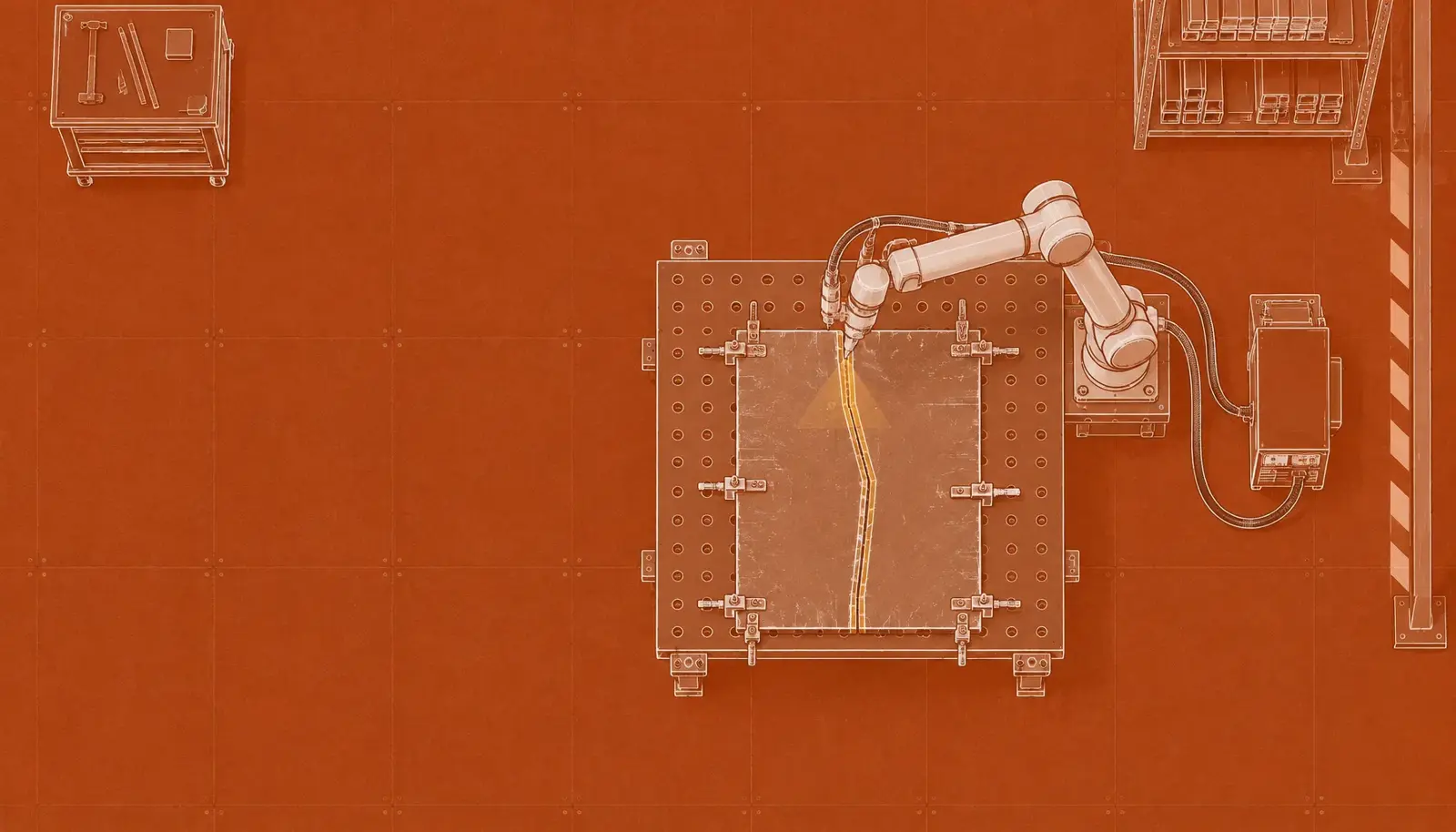
The workflow starts with an operator showing the cobot the weld’s start and end points. XpertLINC then scans the part to capture its actual joint geometry and assess fit-up conditions. Using that information, Lincoln Electric’s welding expertise and any customer-defined Weld Procedure Specifications, the platform sets coordinated robot motion and welding parameters.
That approach targets a familiar constraint in robotic welding: a program built around expected part dimensions may need intervention when the workpiece or joint differs from the plan. Traditional programming, part fit-up and joint-geometry challenges can lead to downtime, scrap, limited flexibility and long changeovers, Lincoln says. XpertLINC is, in the company’s presentation, a way to adapt to real-world variation without the programming time and expertise needed in conventional workflows.
Out-of-spec parts remain a stop for review
Adaptation does not mean every part proceeds automatically. XpertLINC can flag parts that fall outside specified conditions for review and corrective action. The announcement does not describe the thresholds, sensing hardware, accuracy rates or how the system handles particular materials and weld types, so those details cannot yet be assessed from the launch information.
Safety, reliability and data segregation are built into the platform’s architecture, Lincoln also says. Lincoln does not provide technical documentation or independent validation alongside the announcement. Those claims therefore describe the company’s stated design priorities, rather than published test results.
FABTECH is the first public demonstration
Lincoln Electric plans to demonstrate XpertLINC at FABTECH 2026, scheduled for October 21–23 at booth S29000. Attendees will see the platform scan actual joint conditions and generate coordinated robot motion and welding parameters in an integrated workflow, the company says. The demonstration offers a first public look at how the announced scan-and-adjust process operates on Cooper cobots.
The launch’s practical proposition is specific: operators identify the weld endpoints, the system measures the joint it actually encounters, and the cobot adjusts its motion and process settings under the applicable procedure. Lincoln has not yet supplied figures showing whether that workflow reduces scrap, setup time or changeovers in production. For now, the announcement defines the platform’s method and initial hardware; the FABTECH demonstration is the next concrete test of that pitch.
Sources
- Original source · Press release Lincoln Electric lincolnelectric.com