The Floor
Luxonis Opens Orders for a Five-Camera OAK 4 FFC Vision Computer
Luxonis has introduced the OAK 4 FFC, a compact vision computer with five camera ports and onboard processing for depth and AI. Its Developer Kit is listed at $849, while a lighter barebone version is scheduled for Q1 2027.
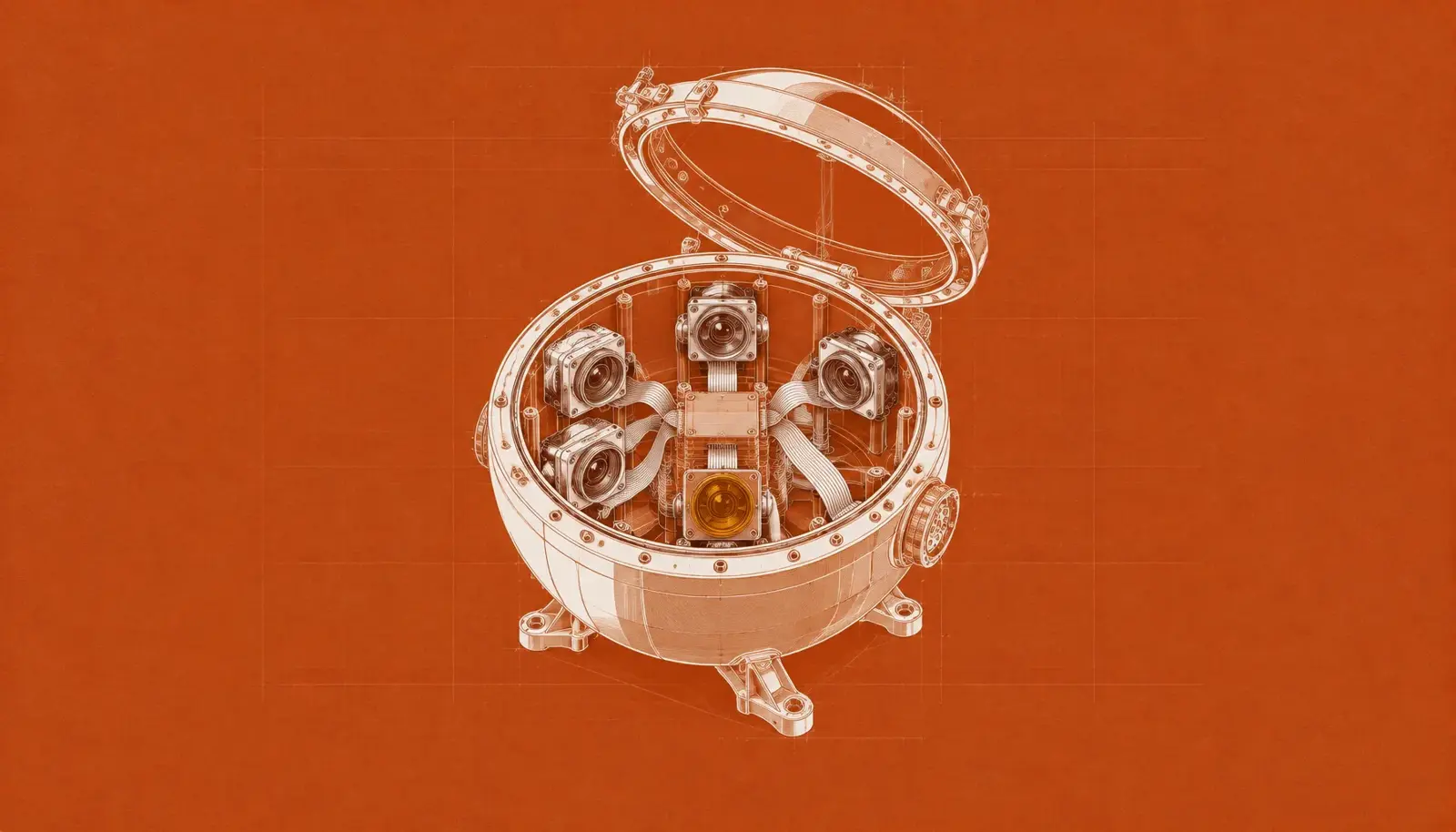
Luxonis announced the OAK 4 FFC on October 27 as a board-level vision computer that lets robot builders place up to five camera modules around a machine instead of fitting the machine around a fixed camera. The 70-by-53-millimeter board combines camera connections, depth processing and AI compute; the company lists a Developer Kit for $849.
The product targets robots with unusual camera layouts, including humanoids, drones and custom inspection systems. Its five flexible flat cable (FFC) ports connect directly to camera modules, while the board handles synchronization, calibration, stereo depth and neural-network inference. Luxonis says the system can run as a robot’s main computer or send processed perception results to a separate host.
Five camera positions, one synchronized rig
Builders can arrange a stereo pair for depth alongside additional views to the sides or rear. Luxonis proposes a humanoid head with forward-facing stereo cameras and peripheral views, or a drone carrying a stereo pair and additional cameras. Each module has factory-calibrated lens data; the company’s Dynamic Calibration software refines the camera alignment from features in the surrounding scene, rather than requiring a printed calibration target.
The company says the board can capture five synchronized streams and stitch overlapping views on-device into a panorama or bird’s-eye view. That processing can reduce the raw image data sent to a robot’s main computer. Camera modules are sold separately, and the product page lists supported options including 48-megapixel IMX586 color cameras and 5-megapixel OG05 global-shutter modules.
RVC4 compute and robot-facing connections
OAK 4 FFC is based on Luxonis’ RVC4 system-on-module, with a six-core ARM CPU, 8 GB of RAM and 128 GB of onboard storage. The product page advertises 52 TOPS overall; its detailed specifications break that down as 48 TOPS INT8 on the AI accelerator and 4 TOPS FP16 on the GPU. The board runs Linux-based Luxonis OS and supports DepthAI pipelines in Python and C++.
Connections include Ethernet up to 2.5 Gbps, USB-C up to 5 Gbps, CAN, SPI, I²C and UART, plus frame-sync and strobe signals. Power can come through a 6–32-volt DC input, USB-C power delivery or PoE+ with the relevant module. Those interfaces let a developer connect the vision board to a robot’s control system without routing every camera stream through a separate host first.
Kit and barebone have different delivery dates
The Developer Kit includes the carrier board and OAK 4 SoM, a PoE+ module, panel-mount connectors, passive heatsink, thermal interface material and mounting hardware. Luxonis lists it at $849. The barebone version is listed at $730 and 36 grams, with the customer supplying an enclosure and cooling; the product page schedules it for Q1 2027.
Availability language differs across the launch materials: Luxonis’ product page labels the Developer Kit “Ships now,” while the October 27 announcement says Developer Kit orders begin shipping in November. The launch announcement also puts barebone deliveries in Q1 2027 and says camera modules are sold separately, starting at $39.99. Buyers should check the current product listing for the specific configuration and delivery estimate.
“The machines our customers are building, from humanoids and drones to surgical and mobile robots, don’t have room for a camera designed for someone else’s machine. They kept asking for the same thing: let us choose the sensors and where they go, and you handle the hard parts underneath. With OAK Modular now on OAK 4, a team can design its vision system around its robot, instead of its robot around a camera.”
Bradley Dillon, CEO of Luxonis
A vision board that can also be the computer
Luxonis presents OAK 4 FFC in two roles: as a standalone computer running models and application logic, or as a perception unit that sends depth, detections and tracks to a Jetson or another host. That distinction matters for mobile robots where camera placement and onboard processing compete for space, power and bandwidth. The product page’s clearest near-term detail is the Developer Kit’s listed $849 price and “Ships now” status; its barebone counterpart remains slated for Q1 2027.
Sources
- Original source Luxonis luxonis.com
Other pages read
- Electronics Era electronicsera.in