The Floor
Maximo Robotics Logs 300,000 Solar Construction Tasks
Maximo Robotics’ systems have completed more than 300,000 construction tasks under performance-based contracts, the company says. Crews working with Max 4.0 systems delivered 2.5 times their manual installation rates per person per shift hour, the company also reports.
“The future of solar construction depends on bringing together the experience of our people and new technology,” said Matt Tetrault. “Close collaboration between our craft professionals, project leadership, and the Maximo team has allowed for the refinement and advancement of the technology in real time, turning field experience into practical improvements in installation performance, safety, and workflow integration.”
Matt Tetrault, President of Primoris' Renewables business
More than 300,000 construction tasks
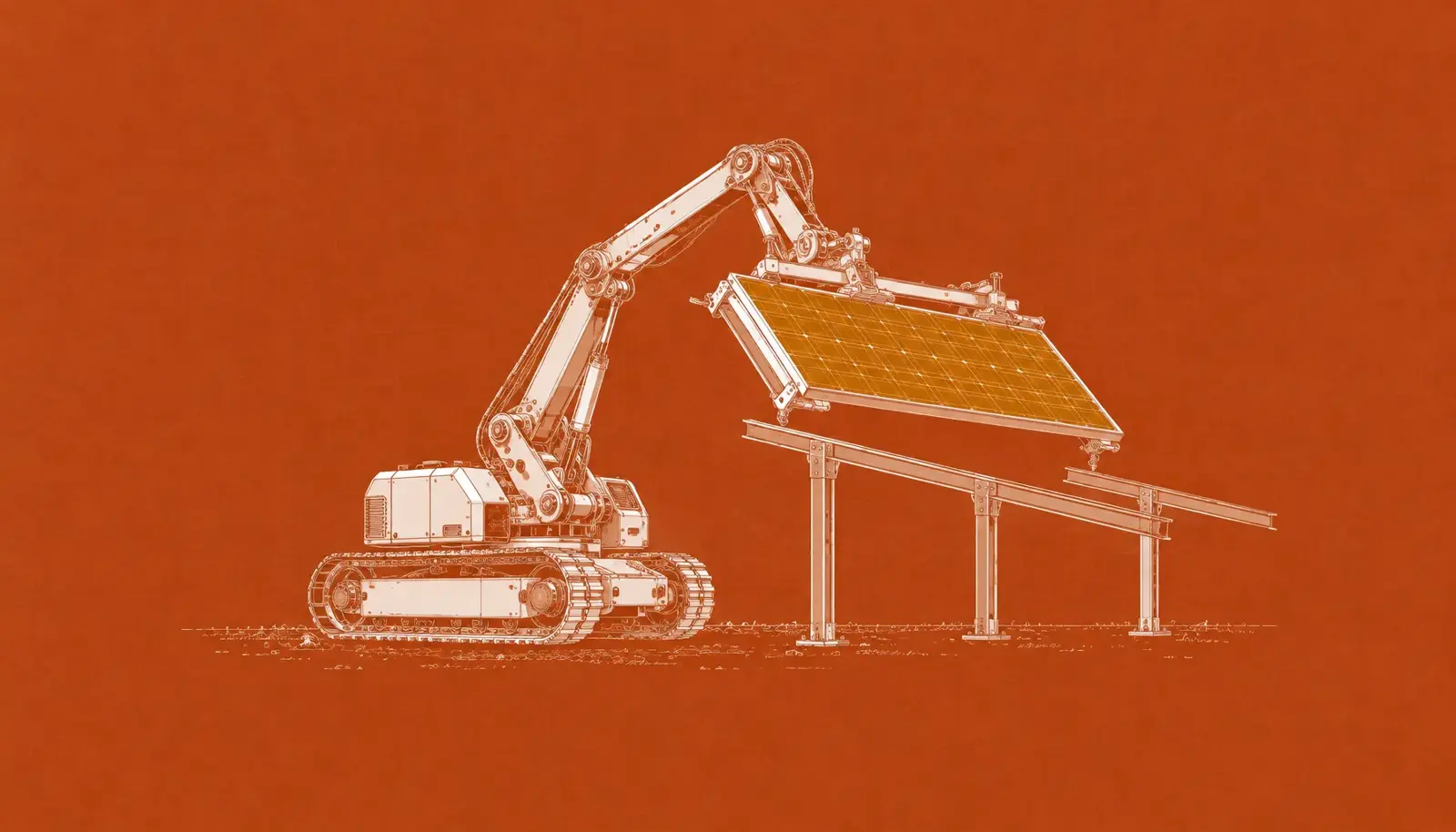
Maximo Robotics said on October 29 that its U.S.-made systems had completed more than 300,000 construction tasks under performance-based robotics-as-a-service contracts. The company works on utility-scale solar construction, where its systems autonomously place heavy solar modules. That placement is millimeter-precision work carried out alongside professional construction crews, Maximo says.
Projects involving six engineering, procurement and construction contractors span California, Illinois, Kansas, Louisiana, New York, Texas and Washington, the company said. The states describe the reach of current projects, not where the 300,000 tasks were completed. Maximo did not break down the task total by site, contractor or task type, or state how many modules it represents.
Primoris Services Corporation's Renewables business is one of the contractors working with Maximo. Primoris integrated the technology into field operations and helped refine how it fits into construction workflows, the company says. Tetrault's statement points to that site-level collaboration, rather than describing the robots as a stand-alone replacement for crews.
Max 4.0’s productivity claim
Crew members working alongside Max 4.0 systems have delivered 2.5 times their manual installation rates per person per shift hour, Maximo says. The company does not provide a site-by-site comparison, the underlying manual rate, or details of how it measured the difference in its announcement. The productivity figure is a company-reported result, not an independently documented benchmark in the release.
The company’s commercial model charges customers per completed task, tying its revenue to installation throughput. The completed work includes autonomous placement of solar modules; Maximo lists module attachment and field logistics as possible contract expansions. The announcement does not say those additional services account for any part of the 300,000-task figure.
Three parts make up the Max 4.0 platform
Max 4.0 is a combination of AI models, robotics hardware and operational software. Cortex supplies vision and planning models for construction tasks and mobility. Form is the family of robots and task-specific tooling, while IQ manages service performance, fleet information and operational feedback.
Completed tasks generate deployment data that feeds improvements to future work, the company says. Its late-stage pipeline for 2027 represents demand for an additional 3 million construction tasks and 1.5 gigawatts of solar installation, the company also says. Those are prospective volumes, not completed work; the release does not identify the projects behind that estimate or give a timetable for each deployment.
The reported total has a narrow definition
Maximo’s announcement marks a commercial deployment milestone, but the public figures leave comparison questions open. The release gives no task-count methodology, per-site output, pricing, service uptime or rework rate. Without those details, the 300,000 total establishes the scale the company reports, while the 2.5-times productivity figure is difficult for customers to compare with their own crew performance.
The announcement describes the work Maximo says its systems have already performed: autonomous placement of heavy utility-scale solar modules. Module attachment and field logistics are options for future contract expansion, beyond the reported task set.
Sources
- Original source · Press release PR Newswire prnewswire.com