The Floor
Researchers report doubled agent scale with path-planning search
A new planner handled up to 800 agents on one benchmark map, twice the scale reported for its rule-based component alone. The preprint evaluates agents of different sizes and action durations, with a 60-second limit per instance.
A path planner handled up to 800 agents on one benchmark map, twice the scale of its rule-based component alone, researchers report in a preprint. The planner, called LSRP*-LA, finds routes for agents that occupy different amounts of space and can move at different rates.
Dachuan Liu, Shizhe Zhao and Zhongqiang Ren of Shanghai Jiao Tong University submitted the paper to arXiv on November 25 and to IEEE Robotics and Automation Letters. Their evaluation used benchmark maps and computer-based planning instances rather than a reported robot deployment.
Planning for size and timing
Multi-agent path finding seeks routes from starting positions to goals without collisions while minimizing path costs. Many planners model each agent as occupying a single point and assume that all agents start and finish actions together, the paper says.
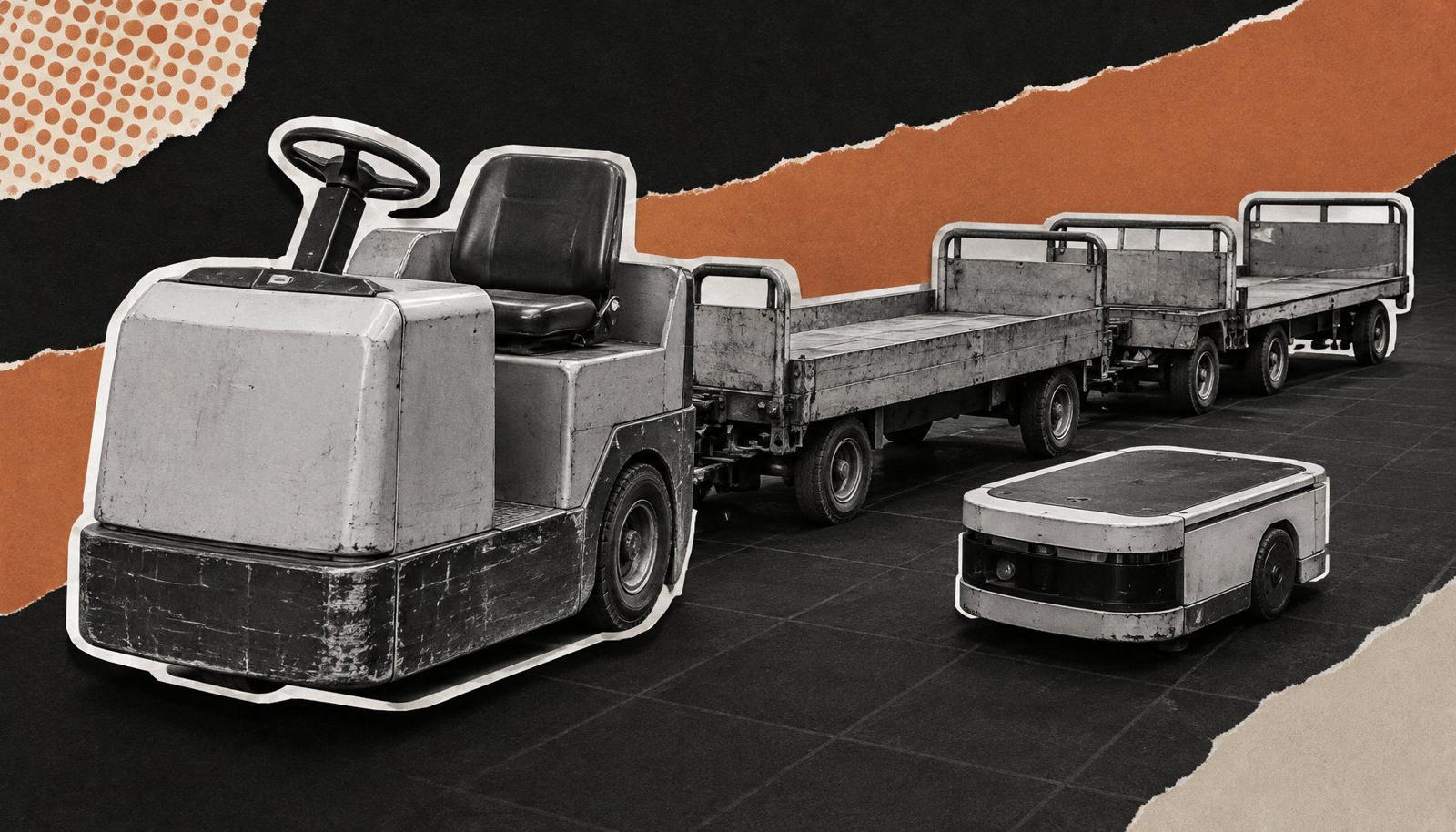
LSRP*-LA instead models agents that can occupy several grid cells and whose actions can have different durations. The authors use the example of tugger trains and smaller transport robots sharing a car plant: the machines take up different amounts of space and move at different speeds.
The new method builds on an earlier planner, LSRP*, which handles asynchronous actions but models agents as occupying single vertices. Its search continues to refine an initial solution while time remains, while a rule-based procedure assigns actions to agents left unplanned by the search.
How the planner clears a path
When a large agent's intended move is blocked, the procedure can plan moves for several agents in its way. A blocked agent may take a short sequence of moves, called an evacuation, to get clear; the larger agent waits until those moves are complete.
Before a queued action begins, the planner checks whether its swept area conflicts with another agent's footprint or swept area. If the check fails, the queued actions are discarded and the agent is planned again.
The paper's analysis states that the planner finds a solution for every solvable instance and returns an optimal solution if its search runs until the search stack is empty. The experiments, by contrast, imposed a fixed runtime limit.
Benchmark results and caveats
The experiments used a 60-second limit per instance and four benchmark maps, with 20 instances for each map and agent count. Square agents occupied one, four or nine cells, and their move durations were drawn from a range of one to five; after adjustments to starts and goals, about 65% were larger than a single cell.
On the den520d map, LSRP*-LA scaled to 800 agents, compared with 400 for its rule-based procedure without search, according to the results. On the maze and empty maps, it scaled to 250 and 300 agents respectively.
With the same 60-second limit, the full planner found solutions up to about 25% cheaper than its rule-based component alone. On small instances solved by an extended optimal planner, its solution costs were at most 2% higher, the paper reports.
The researchers also compared LSRP*-LA with synchronous planners given action durations of five. Its solution costs were about half theirs, but the paper cautions that the comparison favors LSRP*-LA because part of the gap comes from those durations alone. In a separate synchronous setting with all durations set to one, its average solution cost was never higher than those of the compared planners.
Sources
- Original source · Preprint LSRP*-LA: Scalable and Anytime Multi-Agent Path Finding for Large Agents with Asynchronous Actions arXiv:2611.33793
Related stories
- Turn-Aware Planner Solves Tested 1,000-Agent Warehouse Cases
- EMS-Nav uses functional regions to guide multi-scale robot navigation
- Researchers propose ASPIRE agent for system identification
- Robot memory model cuts planning latency in tests, researchers say
- Researchers present low-cost TAG testbed for coupled robot control