The Floor
Turn-Aware Planner Solves Tested 1,000-Agent Warehouse Cases
A new arXiv preprint reports a turn-aware planner solving every tested benchmark instance and warehouse-map case with up to 1,000 agents. In a flexible-manufacturing simulation, the authors report lower execution times than a planner that ignores turns, and they also demonstrate the method with three TurtleBot4 robots.
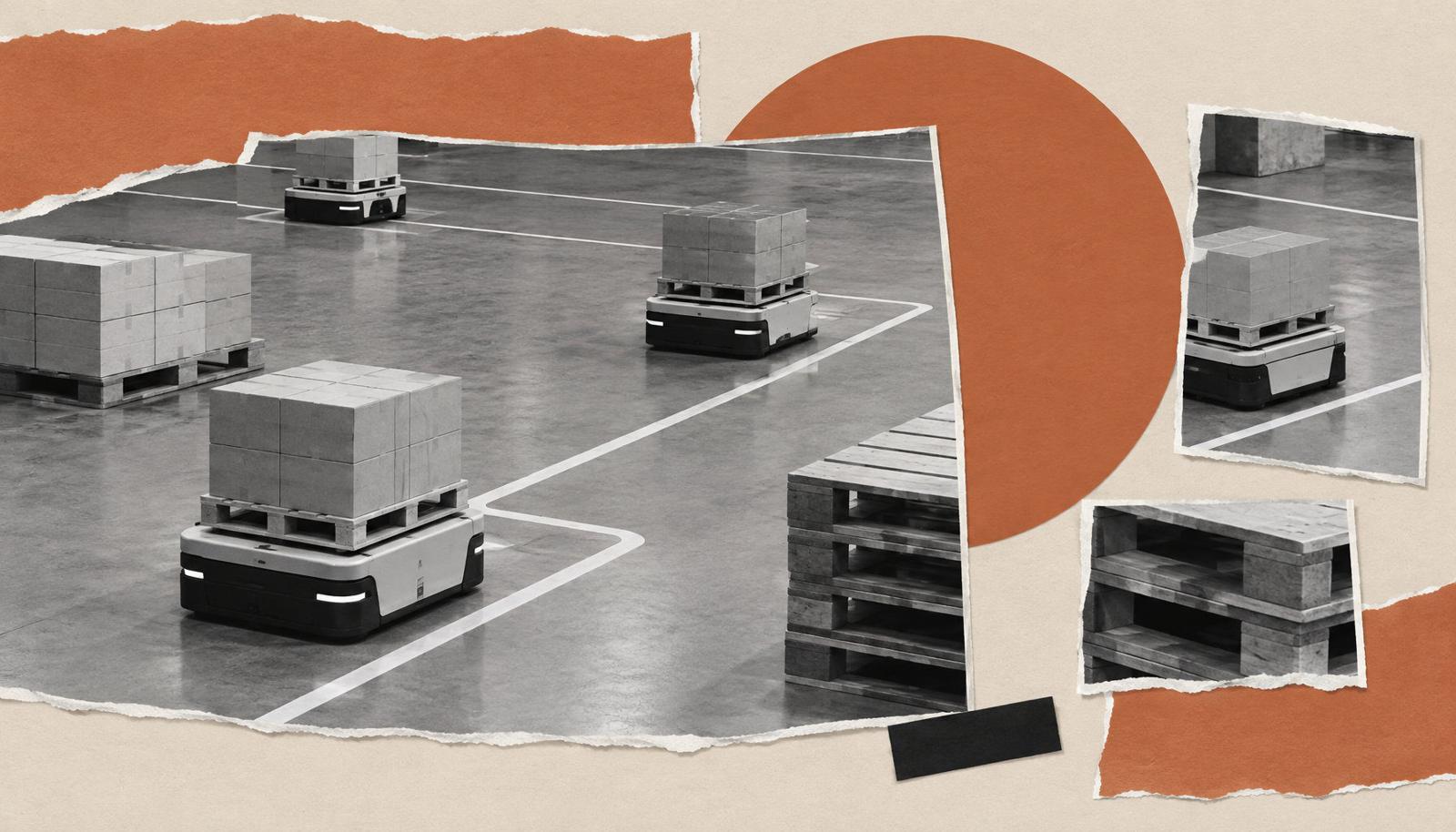
A planner for turns and traffic
A turn-aware planner solved all tested benchmark instances and warehouse-map cases with as many as 1,000 agents, according to a new arXiv preprint by Zheyu Tao, Chunlong Yu and Yicheng Hu. The paper, submitted to arXiv on November 18, 2026, describes a method called PIBT*_T for coordinating mobile robots while accounting for the time and dependencies introduced by turning.
The method builds on Priority Inheritance with Backtracking, or PIBT, which plans one joint movement step at a time. Rather than assuming a robot immediately vacates its current grid position when another robot requests it, PIBT*_T distinguishes a requested destination from the action the robot can take next. Depending on its orientation, that action may be moving forward, rotating in place or waiting.
Deadlocks and repeated pushing
The authors add two mechanisms to address coordination problems: a swap pattern detector, which identifies local blocking configurations and supports cooperative yielding, and a k-Push Escape Trigger, which uses interaction history to interrupt repeated pushing. The method also includes checks for circular chains of robot requests and a node-selection strategy that accounts for orientation and turn costs when ranking possible routes.
Tests covered five standard maps, with fleet sizes from five to 100 robots and 25 start-and-goal scenarios for each map and fleet size. The paper reports a 100% success rate across these benchmark instances for PIBT*_T; the comparison methods were the earlier turn-aware PIBT_T and CBS_T. For the larger stress test, the researchers used a warehouse map and increased the fleet from 50 to 1,000 agents. PIBT*_T solved all tested cases, with the 1,000-agent instances taking less than three seconds, while the earlier PIBT_T method’s success rate fell to 92% at that fleet size, the paper reports.
Simulated execution and robot test
The paper also compares turn-aware plans with classical PIBT plans in an Action Dependency Graph-based simulator that incorporates turns, acceleration, deceleration and inter-robot dependencies. In a separate flexible-manufacturing-system simulation, the map covered 44 by 48 meters and included parking and pickup/drop-off areas connected by wide corridors and single-lane branches. Across ten simulated task instances, PIBT*_T had higher theoretical planning makespan but lower simulated execution makespan in every case; the authors report average reductions of 23.3% for 10-agent instances and 20.2% for 20-agent instances.
A physical demonstration used three TurtleBot4 robots—two Lite models and one Standard—on a 6-by-6 grid with obstacles. The authors compared classical PIBT paired with an execution controller against PIBT*_T paired with the same controller. In the first setup, two robots became deadlocked about five seconds after execution began; in the turn-aware setup, all three reached their goals, with one arriving at 32 seconds and the other two at about 36 seconds, according to the paper.
Limits stated in the paper
The authors describe PIBT*_T as a heuristic and say it does not yet provide formal completeness or optimality guarantees. They identify stronger theoretical guarantees and extensions for dynamic tasks, uncertain execution times and online disturbances as future research directions.
Sources
- Original source · Preprint Scalable Iterative Multi-Agent Path Finding under Turn Constraints arXiv:2611.23911