The Floor
3DTouch preprint reports 42-point gain in manipulation success
A preprint reports that 3DTouch raised average success by 42 percentage points over a corresponding vision-language-action baseline across five real-world manipulation tasks. The system combines RGB-D scene geometry, five-finger tactile readings and explicit geometric relations between hands and objects.
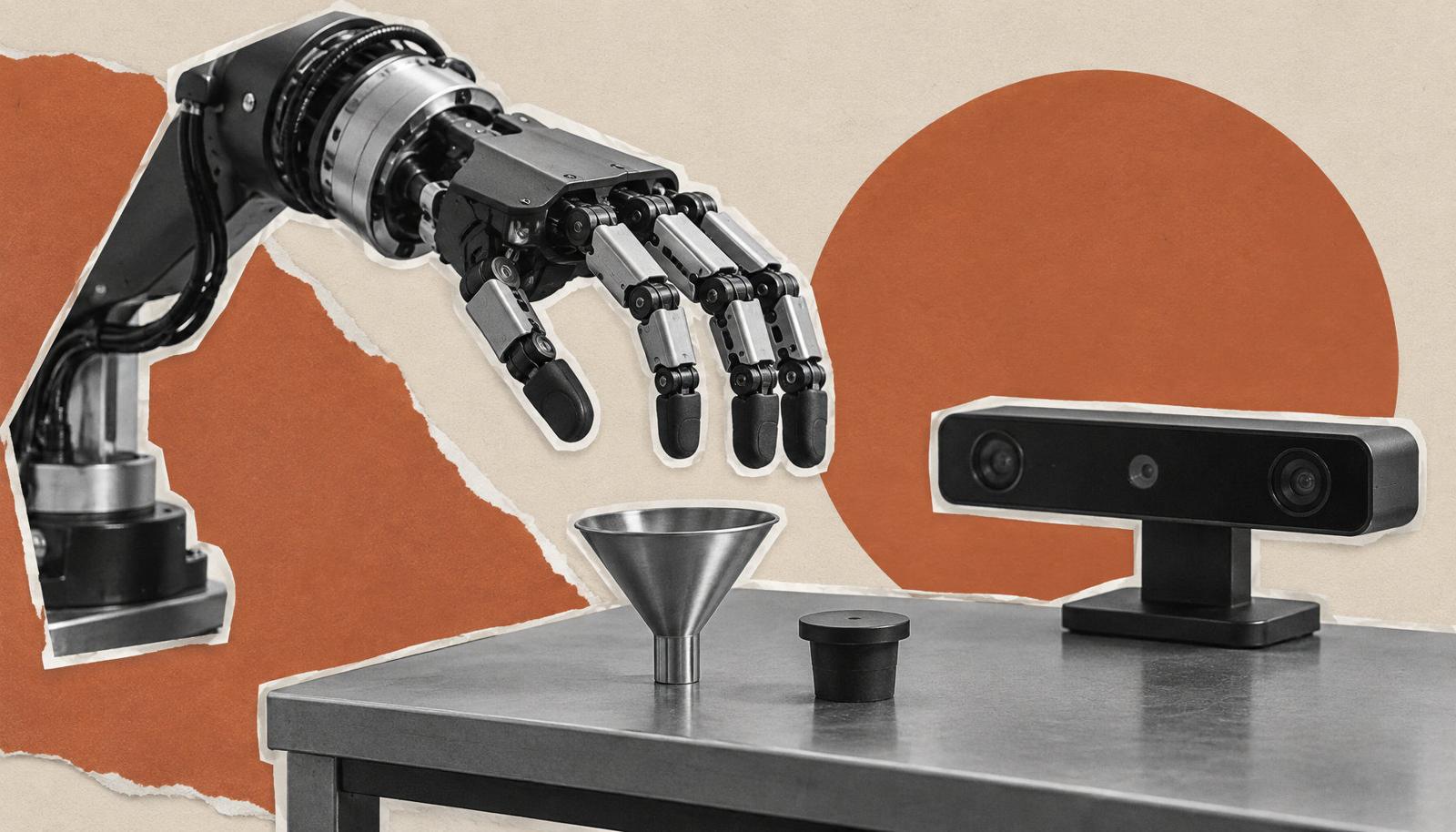
A tactile-aware manipulation model recorded an average task-success rate 42 percentage points higher than a corresponding vision-language-action baseline, according to a preprint by the 3DTouch authors. The paper, submitted to arXiv on November 18, also reports a 20-percentage-point advantage over the strongest evaluated alternative across five real-world dexterous-manipulation tasks.
Touch and geometry in one policy
3DTouch adds tactile and geometric inputs to a pretrained vision-language-action model. It represents RGB-D scene points and tactile measurements from all five fingers in the robot’s base coordinate frame, retaining each sensor element’s location and force vector. The model also encodes geometric relationships between hand landmarks and object surfaces, and between pairs of objects.
The researchers tested the system on a UR7e robot arm fitted with an XHand dexterous hand. The hand has 120 three-dimensional force-sensing taxels per finger. The model processes 4,096 sampled points from RGB-D scene data alongside tactile readings, then supplies scene, touch and geometric-relation representations to the model’s action expert.
Five real-world tasks
The tasks covered funnel insertion, plug assembly, button pressing, sponge wiping and pipette pressing. The paper describes inserting a funnel into a flask, aligning and inserting a plug into its socket, pressing a button followed by a transfer operation, wiping marks from a whiteboard with a sponge, and removing a pipette from its holder before pressing its plunger.
The researchers collected approximately 100 real-robot demonstrations for each task. They evaluated each method over 20 real-robot trials per task, counting a trial as successful only when the complete task objective was achieved. The reported average is an unweighted mean across the five tasks.
Reported results and comparisons
The authors report a 65% average success rate for 3DTouch. Its task-level success rates were 35% for funnel insertion, 60% for plug assembly, 80% for button press, 90% for sponge wiping and 60% for pipette press. The strongest baseline on average, Tactile-VLA, scored 45%; the paper says 3DTouch’s average was 20 percentage points higher.
For a separate robustness test, the team varied target poses in funnel insertion and plug assembly, testing translation, rotation and combined changes. Across the two tasks and three perturbation settings, the paper reports that 3DTouch’s success rate fell by 5.0 percentage points from the unperturbed setting, compared with 13.3 points for the tactile-augmented vision-language-action baseline.
Ablation tests removed or changed parts of the system to examine their contribution. The paper reports that robot-base-frame tactile encoding improved average success by 11 percentage points over hand-local tactile encoding, while removing geometric relations lowered the full model’s average by 12 points. These results are from the authors’ reported real-robot evaluations.
Sources
- Original source · Preprint 3DTouch: A Tactile-aware VLA Model with 3D Geometric Relations for Dexterous Manipulation arXiv:2611.23961
Related stories
- Study finds action-expert tuning best steers VLA hand policies
- CoRA-VTLA preprint adds tactile memory to robot manipulation
- TacPilot paper reports 56.4% fewer tactile regions encoded
- Preprint outlines Geo-Force limits for geometry-based force sensing
- TacHOI reports lower object-tracking error using touch and video