The Floor
Preprint outlines Geo-Force limits for geometry-based force sensing
A preprint proposes estimating contact forces from object geometry seen by a depth sensor, using a virtual touch-sensing pipeline. It also identifies object stiffness as a limit and says experiments remain for future work.
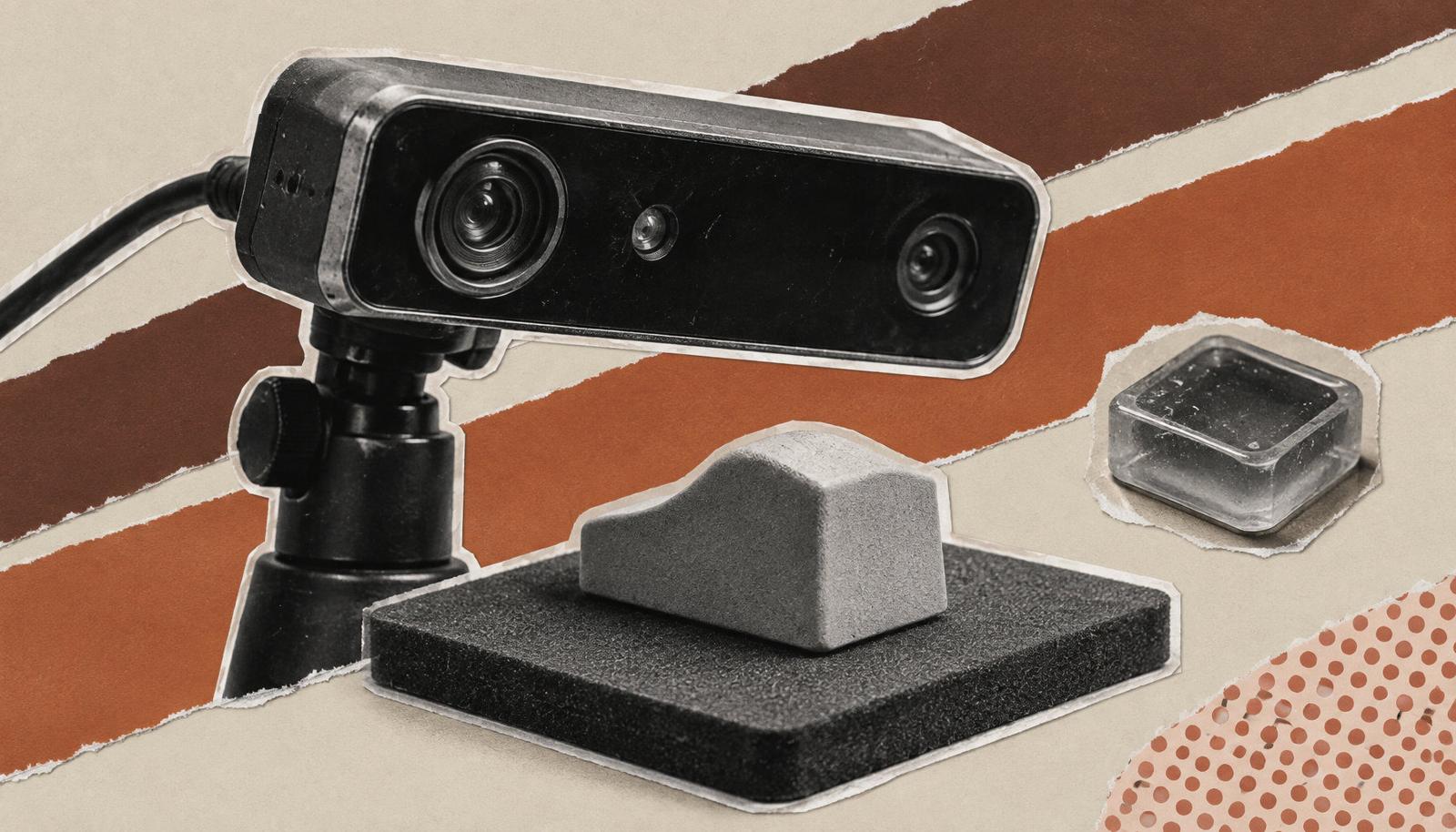
A geometry-based virtual touch sensor
A theoretical framework turns depth-camera measurements into estimated contact forces at the sensing surface, according to a preprint by Abdullah Ayad. Submitted to arXiv on November 20, 2026, the paper defines a quantity called Geometric Force for a virtual touch sensor that keeps the physical sensing surface but replaces the electronics that read it with a predicted touch signal.
The proposed computation has three stages: render the object surface as seen from the virtual sensor, predict a touch signal from that depth patch, then estimate force from the signal. The framework uses a reference depth measurement taken before contact, a second measurement at the force-estimation moment, and the poses of the depth and touch sensors.
What the framework claims
The paper says the estimated force vectors rotate with a change in coordinate frame and, for a contact-gated touch map, vanish when the rendered surface is not in contact with the virtual sensor. It also derives stability bounds: for Lipschitz touch and force maps, estimation error grows at most linearly with errors in the rendering, touch-prediction and force-estimation steps.
Rendering error depends on the quality of surface sampling or reconstruction and the accuracy of the sensor’s placement, according to the preprint. One proposed route is to reconstruct the object while it is visible, track its movement, and render the estimated surface from the touch sensor’s viewpoint after the contact area is obscured.
Stiffness remains unknown
Geometry alone cannot distinguish objects with the same shape but different stiffness, the paper says; those objects can produce different real touch signals. Under the paper’s elastic contact model, object-specific information therefore resides in the map that predicts touch, while the force-estimation map depends on the sensor.
The preprint says a depth sensor needs point spacing finer than the surface detail being measured, with depth noise well below the gel indentation. It also sets conditions for the objects: they should retain their shape until contact, have no sharp edges, and be much stiffer than the gel or all about equally stiff.
Scope and status
The analysis is quasi-static and considers normal force, not friction or shear. It does not model contact history, gel hysteresis or deforming objects, and it takes the error of shape completion as given rather than analyzing how well that reconstruction works.
The paper presents a theoretical analysis, not a validated robot demonstration, and says experiments testing its results are left to future work. Its bounds apply only when the stated assumptions hold.
Sources
- Original source · Preprint Geo-Force: A Theory of Force Sensing from Object Geometry arXiv:2611.26992
Related stories
- FORTH preprint pairs robot learning losses with force measurements
- TacHOI reports lower object-tracking error using touch and video
- Preprint models a capacitive fingertip for approach and contact
- BeyondEgo raises humanoid task success in simulation, preprint says
- FoRe preprint reports gains in robot grasp recovery