The Floor
Preprint models a capacitive fingertip for approach and contact
A preprint models a fingertip sensor that uses capacitive electrodes to detect approaching conductive objects and contact force. Its finite-element results are simulations, not measurements from a tested prototype.
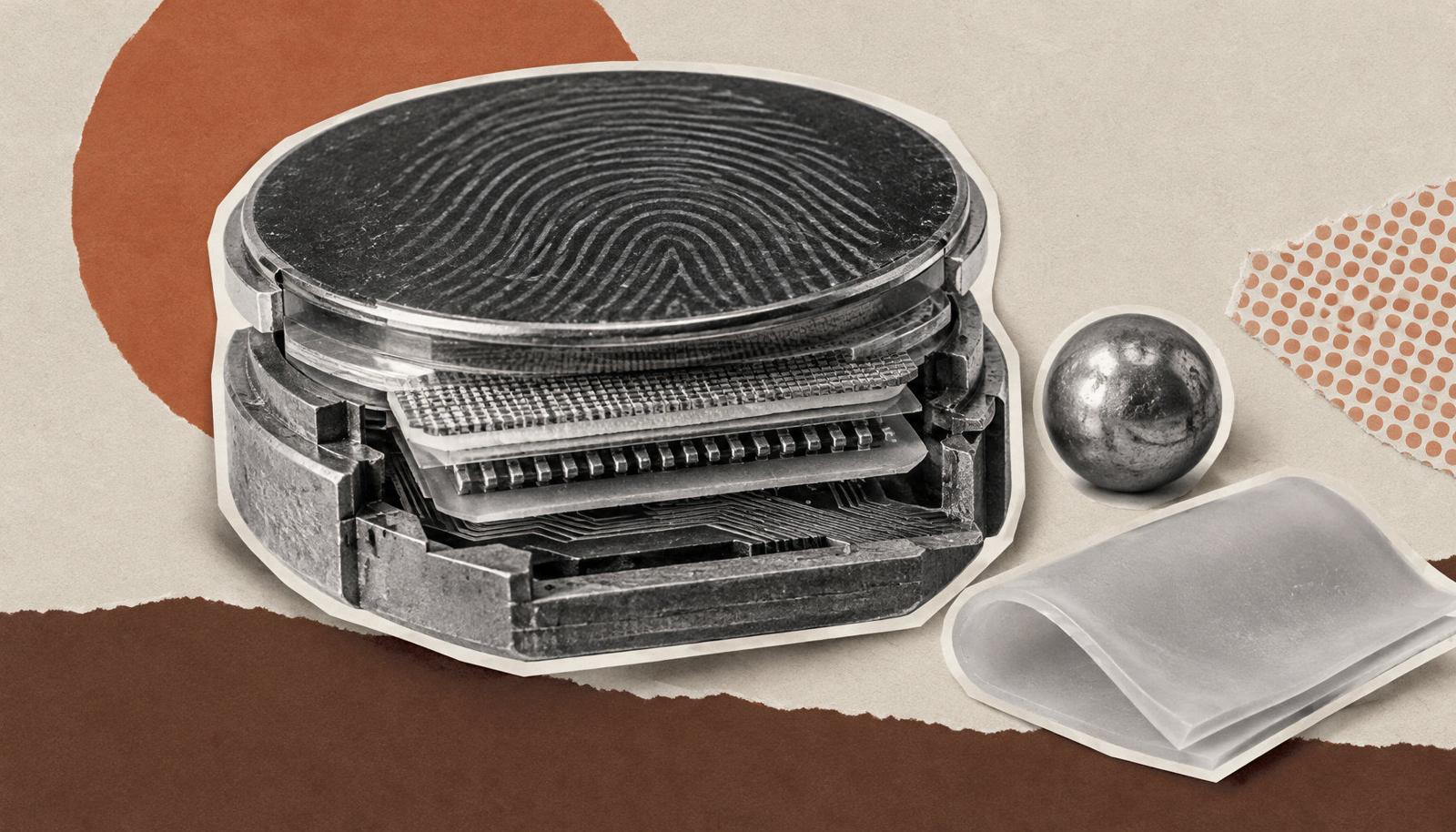
One array, two sensing regimes
A capacitive fingertip design models how one set of electrodes could sense a conductive object approaching and then measure compression after contact, according to a preprint by Shun Cheng posted on November 20, 2026. The analysis focuses on a sensor mounted over a metal finger segment, or phalanx, beneath a thin silicone skin.
Source arxiv.org
Before contact, the electrodes detect changes in fringing electric fields as a conductive target approaches. Once the skin is compressed, changes in capacitance instead reflect compression of a silicone layer between electrode arrays. The paper treats those as separate measurement regimes, with different electrode connections and observation models.
Shielding the finger’s metal structure
The metal support creates a large parasitic capacitance between the electrodes and the robot body. The paper estimates that this background can exceed the useful signal from an approaching object by one to three orders of magnitude, making a driven shield important to the design. The shield is driven at the electrode’s potential so that current flowing between them does not dominate the measurement.
The analyzed stack has two 4-by-4 electrode arrays, with 1.4-millimeter pads on a 2-millimeter pitch. In the proposed contact mode, the outer array is grounded to act as a Faraday screen, while the inner array measures compression of the silicone gap. In proximity mode, the outer array senses outward while the inner array acts as a shield; a third mode compares neighboring electrodes to estimate lateral position.
Simulation results and limits
Electrostatic finite-element simulations produced a monotonic but nonlinear contact response: the modeled capacitance change ranged from 4.6 femtofarads at 0.05 millimeters of compression to 370 femtofarads at 0.5 millimeters, against a 1.08-picofarad base. The simulation also found a nylon-versus-metal probe difference of at most 0.3 femtofarads at the exported matrix’s print resolution, and electrical crosstalk of about 1 femtofarad at the current coarse mesh’s convergence level.
For proximity sensing, the model gives a 15.9-femtofarad signal increment as a target approaches from 20 millimeters to 5 millimeters. The paper says a mismatch in the driven-shield circuit can leak a comparable signal into the measurement: at a mismatch of about 10^-2, the modeled leakage equals that increment. It identifies tight control of gain and phase mismatch as a design constraint, rather than reporting a measured circuit result.
Prototype work remains
The reported figures come from electrostatic simulations, not tests on a physical fingertip. The paper says its contact-force map, mechanical crosstalk and bench measurements remain unvalidated; its model also treats the outer contact screen as an ideal continuous conductor, rather than accounting for gaps and finite ground-return impedance in a real array.
Cheng presents the equations and simulation results as a baseline for prototype calibration, not as measured performance claims. The analysis also leaves unresolved how the sensor’s force readings would map to actual force and how the complete system would perform on hardware.
Sources
- Original source · Preprint Mechanistic Analysis of Unified Proximity-Tactile Observation by a Capacitive Fingertip Array Constrained by a Metal Phalanx arXiv:2611.26950
Related stories
- FORTH preprint pairs robot learning losses with force measurements
- Preprint outlines Geo-Force limits for geometry-based force sensing
- 3DTouch preprint reports 42-point gain in manipulation success
- CoRA-VTLA preprint adds tactile memory to robot manipulation
- Preprint details LuxTac's thin optical array for three-axis touch