The Floor
CoRA-VTLA preprint adds tactile memory to robot manipulation
A new preprint describes CoRA-VTLA, which combines recent tactile responses with visual attention directed toward fingertip contact regions. Its authors report improved task success in simulation, a public benchmark and three real-robot tasks.
A tactile memory for post-contact corrections
A new arXiv preprint describes CoRA-VTLA, a method for adding tactile sensing to pretrained vision-language-action (VLA) models used in precision manipulation. The authors, Chengye Song, Rui Song, Shengqi Wang, Jiawei Zhang, Hongzhou Wang, Xueyang Guo and Yang Liu, submitted the paper on November 18, 2026. They report a mean success rate of 73.33% across three simulated tasks, compared with 50% for direct tactile fusion using the same sensor inputs.
CoRA-VTLA combines two components. Its queryable action-response memory stores recent changes in contact measurements and retrieves responses based on the robot’s current contact and state, giving the action model a history to use alongside immediate tactile feedback. A separate contact-guided gaze objective directs a tactile semantic token’s visual attention toward image regions corresponding to fingertip contact.
Tests in simulation and on a benchmark
The paper evaluates the method on nail insertion, plug insertion and knob operation in MuJoCo. Demonstrations include both ordinary task execution and recovery from blocked interactions; the simulated sensors provide fingertip pressure arrays and wrist force and torque. The researchers evaluated each policy on 50 unseen scenes per task, for 150 trials overall.
CoRA-VTLA succeeded in 110 of 150 trials, the paper reports. Its success rates were 78% for nail insertion, 76% for plug insertion and 66% for knob operation. Direct tactile fusion scored 50% on average, while the adapted FTP-π0.5 comparison method scored 44%; that method did better on the knob task, with a 72% success rate. The paper also records four safety failures for CoRA-VTLA, all on nail insertion, and 36 timeouts.
For a separate evaluation, the researchers adapted the memory design to Insert Tube, an optical-tactile task in the public UniVTAC benchmark. The paper reports 67% success across 100 fixed scenes, versus 51% for direct fusion and 46% for the base model. This test used optical tactile images rather than the pressure arrays and wrist force/torque used in the MuJoCo experiments.
Real-robot evaluation
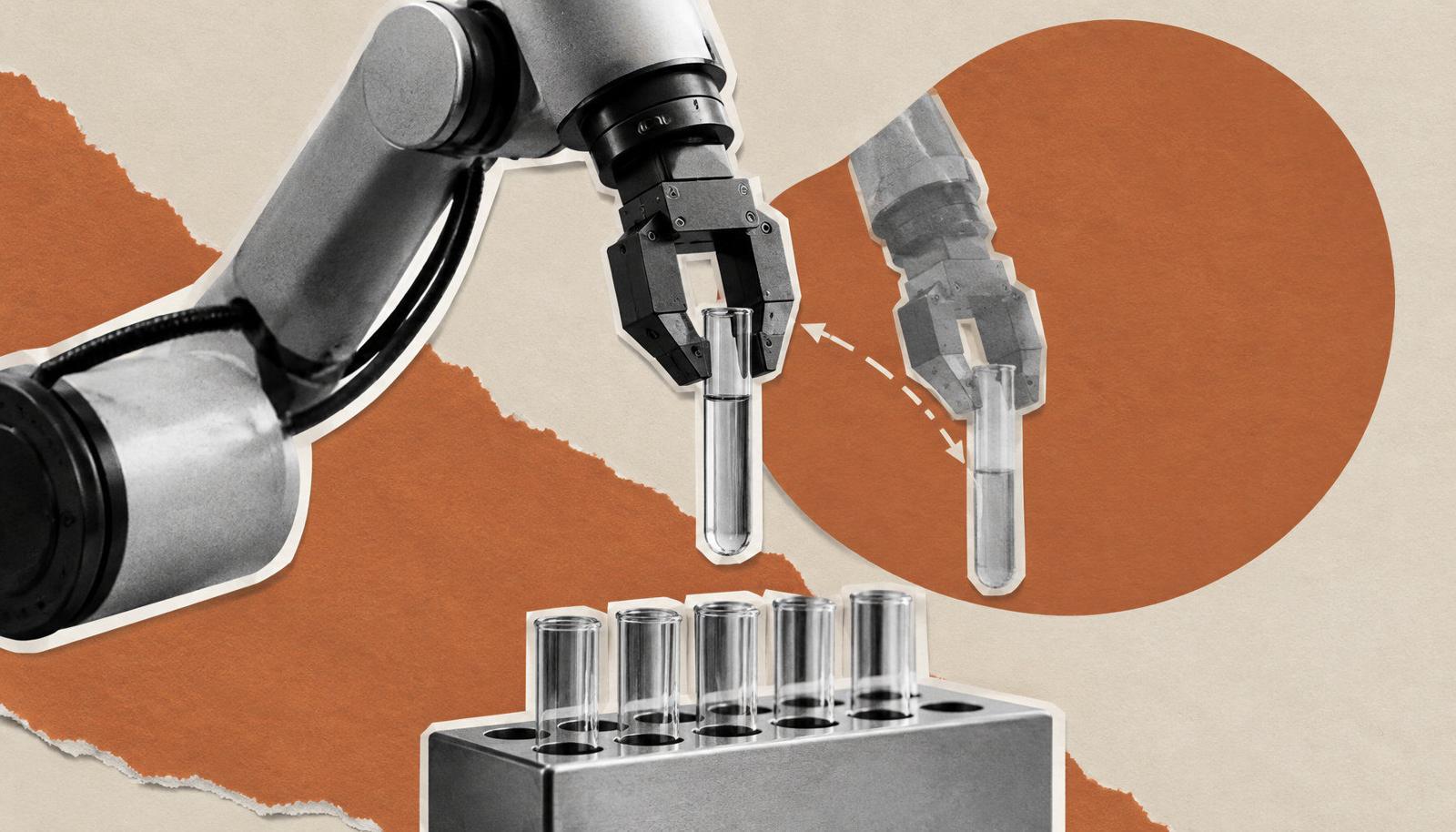
The real-robot platform used a UR5e arm and a Robotiq 140 gripper with Xuanya electronic skin on both fingertips. The three tasks were stacking soft paper cups, stamping on paper and inserting a test tube into a rack; each method was tested in 50 trials per task. In the tube task, the paper describes recovery after the tube catches on the rim: the robot backs off, realigns and tries the insertion again.
The authors report a 66.7% average success rate across the real-robot tasks, compared with 44.7% for the strongest baseline in their table. CoRA-VTLA’s task rates were 68% for cup stacking, 76% for stamping and 56% for tube insertion. In an ablation of the simulated tasks, removing the memory token lowered average success from 73.33% to 54%; removing gaze supervision produced a 49.33% average.
Sources
- Original source · Preprint CoRA-VTLA: Contact-Guided Attention and Queryable Response Memory for Tactile Post-Training arXiv:2611.23963