The Floor
Multiply Labs Raises $75 Million for Drug-Manufacturing Robots
Multiply Labs announced a $75 million Series B on October 6, led by Dr. Patrick Soon-Shiong with NantWorks. Its robotic clusters automate biologics manufacturing, and the San Francisco company will use the funding to expand capacity, develop products and grow its teams.
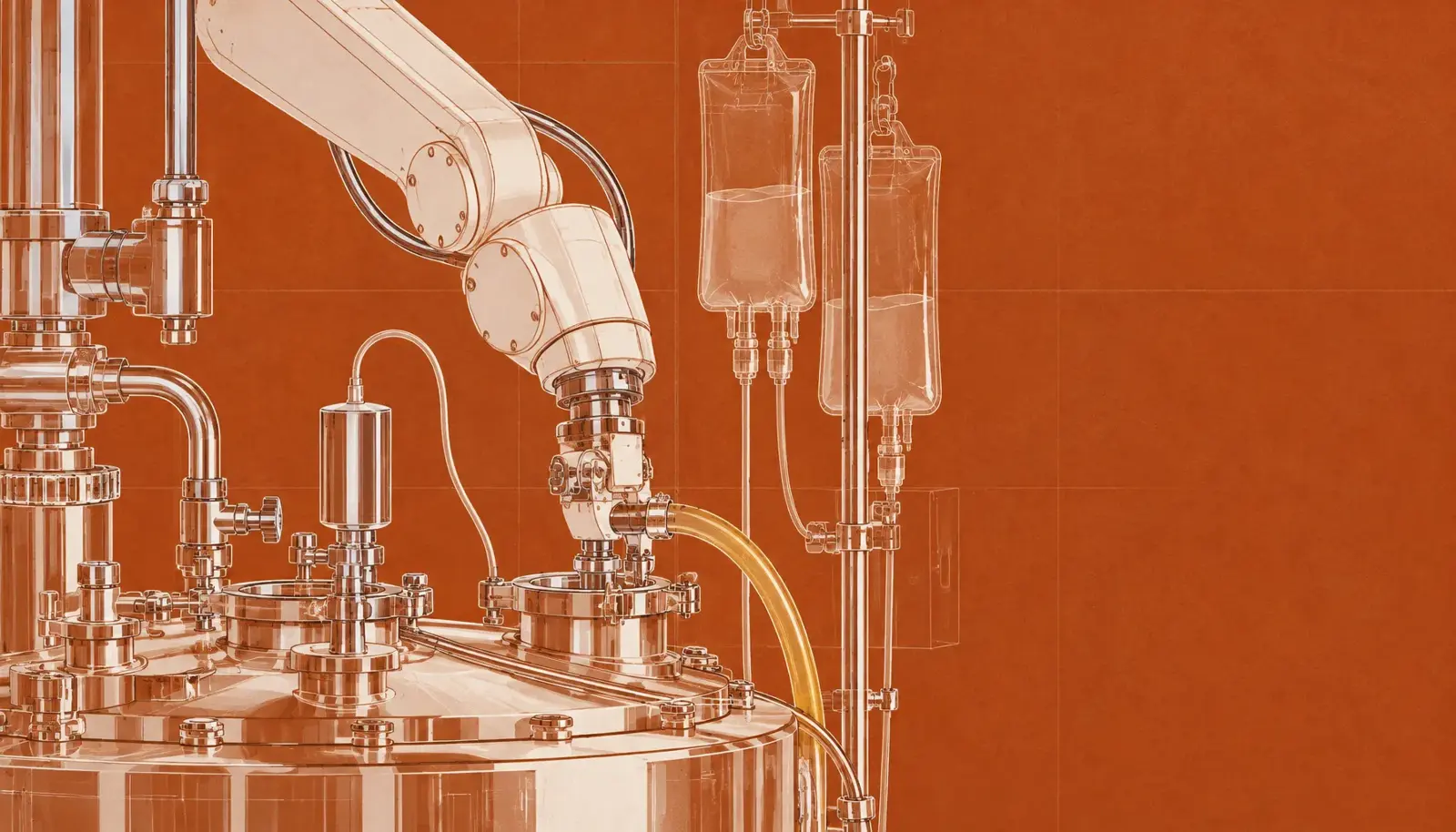
Multiply Labs says its robotic manufacturing clusters can deliver up to 100 times the throughput of manual production and cut cost per dose by 74%. The San Francisco company announced a $75 million Series B on October 6, saying it will use the capital to expand manufacturing capacity and prepare its systems for commercial-scale production.
Investors back a factory-floor approach to biologics
Dr. Patrick Soon-Shiong, through NantWorks, led the round. New investors include AstraZeneca, Lingotto, Teradyne and Strange Ventures; returning investors include Casdin Capital, Lux Capital, Fifty Years, Ora Global and Founders Fund. The financing brings Multiply Labs’ total capital raised to more than $100 million since its founding in 2016, the company said.
The investor mix includes a drugmaker and Teradyne, whose businesses span biopharmaceuticals and industrial technology. Pharmaceutical and biologics companies own and operate Multiply Labs’ clusters themselves, rather than hiring the startup as an outsourced manufacturing service. That arrangement gives the customer direct control of production capacity, according to the company.
“Robotics is the only way to deliver these therapies to patients at scale. AI is designing more therapies than the industry will ever be able to manufacture. This funding lets us build the capacity to close that gap, so more of the patients who need these treatments can actually get them.”
Fred Parietti, Co-Founder & CEO, Multiply Labs
Robotic clusters fit around existing instruments
Multiply Labs describes its clusters as enclosed, good-manufacturing-practice-compliant systems that integrate with manufacturers’ existing instruments and processes. They automate timed, repetitive steps in biologics production without requiring a new facility or changes to already-validated practices, the company says. The system runs continuously and adapts, aiming to remove manual handoffs between process steps.
The platform began with cell and gene therapy manufacturing and is expanding to antibodies, viral vectors and mRNA therapies, according to the announcement. These are different kinds of biologic medicines, but the company’s stated approach is to automate processes around existing manufacturing equipment rather than replace an entire production site. That distinction puts the product in customers’ facilities, where production workflows and validated procedures already exist.
The performance figures need more context
The claimed 74% cost-per-dose reduction and throughput of up to 100 times manual manufacturing are the release’s most specific performance figures. Multiply Labs does not describe the comparison baseline, the therapies or processes used to calculate them, or how broadly the results apply. The announcement also does not quantify the number of installed systems or doses produced.
Those details matter because manufacturing performance can depend on the therapy, process and facility. The company’s claims signal the potential it sees in automating repetitive tasks, but the release does not provide enough information to compare those figures across products or deployments. Its claims should therefore be read as company-reported performance, not as a universal result for biologics manufacturing.
Capital targets capacity and commercial readiness
Multiply Labs plans to put the funding toward manufacturing capacity, its product roadmap, and hiring across engineering, regulatory and commercial functions. The company describes the spending as preparation for a shift from clinical-stage deployments to commercial-scale production. It does not give a timetable, hiring targets or a breakdown of how much of the round will go to each area.
The immediate test is whether the systems can move from automating individual manufacturing steps to supporting repeatable production at commercial scale. Multiply Labs’ announcement sets out that ambition and its intended spending, but leaves open the deployment count, performance methodology and timing. For now, the company’s headline benchmarks remain 74% lower cost per dose and up to 100 times the throughput of manual manufacturing, figures it has not detailed further in the release.
Sources
- Original source · Press release Multiply Labs multiplylabs.com
Related stories
- Mecka Raises $60M to Scale Human Data for Robot Learning
- Lockheed Martin Leads Fortem's $50M Round to Expand SkyDome Counter-Drone Production
- Meta Builds Fourier Humanoid and Starts a Second Version
- Researchers Present LumiTac, a Six-Axis Sensor With a 12 mm-Diameter Sensing Head
- Preprint adds data-aware state exploration to SkiNet-Sim