The Floor
One RL Policy Flies a Payload Drone Across Four Conditions
A study published in Scientific Reports on October 26 tests one reinforcement-learning policy on a Crazyflie 2.1 carrying a suspended payload. The drone flew different paths and speeds and faced crosswinds, while results showed higher tracking error under harder conditions.
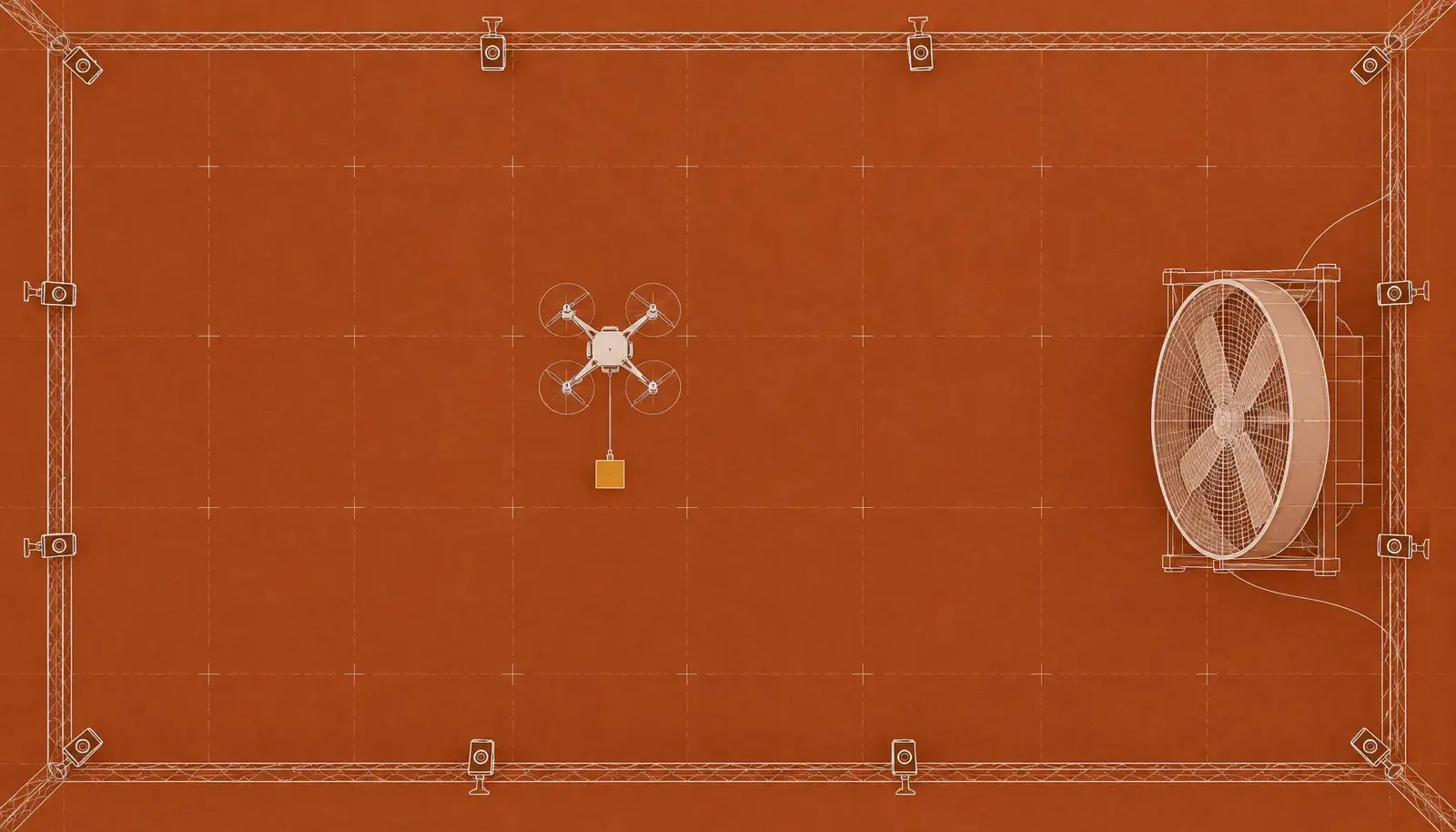
One controller, four flight tests
A single reinforcement-learning policy handled four flight conditions in real-world tests, but its tracking error rose as the demands increased. The study, published in Scientific Reports on October 26, used a Crazyflie 2.1 quadrotor carrying a 5-gram payload on a 0.3-meter cable. The researchers tested a slow figure-eight path, a sharp-turning pentagram, a higher speed setting and crosswind.
The authors write: “The single RL policy successfully generalizes to different trajectory profiles and velocity references and maintains stability under a crosswind disturbance of up to 1.0 m s−1.” Their result demonstrates that one trained controller can transfer across these tested conditions without manual retuning. It does not show that tracking quality stayed constant across them.
“The single RL policy successfully generalizes to different trajectory profiles and velocity references and maintains stability under a crosswind disturbance of up to 1.0 m s−1.”
Ali Tahir Karasahin, Ziniu Wu and Basaran Bahadir Kocer, Scientific Reports
Simulation training, then physical flight
The team trained the policy with proximal policy optimization in the SimpleFlight framework, using the Isaac Sim physics simulator. Its reward function focused on the suspended payload’s position relative to the target, rather than directly constraining the quadrotor’s position. The authors say that design lets the policy learn how to position the aircraft to move the load along its path.
The trained policy went directly to the real aircraft without an intervening simulation-based evaluation. The team ran 20 flights: five trials in each of four configurations. A VICON motion-capture system recorded the aircraft and payload positions at 100 hertz while the vehicle held a reference altitude of one meter.
Sharp turns and wind expose the limits
The baseline test used a slow lemniscate, or figure-eight, with no wind. Its mean Euclidean distance error for the payload was 0.107 meters. On the pentagram path, whose sharp transitions make it harder to follow, that error rose to 0.136 meters. The policy completed the unfamiliar path without being retuned, but the gap shows that generalization did not erase the added tracking challenge.
At the higher speed setting, the researchers observed further tracking degradation, which they link to greater aerodynamic drag and actuator saturation. In the wind condition, a stationary industrial fan created airflow that varied across the flight path. The payload cable sometimes went slack, shifting the system’s dynamics, yet the paper reports that the aircraft completed the experiments without a crash.
The wind also brought a marked rise in payload swing rate: the reported root-mean-square rate reached 182.38 degrees per second, compared with 25.22 degrees per second in the baseline. The study therefore distinguishes keeping the flight stable from keeping the suspended load’s motion small. For payload delivery, that difference matters: a flying vehicle can remain aloft while its load swings enough to compromise a precise placement.
Five trials per condition leave a narrow test base
Each condition had five trials, and the authors identify that sample size as a practical constraint of physical flight testing. The results characterize a single Crazyflie and one payload setup; they do not establish how the policy performs with other aircraft, heavier loads or more severe wind. The paper also calls for work to improve higher-speed performance and adapt the trained policy to different aerial robots.
For now, the strongest evidence is specific: one policy trained in simulation flew a 5-gram suspended load through four real-world test configurations, including a path absent from training and crosswind up to 1.0 meter per second. Its lowest reported tracking error was 10.7 centimeters on the baseline figure-eight; on the sharp-turning pentagram, it was 13.6 centimeters.
Sources
- Original source · Paper Scientific Reports nature.com