The Floor
Researchers Report uni-robot-agent Harness Reaching 25% Success on RoboDojo With an Open Qwen Model
The authors introduce uni-robot-agent, a unified and modular harness for robot use without privileged inputs that unifies interaction records across environments and supports efficient experience collection for open models. On RoboDojo, Qwen3.8-Flash-Next reaches 31.39 Score and a 25.00% success rate; on physical robots, Qwen achieves a zero-shot Score of 53.50.
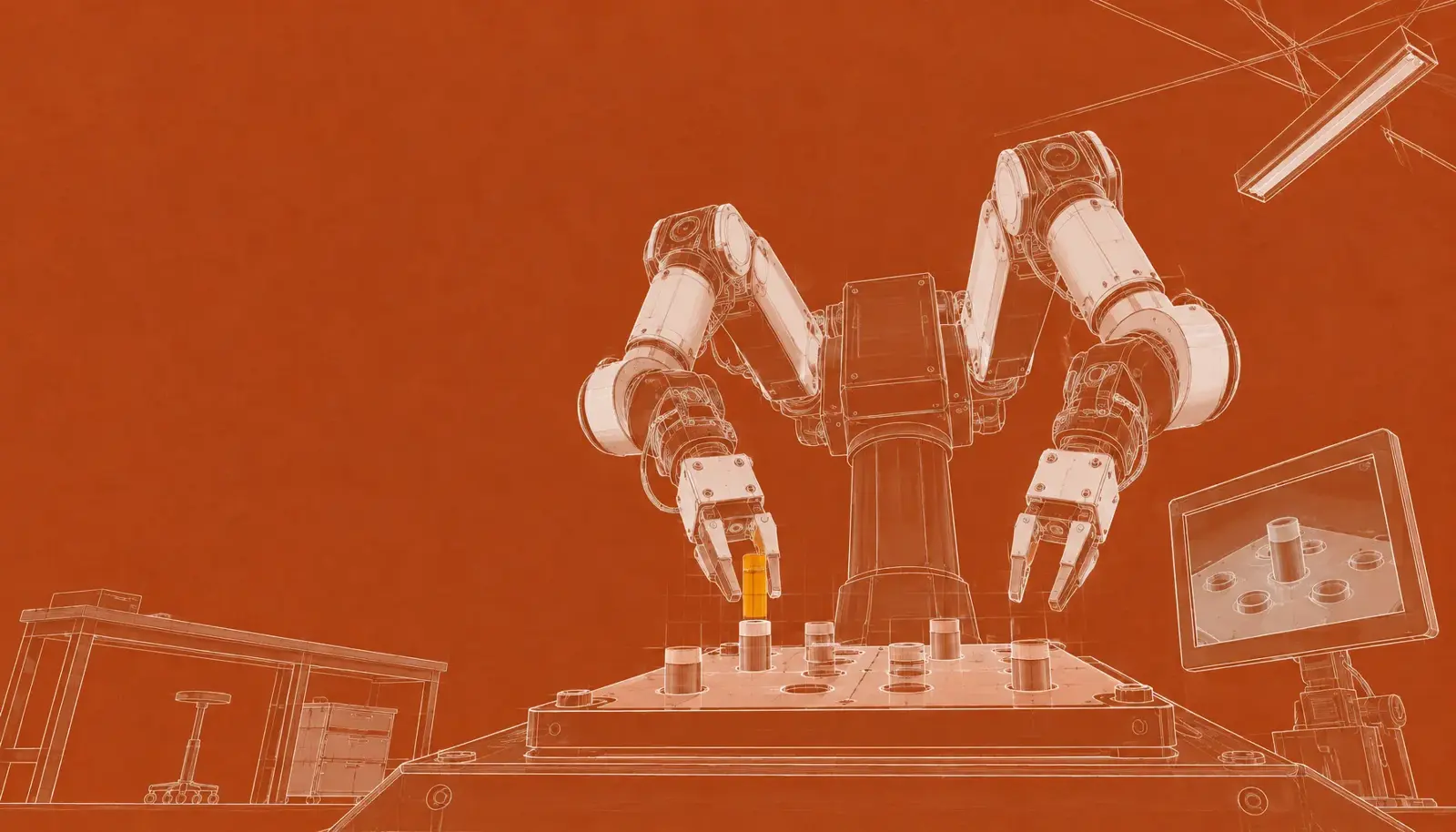
The authors write that proprietary models constrain how researchers develop robot-use agents: their weights are unavailable, while API dependence makes large-scale interaction costly. They also write that open-weight models often fall short in spatial understanding and agentic capabilities. The authors introduce uni-robot-agent to provide a foundation for competitive robot use with open models and future training, without privileged inputs.
Source openrua.ai
Shared tools connect models to environments
Uni-robot-agent uses a common interface for motion, perception, skills and episode control. Environment adapters translate those shared operations into native control, while returning observations and execution receipts to the agent. The architecture has five layers: agent interaction, orchestration, tools, services and a backend layer where concrete simulator, robot and model implementations sit.
The harness also schedules actions around robot resource constraints. A background tool call gives the agent a job handle so it can continue reasoning while the operation runs; calls controlling the same arm queue in submission order. Independent operations, such as reading an existing snapshot, can overlap movement. If new feedback changes the plan, flush_queue cancels calls that have not yet started for the specified resource.
Agents work without privileged inputs
In the main simulation setting, agents receive RGB images, camera calibration, robot proprioception and descriptions, and task instructions. They do not receive depth measurements, supplied object CAD assets, hidden scene annotations, task-verifier feedback or external web access. Localization must derive coordinates from permitted observations, and verifier results are used only for evaluation.
The authors add brief clarifications to some RoboDojo instructions where task requirements are omitted or ambiguous. The examples include specifying that each red button’s prescribed press count must be confirmed with the blue button and clarifying the arrangement of blocks and boards in tower-building tasks. The authors say those clarifications clarify task rules without providing scoring rubrics or verifier logic.
Qwen3.8-Flash-Next reaches 31.39 Score on RoboDojo without privileged inputs
The authors evaluate the harness on 42 RoboDojo tasks across generalization, precision, long-horizon execution, memory and open-vocabulary instruction following. The main configurations use three seeds and two layouts per seed, for 252 episodes each. Score credits partial progress, while success rate counts fully successful episodes.
With uni-robot-agent and no depth, Qwen3.8-Flash-Next reaches a 31.39 Score and a 25.00% success rate. The same model scores 1.90 with RoboProbe, while the published GPT-6 Astra result with RoboProbe is 28.97. GPT-6 Astra reaches a 51.90 Score and a 46.67% success rate with uni-robot-agent; adding depth raises Qwen’s Score to 35.89.
Real-world comparison uses sensor depth
On the Real-World Benchmark, the authors report results across 19 evaluation entries and five dimensions. Qwen3.8-Flash-Next scores 53.50 zero-shot using RGB and D405 sensor depth. The page compares that result with 47.75 for fine-tuned π₀.₅ and 43.50 for zero-shot Dream-1; both baselines use RGB only, and π₀.₅ is fine-tuned with 10 hours of robot data per task.
The authors present the harness as a foundation for collecting experience in a common format across environments. They identify data selection, learning objectives and reward design as separate questions, and write that training on the collected experience is future work.
Sources
- Original source OpenRUA openrua.ai
Related stories
- ExRL learns when to replan robot actions, researchers report
- Robot memory model cuts planning latency in tests, researchers say
- AgiBot Reports G2 Robot’s Store-Task Success Stabilized at 85.7%
- Researchers Present Multi-Agent Reinforcement Learning for Planar Tangram Assembly
- VICTR Preprint Reports 23.8% Success on Unseen Out-of-Domain Real-World Robot Tasks