The Floor
PanoTac Adds Shear Sensing for Under $50 per Fingertip, Excluding Readout Boards
A paper submitted to arXiv on November 2 describes PanoTac, a compliant robotic fingertip that captures contact shape and force in three directions. In tests across three manipulation tasks, policies using the sensor achieved 91.7% overall full-task success, compared with 45.0% for vision alone.
“Hardware characterization showed spatially consistent and temporally repeatable responses across loads and sensor instances.”
Binglin (Andre) Wang and coauthors, authors of the paper; the sentence appears in the paper’s conclusion
A paper submitted to arXiv on November 2 describes PanoTac, a compliant robotic fingertip that records contact shape and force in three directions. The sensor costs less than $50 per fingertip, excluding readout boards. The authors tested it on a Franka Panda arm fitted with a Robotiq 2F-85 parallel-jaw gripper, using tasks that included removing a test-tube stopper, scooping grain and sorting salt bottles by weight.
Pressure maps meet magnetic shear sensing
Each fingertip produces a 12 × 32 × 3 tactile representation: a normal response for pressure into the pad, plus two components for sideways shear. A piezoresistive array supplies the dense contact map. Magnets embedded in the compliant support move as it deforms; magnetometers fixed at the base read those changes to estimate shear.
The contact surface measures 62 × 30 millimeters, and the sensing stack is 18 millimeters thick. The pad combines two elastomer layers with different stiffnesses, an array of 12 × 32 taxels and two groups of embedded magnets. Its readings arrive at 60 Hz. The sensing module sits in a rigid PLA housing that attaches to a gripper finger and can be replaced without tools.
One policy faces three touch-heavy tasks
The team compared four policies trained on the same demonstrations: vision alone, vision with a dense normal-pressure map, vision with sparse three-axis magnetic readings, and vision with PanoTac’s dense three-axis representation. The test-tube task used 50 demonstrations, grain scooping used 45, and salt pouring used 40. Each policy completed 20 evaluation rollouts per task, for 60 rollouts across the suite.
PanoTac’s policy recorded 91.7% overall full-task success, against 45.0% for vision alone. The paper reports that the resulting policies outperformed vision-only baselines by an average of 46.7 percentage points across the three tasks. On test-tube preparation, PanoTac reached 90% success at removing the stopper, compared with 35% for vision alone; the paper describes shear feedback as a cue for detecting when the stopper releases.
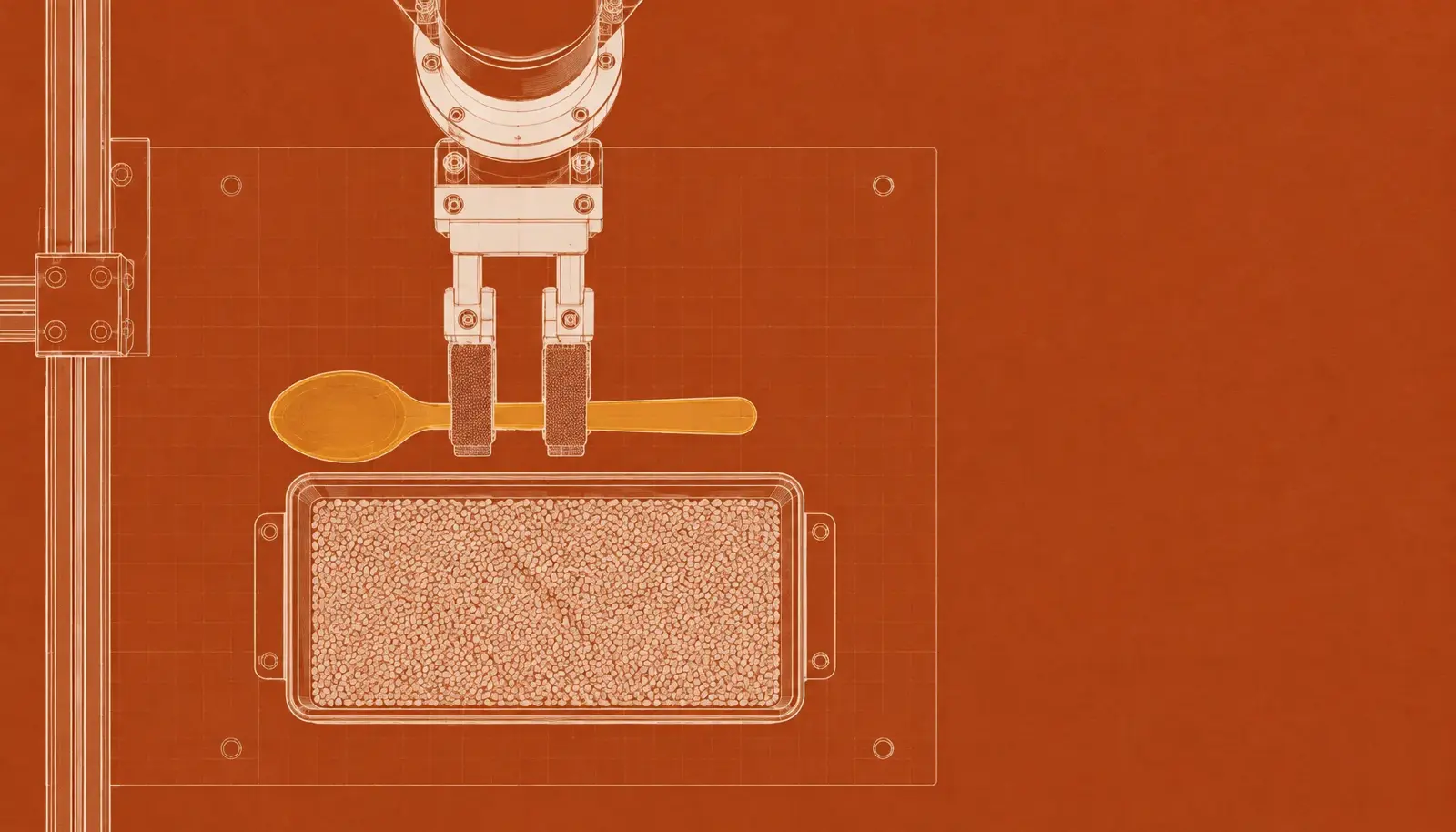
For grain scooping, PanoTac selected the correct direction in all 20 trials, while the vision-only policy did so in 50%. The spoon bowl was hidden from the wrist camera after grasping, leaving contact patterns on its handle as an orientation cue. In salt pouring, the bottle was opaque and its contents were hidden from view: PanoTac achieved 100% sorting success, compared with 55% for vision alone.
Magnetic interference remains a constraint
The results come from a defined set of tasks and 20 rollouts per policy for each one. The paper also reports that removing either spatial contact information or shear feedback reduced performance across the task suite. Its sensor characterization tested three independently fabricated units under normal loads from 0.4 to 12 newtons; at 6–12 N, mean within-unit variation reached 4.8% for the normal response and 4.3% for shear.
The authors identify sensitivity to ferromagnetic objects and external magnetic fields as a limitation. They also say force resolution depends on the elastomer’s compliance and the number of magnetometers, and that the current fingertip is shaped for a parallel-jaw gripper. The work describes a tactile interface tested in that gripper setup, while leaving adaptation to dexterous hands and in-hand manipulation untested.
Sources
- Original source · Preprint arXiv arXiv:2611.03520
Related stories
- Researchers Present LumiTac, a Six-Axis Sensor With a 12 mm-Diameter Sensing Head
- Hsu and Stone Introduce ELA Preprint for Learning Robot Policies from Video Demonstrations
- VICTR Preprint Reports 23.8% Success on Unseen Out-of-Domain Real-World Robot Tasks
- ExRL learns when to replan robot actions, researchers report
- UniLatent preprint tests robot-to-robot transfer in simulation and on arms