The Floor
PrimeSim Uses Cross-Embodiment Data to Simulate Robot Tasks
PrimeSim is an action-conditioned world model trained on robot demonstrations from 22 platforms, with methods for generating consistent camera views and longer simulations. The paper reports benchmark results and use of the model for policy optimization, with closed-loop policy results validated in simulation.
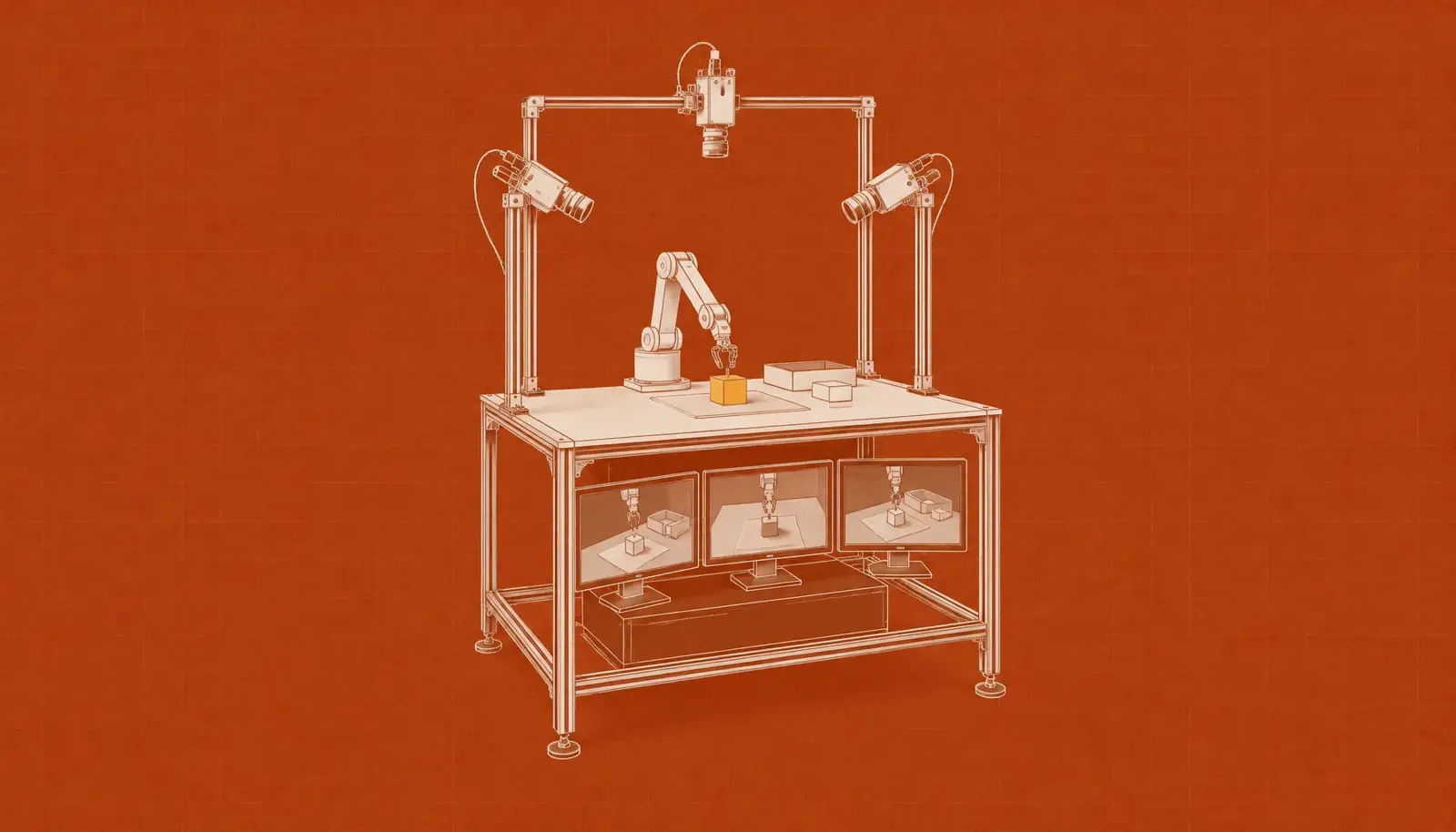
PrimeSim is an action-conditioned, multiview world model designed to simulate robot tasks. The preprint was posted to arXiv on Nov. 3, 2026. It describes a training process that starts with a pretrained video generator and midtrains it on 30,110 hours of robot demonstrations spanning 22 platforms. The system is intended to follow commanded actions, keep multiple camera views consistent and produce coherent simulations over longer periods.
Training across robot platforms
The training corpus combines real and simulated footage from humanoid, dual-arm, single-arm and handheld UMI systems. The corpus contains 30,110 hours of demonstrations, 2.38 billion frames and 1.52 million episodes drawn from 1,773 repositories. Its real-to-simulated data ratio is 84:16. PrimeSim represents controls across embodiments in a shared format. The model takes language prompts, three camera views and actions covering the head, torso, waist, end-effector, gripper and chassis.
To improve action following across different robot embodiments, the preprint introduces a unified cross-embodiment action representation and frame-aligned dual-path conditioning. The latter is described in the paper as a way to strengthen correspondence between actions and video frames. For multiview consistency, PrimeSim uses view-aware interleaved attention and explicit camera identities. These mechanisms enable information exchange across views while preserving view-specific representations.
The work begins with a bidirectional video generator and uses posttraining to turn it into an autoregressive simulator. Its fast-video, slow-memory framework combines causal generation with self-rollout training, in which the model trains on histories it generated itself rather than relying only on ground-truth context. The paper also describes hierarchical temporal memory: a bounded KV cache preserves the initial scene, sparse long-term history and dense recent motion. This design is intended, the authors say, to help the model maintain coherent rollouts beyond its original training window.
Simulation speed and evaluation
PrimeSim reaches a speed of 10.1 frames per second at four sampling steps under its short-window benchmark condition, according to the paper. For longer continuous-KV episodes, the reported figure is 7.63 temporal frames per second. The reported rollouts extend up to 105 seconds. Stable long-horizon simulations on tasks involving rigid and deformable objects are described in the paper. Transfer to held-out platforms is also reported within 100 to 200 gradient steps, while the pretrained backbone does not transfer within that interval.
In comparisons with five open-source action-conditioned world models, PrimeSim leads four of five WorldSimProbe suites. Gains of 10.0% in global trajectory coverage, 41.8% in action-source behavior preservation and 48.4% in interaction dynamics are reported, each compared with the strongest competing model on that measure. An interaction-grounding score of 85.7 is also reported. On EWMBench, PrimeSim has the best overall score, while the paper places weaker fine-grained local calibration in WorldSimProbe’s T1 suite.
Data and policy evaluation
The work reports generation using real-platform data as well as simulated footage. Its evaluations include real-platform data, including XVLA and three held-out embodiments; the paper’s closed-loop policy results, specifically, are validated only in simulation. The researchers also use PrimeSim as a learned simulator for GRPO-based policy optimization. In this setup, generated interactions provide an environment for policy training, rather than a report of closed-loop deployment on a physical robot.
The model weights, inference code and training code are released. The paper presents PrimeSim as a simulator intended to support action-conditioned, multiview generation and long-horizon rollouts across robot embodiments.
Sources
- Original source · Preprint arXiv arXiv:2611.04870
Related stories
- Genie Sim Scores Correlate 96.7% With Real Robots, AgiBot Says
- NTT says physics-based model improved robot shelf-loading test
- AgiBot’s Rollback Rewinds Robot Policies to Test Better Actions
- ThinkWorld Trains Robot Policies by Scoring Imagined Futures
- Library of Hands more than doubles simulated success, preprint reports