The Floor
Princeton Researchers Tie Safety-Filter Caution to Policy Confidence
A paper proposes adjusting an autonomous policy’s safety filter according to the policy’s confidence in its current input. In simulated racing tests, the method completed all 60 low-friction laps and was 0.5 seconds faster on average than a fixed conservative filter.
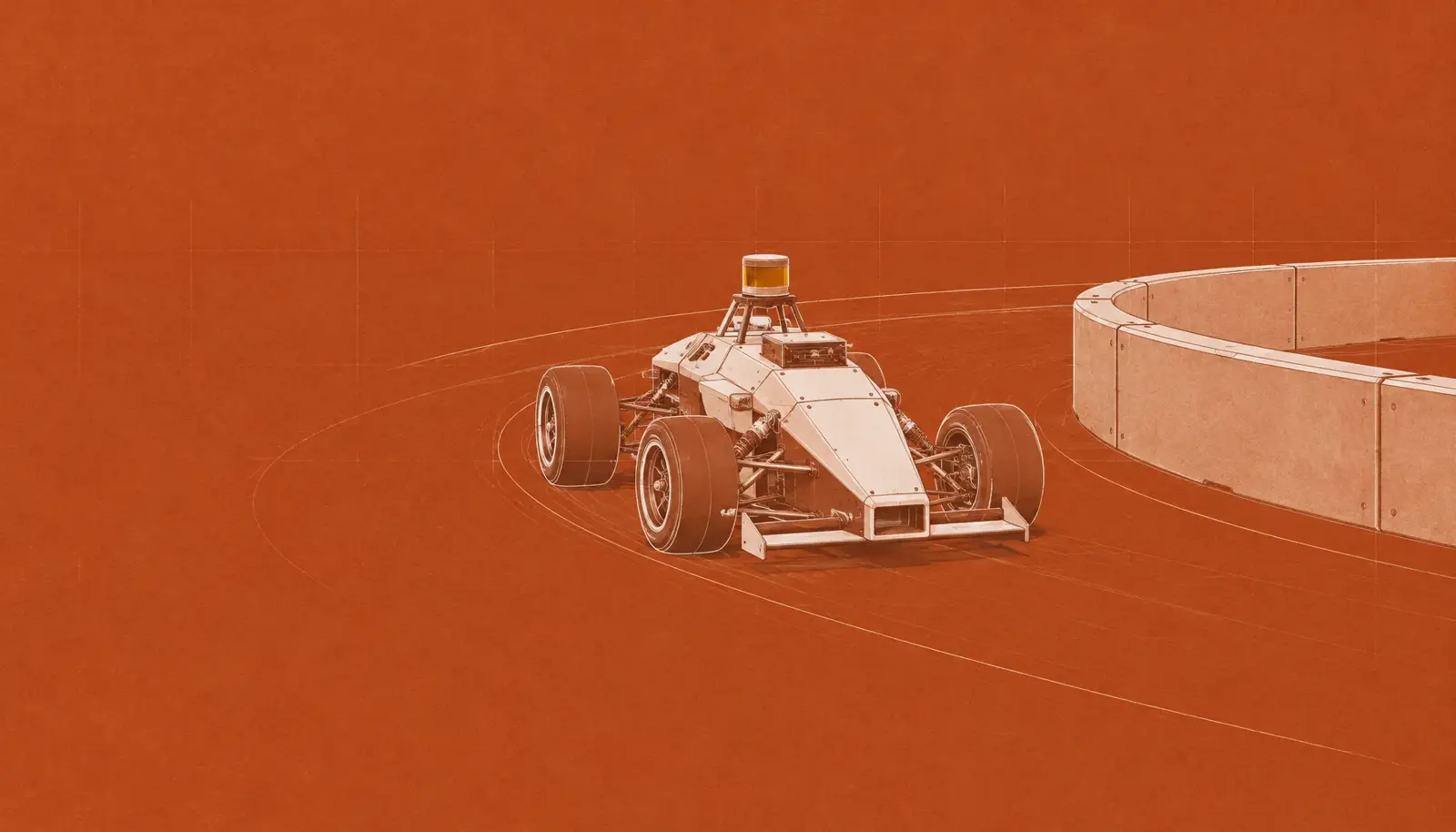
A fixed safety filter can protect an autonomous policy while also slowing it down; a more permissive filter preserves speed but can leave less room for error. In a paper submitted to arXiv on October 29, Princeton University researchers Javier Borquez and Jaime F. Fisac propose a way to adjust that tradeoff: use the policy’s confidence in its current input to set how conservative the filter should be. Their evidence is preliminary, from simulations of autonomous racing rather than tests on a physical robot.
Confidence sets the filter’s margin
Safety filters review a policy’s proposed action and can modify it when it risks entering an unsafe state. Their guarantees depend on assumptions about the system and its environment, such as vehicle dynamics, disturbances and perception. The researchers call the conditions under which those assumptions hold the filter’s operational design domain, or ODD; the policy also has a separate competence domain, where its learned behavior is reliable.
Most filters use a fixed conservativeness setting, regardless of whether the policy appears familiar with the current situation. Borquez and Fisac instead describe a filter whose conservativeness changes with a confidence score: higher confidence selects a more permissive setting, while lower confidence selects a more conservative one. As the paper’s authors write:
“Inside the ODD, safety is untouched, since every setting is certified, and modulation only buys performance; beyond it, modulation adds margin where the policy is less trustworthy.”Javier Borquez and Jaime F. Fisac, paper authors at Princeton University
Sixty laps test the tradeoff
The team tested the method in the F1TENTH racing benchmark using a simulated end-to-end controller trained on five tracks with gentle left-hand corners. Its confidence monitor uses an autoencoder trained on the policy’s own observations; reconstruction error provides the confidence signal. The safety filter uses backup control-barrier functions, with braking maneuvers that keep the car’s steering straight, fully left or fully right.
For the out-of-domain test, the researchers reduced simulated tire friction from 1.05 to 0.6 without updating the filter, then evaluated on three harder tracks with corners up to 135 degrees, including right turns absent from training. Each method ran 60 laps. Without a filter, the policy crashed on all 60 laps in the low-friction setting.
The permissive filter loses ground off-domain
In the low-friction tests, the fixed permissive filter completed 48 laps, timed out on two and crashed on 10. The confidence-modulated filter completed all 60, matching the fixed conservative filter’s completion count. It averaged 30.8 seconds per lap, 0.5 seconds faster than the conservative filter’s 31.3 seconds. On the in-domain setting, all three filters completed every lap without a crash; the modulated version averaged 30.2 seconds, compared with 30.4 seconds for the permissive filter and 31.4 seconds for the conservative one.
The results hinge on a specific relationship: low policy confidence must occur where the policy is more likely to act unsafely, and, outside the filter’s ODD, where its safety model is unreliable. In this experiment, the autoencoder could not detect the change in friction directly. Confidence fell at unfamiliar sharp corners, which also happened to be where the lower friction invalidated the filter’s assumptions. The alignment helped the method in these tests, but does not establish that a confidence score will reliably identify risk in other settings.
Real-robot tests remain ahead
The authors describe the results as preliminary and say broader tests in simulation and on real robots are still needed. Their conclusion also points to robot foundation models as a possible application: a generalist policy may be competent on some tasks and less reliable on others, making a single fixed filter setting costly. The paper’s experiments, however, cover simulated F1TENTH racing only; they do not demonstrate the method on a physical vehicle or a foundation model.
Sources
- Original source · Preprint arXiv arXiv:2610.40922
Related stories
- Preprint adds estimator uncertainty to robot safety reachability
- Preprint measures how world-model safety filters refuse safe actions
- Preprint proposes certifying robot safety through recoverability
- Researchers test latent steering for safer robot path planning
- Preprint proposes robot planning with explicit, reusable safety rules