The Floor
Preprint adds estimator uncertainty to robot safety reachability
A preprint proposes a reachability method that accounts for changing uncertainty in a robot’s state estimate. In simulations, its safety filters reduced collisions in tests involving a quadrotor and a car.
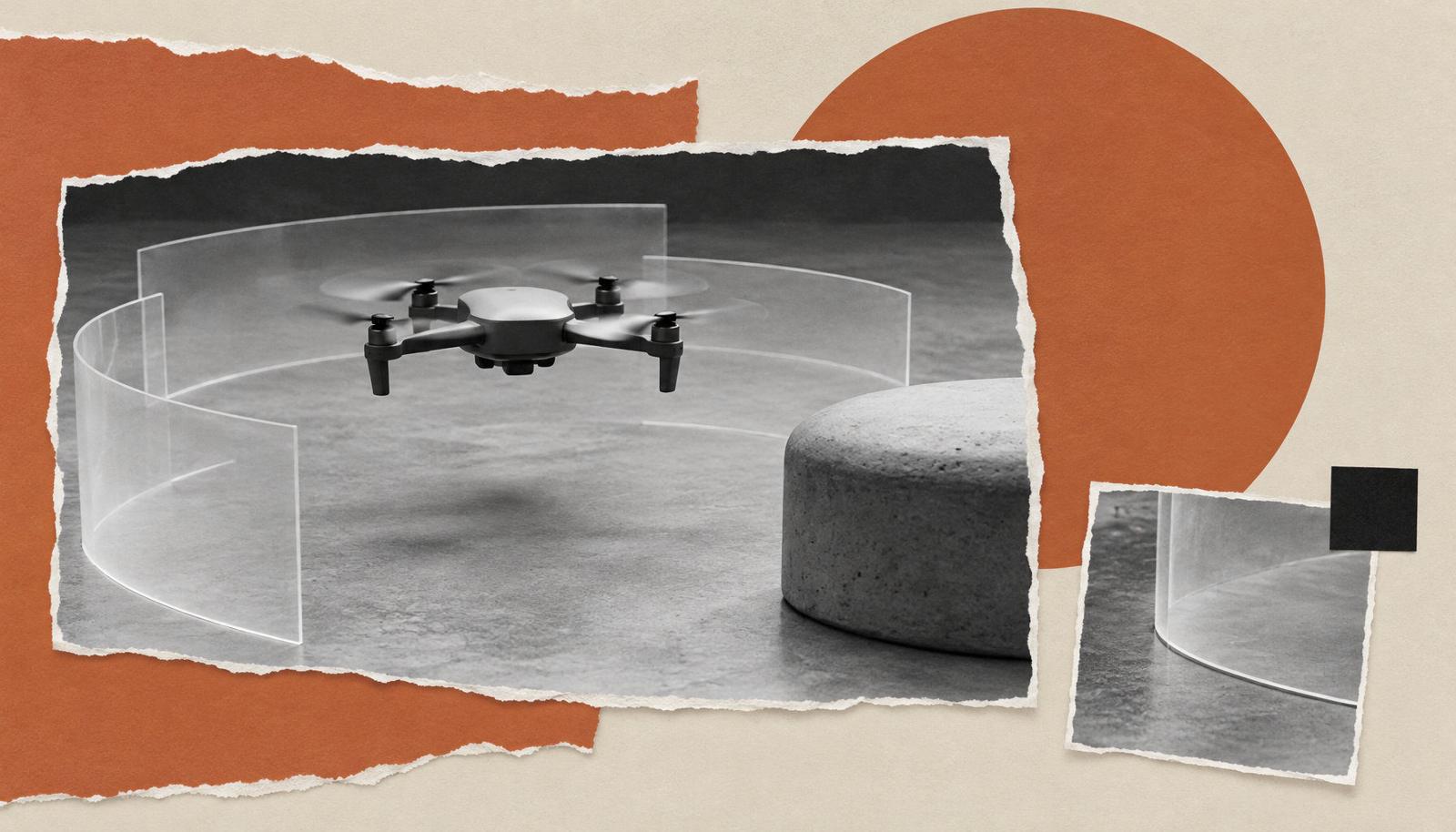
A reachability method that tracks uncertainty
A new preprint by Himanshu Paudel and Javier Borquez proposes an approach to robot safety that accounts for uncertainty in state estimates as they change during motion. Submitted to arXiv on November 18, 2026, the paper extends Hamilton–Jacobi (HJ) reachability, a method for identifying states from which a system can be kept safe despite disturbances. Conventional HJ reachability assumes the system’s state is known exactly, while robots generally act on estimates derived from noisy measurements.
The proposed method adds the estimator’s mean and covariance to the state used in the reachability calculation. It treats measurement innovations—the differences between incoming measurements and predicted measurements—as bounded adversarial inputs, then expands the unsafe set according to the current estimation uncertainty. The authors say the formulation can be used with existing reachability solvers.
The paper gives a pointwise-in-time probabilistic safety guarantee conditional on a consistent Gaussian estimator: at a given time, a state certified as safe is outside the unsafe set with probability at least 1 − δ. That is not a guarantee that the robot will avoid the unsafe set over an entire trajectory. The authors identify a trajectory-level certificate and less conservative modeling of worst-case measurement innovations as areas for further work.
Three simulated test cases
The study evaluates the approach in simulation on three systems: an Air3D pursuit-evasion problem, a planar quadrotor and a Dubins car. The authors compare its safety filter with alternatives including a conventional reachability filter, versions with fixed uncertainty margins and a belief control-barrier-function filter. No physical robot testing is reported.
For the quadrotor, each method and uncertainty setting was evaluated in 2,000 rollouts. The paper reports that the conventional reachability filter collided in 70.8% of rollouts, while the estimation-aware filter had no collisions at the higher uncertainty multiplier, κ=3; at κ=2, its collision rate was 1.55%. A fixed maximum-margin baseline also had no collisions, but the authors report that it was more conservative, while the estimation-aware filter had the lowest intervention cost among the compared filters.
In the Dubins-car simulation, a vehicle estimated its position from measurements whose noise increased with distance from a beacon. Across 2,000 rollouts, the estimation-aware filter had no collisions, compared with 61.3% for the conventional reachability filter and 0.15% for a fixed steady-state margin. The paper reports that the estimation-aware filter acted during 29% of time steps, versus 49% for the maximum-margin baseline.
Reachable sets change with the estimate
In the Air3D case, the paper reports that the estimation-aware backward reachable set expanded as estimation uncertainty increased, and did not simply grow by a uniform margin. Across the evaluated slices, its area was on average 13.6 times larger than the nominal set at one noise level and 37 times larger at another. These are results from the paper’s simulations and analysis, not reported hardware trials.
Sources
- Original source · Preprint Estimation-Aware Reachability arXiv:2611.23830
Related stories
- Preprint measures how world-model safety filters refuse safe actions
- Preprint proposes certifying robot safety through recoverability
- Preprint Uses Radar Doppler as a Robot Safety Barrier Derivative
- Preprint proposes robot planning with explicit, reusable safety rules
- Northwestern preprint proposes four-factor robot risk filter