The Floor
Preprint Uses Radar Doppler as a Robot Safety Barrier Derivative
A November 18 preprint describes a robot safety filter that uses radar Doppler measurements directly to assess changing obstacle distance. In 508 simulated encounters, the authors report fewer buffer incursions than with two range-based Kalman filters, and they also tested the method on a quadruped.
A radar measurement enters the safety loop
A new arXiv preprint proposes using radar Doppler measurements directly in a robot’s distance-safety controller, rather than estimating obstacle motion from successive range readings. The paper, submitted November 18, 2026, is by Johannes Mootz, Hesam Mojtahedi and Reza Akhavian.
The approach uses a control barrier function, a mathematical constraint for filtering a robot’s movement command to maintain a specified distance. The authors use frequency-modulated continuous-wave radar’s measured radial relative velocity as the derivative of that distance constraint, then calculate a closed-form limit on the robot’s forward velocity. A margin accounts for measurement errors in range, Doppler, the robot’s velocity and the obstacle’s bearing.
Simulation comparison
In 508 simulated encounters that were within the platform’s ability to retreat, direct Doppler produced two buffer incursions, the authors report. The constant-acceleration Kalman filter produced 15, while the constant-velocity filter produced 25; a buffer incursion meant the simulated distance constraint was violated. The comparison used the same plant, radar model, detection processing and measurement margin for each method, changing only the source of the range-rate measurement.
The paper also reports that 52 encounters were excluded from that comparison because the robot could not maintain the buffer within its velocity limits. In a separate simulated motion-change case, the Doppler-based command changed 0.09 seconds after the safety constraint became active, compared with 0.33 seconds for the constant-velocity filter. The constant-acceleration filter responded on the first radar sample in that case, but continued to indicate motion after the obstacle stopped.
Tests on a quadruped
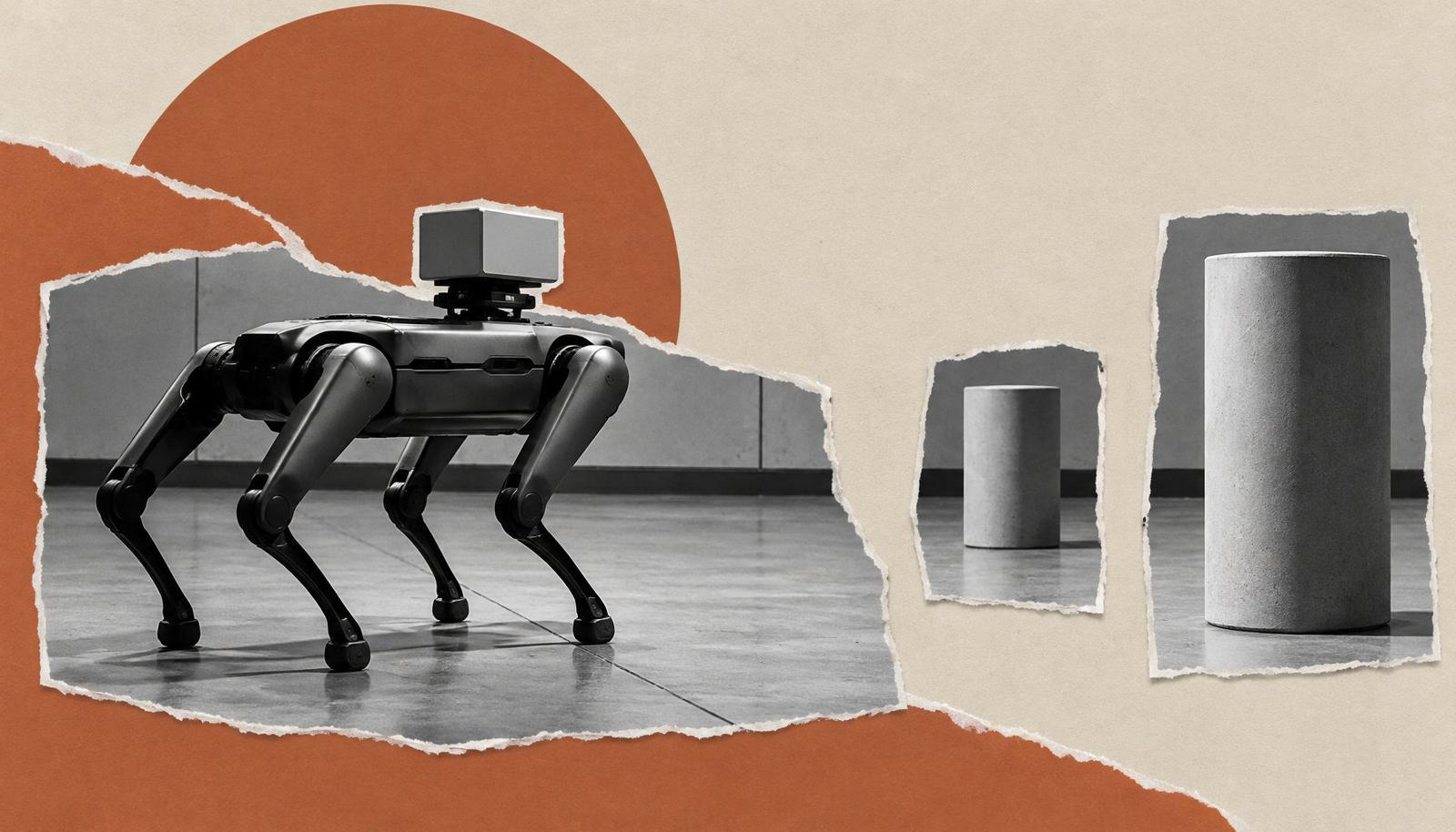
The hardware experiments used a Unitree Go1 carrying a Texas Instruments IWR6843AOPEVM FMCW radar. The radar operated from 60 to 64 GHz and produced a point cloud at 20 Hz. The tests included approaches to a stationary object and trials in which a person or a remote-controlled small robot approached from farther away while a nearer static object remained.
Across 10 static trials, the Go1 stopped at a mean distance of 0.777 ± 0.015 meters, against a predicted stopping distance of 0.758 meters, the paper reports. In one two-object example, the farther moving object set the velocity limit despite the nearer stationary return. The controller’s command followed that radar measurement one frame later.
Across 23 evaluated radar approaches, the paper reports that the Doppler method responded to the approaching object, while range-based filters responded later in the reported comparisons. In the tested radar results, the constant-velocity and constant-acceleration filters responded in 22 of 23 approaches, with median delays of 0.15 seconds and 0.08 seconds relative to Doppler, respectively.
Conditions on the guarantee
The paper’s safety guarantee covers the longitudinal range channel and depends on bounded measurement errors, continuously available detections, continuous enforcement of the constraint, accurate command tracking and a feasible command. It applies to obstacles returned by the radar; the authors note that missed detections, ghost detections and changes in radar scattering points are not covered by the measurement margin. The paper identifies sampled-data updates, changing detection sets, lateral motion and steering as areas for further work.
Sources
- Original source · Preprint Radar-Native Control Barrier Functions: Doppler Range Rate as a Measured Barrier Derivative arXiv:2611.23654
Related stories
- Researchers test latent steering for safer robot path planning
- RaMOD preprint reports moving-object detection from radar cubes
- Preprint adds estimator uncertainty to robot safety reachability
- Preprint proposes certifying robot safety through recoverability
- Preprint proposes robot planning with explicit, reusable safety rules