The Floor
Quadrotor reaches photo goals in indoor test, researchers report
A vision-based flight policy reached its target viewpoint in 84% of 25 real-world trials, according to a research preprint. The policy commands thrust and body rates without explicit state estimation or a separate velocity controller.
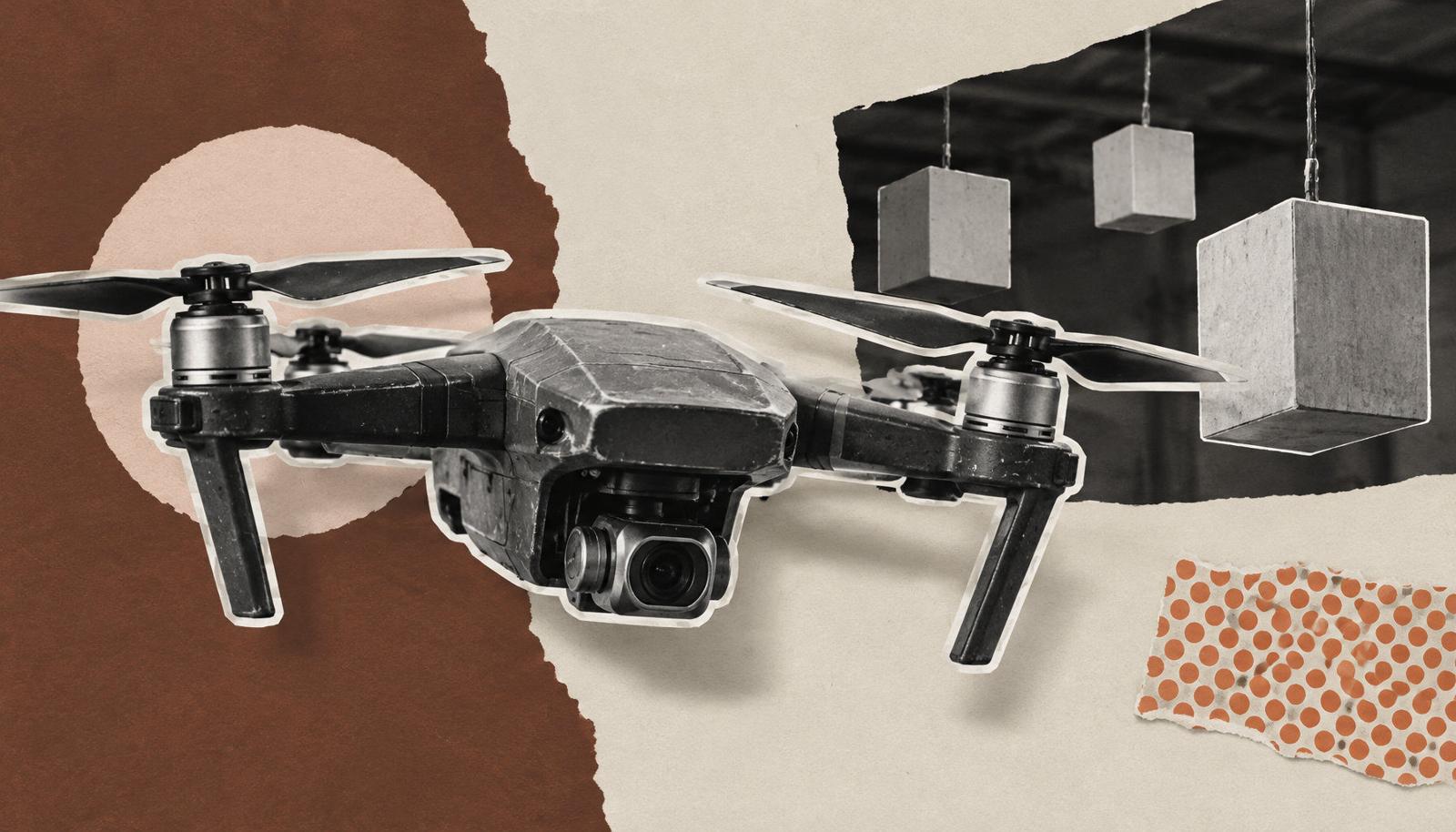
A quadrotor using a learned visual flight policy reached the viewpoint of a target photograph in 84% of 25 trials in an unfamiliar indoor environment, researchers report in a preprint. The system directly commands thrust and body rates without explicit state estimation or a separate velocity controller.
Source arxiv.org
Simone Nascivera, Ismail Geles and Davide Scaramuzza of the University of Zurich's Robotics and Perception Group trained the policy in simulation and tested it on a physical quadrotor without fine-tuning. Their approach uses a recurrent model that combines camera observations with the previous control command.
Flights in simulation and indoors
Across 1,000 simulated flights in 100 buildings held out from training, the policy achieved an 82.3% success rate, according to the paper. Successful simulated flights had a mean terminal position error of 0.10 meters.
The researchers used the same success criteria in the indoor experiment as in simulation: position error below 0.15 meters, attitude error below 10 degrees and speed below 0.08 meters per second for one control step of 0.02 seconds. A motion-capture system recorded performance in the physical tests, rather than supplying the policy with state information.
In the real-world trials, mean final position error was 0.118 meters and mean orientation error was 3.07 degrees across successful flights. The paper reports that 30.51% of received frames were dropped across the 25 experimental recordings.
The modified Agilicious quadrotor sent video from its onboard camera to a workstation, which streamed control commands back to the aircraft through a radio-frequency transmitter. The test took place in an indoor flight arena the policy had not encountered during training.
Learning from a teacher
The task is to fly from a starting view to the viewpoint from which a goal photograph was taken. At deployment, the policy receives the current image, the goal photograph and its previous command; it does not receive position, velocity, attitude or inertial measurement unit measurements.
Training proceeds in four stages. First, a teacher policy learns using privileged information about the goal-relative pose and motion. A visual representation then learns from sequences of images and the goal photograph, with geometric and motion supervision and alignment to the teacher's internal representation.
The student subsequently learns to imitate the teacher, before reinforcement learning fine-tunes the resulting policy. In an ablation on the 1,000 held-out simulated trajectories, success rose from 64.8% after imitation learning to 82.3% after reinforcement learning fine-tuning, the researchers report.
Conditions on the target view
The simulation tests required at least 20% visual overlap between the initial and goal views, along with clearance along the straight segment between them. The pair filter did not constrain the flight path the policy executed.
The current approach assumes partial visual overlap between the starting image and the goal image and does not address exploration, the authors write. Their proposed future work would investigate combining goal-directed exploration with direct visual flight control to relax that assumption.
Sources
- Original source · Preprint End-to-End Image-Goal Navigation for Agile Quadrotors via Recurrent State Distillation arXiv:2611.34046
Related stories
- Researchers report better robot world-model predictions after failure training
- Weight edits improve robot policy in simulation, researchers report
- Meta researchers report exact collision gradients for ellipsoids
- SANA-Robot researchers report faster control with hybrid memory
- Entangle researchers report results on unseen robot tasks