The Floor
Researchers Teach a Quadruped to Push Obstacles From Language
A Qwen-based planner pairs language instructions with a Unitree Go2 quadruped’s navigation and pushing skills to clear movable obstacles. In 45 hardware trials, it chose the correct skill sequence 44 times but completed the full task 34 times.
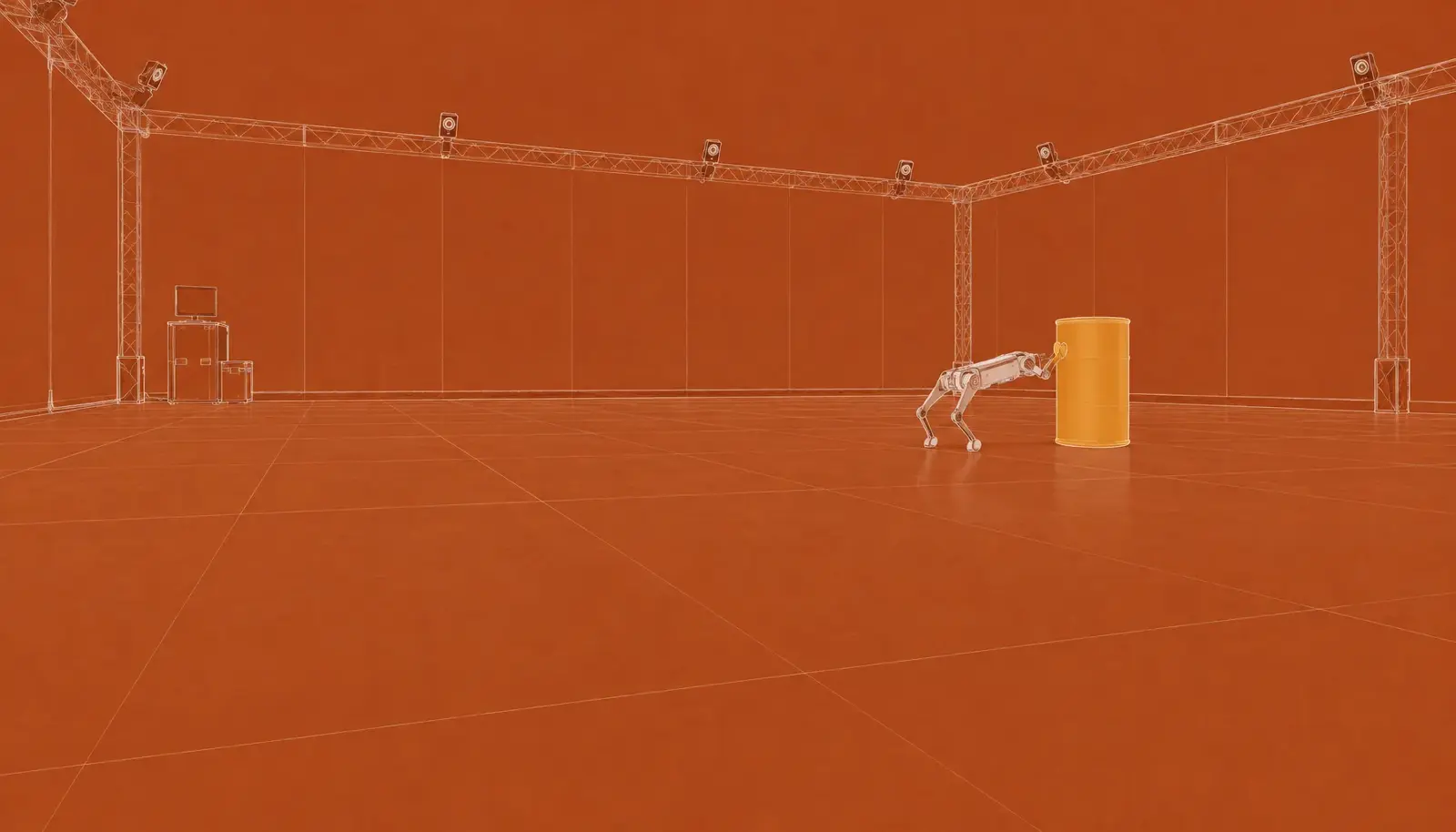
The plan was right more often than the robot finished
A language-guided planner chose the correct sequence of navigation and pushing skills in 44 of 45 hardware trials, but the quadruped completed the full task in only 34. The results appear in “LLM-guided Planar Loco-Manipulation for Quadruped Robots,” submitted to arXiv on October 29 by Georges Jetti, Michael Khayyat, Jean-Pierre Sleiman, Stefano Arrigoni and Francesco Braghin.
The work targets a specific problem: a robot cannot always reach its destination by walking around obstacles. When a movable object blocks the route, the robot may need to approach it, push it aside and continue to the goal. The authors test that combination on a Unitree Go2, using the robot’s body for planar pushing rather than a mounted arm.
“We instead consider a broader decision space, jointly selecting the skill, relevant object, and geometric target.”
Georges Jetti, Michael Khayyat, Jean-Pierre Sleiman, Stefano Arrigoni and Francesco Braghin, authors of the paper
A language model picks the skill, object and target
The high-level planner fine-tunes Qwen2.5-1.5B-Instruct with Low-Rank Adaptation, or LoRA, on synthetic examples. It receives a natural-language task and a structured description of the scene, then selects whether the robot should navigate or manipulate, which object to move when needed, and the target position for that action. The training set contains about 8,000 trajectories, expanded into roughly 16,000 training samples.
The system predicts a sequence of actions but executes only the first one before checking the updated scene and planning again. That event-driven arrangement lets it revise the remaining sequence after each skill finishes. In the hardware tests, however, the scene information comes from a motion-capture system; the experiment does not demonstrate a robot locating objects with its own onboard perception.
Pushing succeeds in simulation; target selection still slips
The authors also compare two low-level pushing controllers. Their end-to-end, whole-body policy succeeds in 93.3% of simulation trials, compared with 83.5% for a hierarchical baseline, and cuts task completion time by more than 60%. In hardware tests across three objects, including a plastic cylinder and an approximately 8-kilogram rectangular prism, the new policy records shorter completion times than the baseline.
For the separate simulated planner benchmark, the fine-tuned system completes 109 of 120 interactive-navigation tasks and 29 of 30 long-horizon tasks. On a shifted task structure—manipulate, navigate, then manipulate, a sequence excluded from training—it completes 12 of 30. A prompted GPT-5.5 baseline completes 94 of 120 interactive-navigation tasks and 2 of 30 shifted tasks, while the paper cautions that planner results depend on how the task and scene are represented.
Hardware exposes the gap between a plan and an action
Across the 45 physical runs, correct skill composition does not guarantee a successful route. The paper attributes failures to geometric targets that the low-level controller cannot execute reliably, as well as cases where pushing an object leaves no collision-free path to the final goal. The authors identify the missing link directly: the planner has no explicit model of whether its chosen targets are feasible for the motor skills below it.
The evaluation also stays within a single room configuration, and the planner is called only at discrete skill transitions. The researchers point to more frequent replanning, evaluation in different room layouts and perception-based scene input as next steps. For now, the measured result is 44 correct skill sequences and 34 completed tasks across the 45 hardware trials.
Sources
- Original source · Preprint LLM-guided Planar Loco-Manipulation for Quadruped Robots arXiv:2610.40248
Related stories
- Eteverse Sends a Quadruped Into Seoul’s Collapsed-Building Drill
- Machenta Raises $40M to Teach Robots From One Demonstration
- Researchers Present Multi-Agent Reinforcement Learning for Planar Tangram Assembly
- ExRL learns when to replan robot actions, researchers report
- Robot memory model cuts planning latency in tests, researchers say