The Floor
Eteverse Sends a Quadruped Into Seoul’s Collapsed-Building Drill
Eteverse deployed a quadruped robot during a simulated building collapse at Seoul’s Sejong Center for the Performing Arts on October 26. The robot searched ahead of responders and relayed live video to help command staff assess conditions before entry.
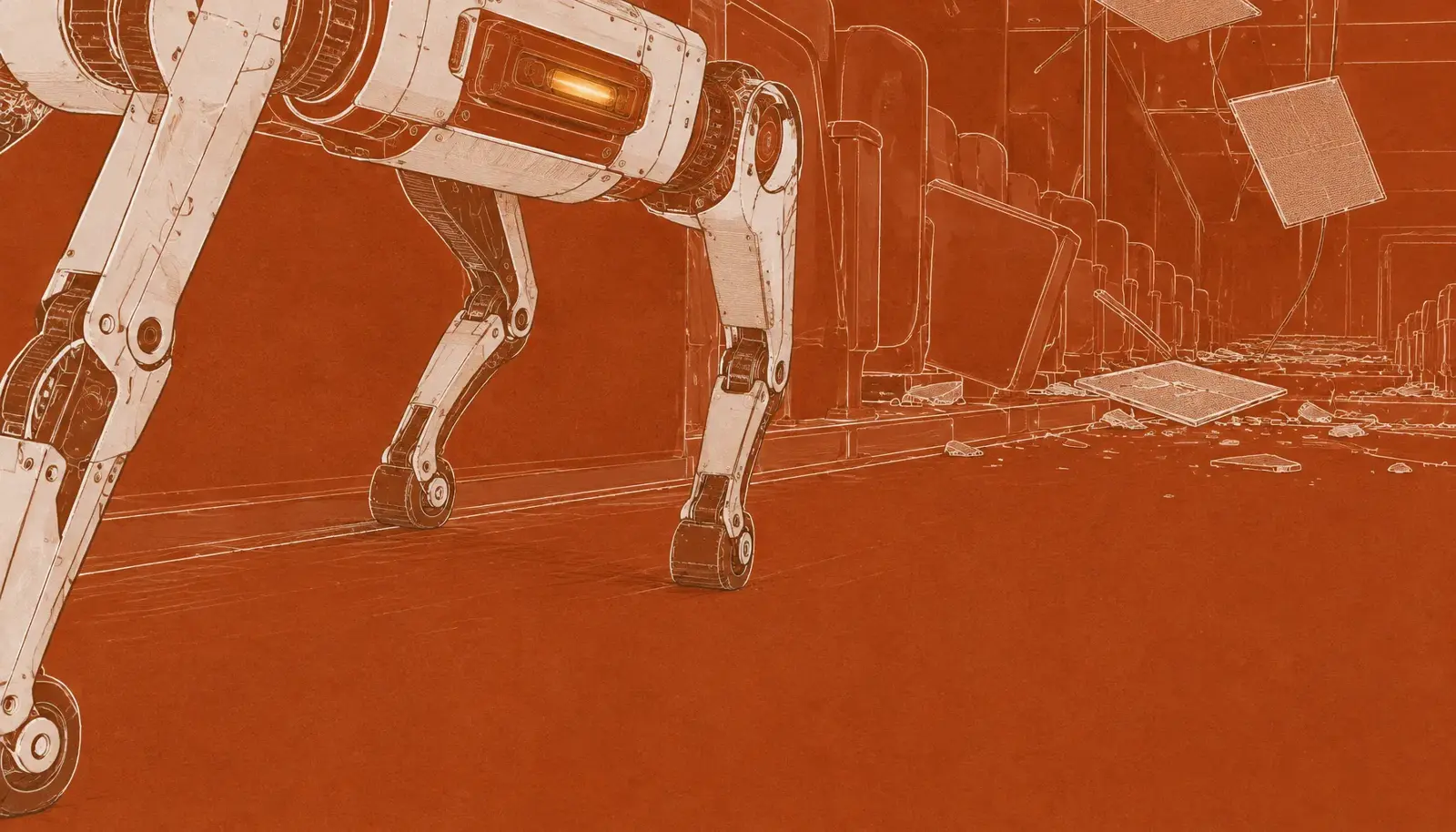
Eteverse put a quadruped robot into a simulated collapse zone at Seoul’s Sejong Center for the Performing Arts on October 26, sending it ahead of rescue personnel to inspect interior conditions. The robot relayed video in real time to incident commanders, who could use the feed to assess the scene and decide whether responders should enter.
Source irobotnews.com
A theater fire scenario leads to a building collapse
The 2026 Jongno-gu Comprehensive Emergency Rescue Drill simulated a fire during a performance, followed by crowd injuries during evacuation and the partial collapse of a structure. The exercise brought together firefighting, rescue, command and interagency coordination procedures in a single compound-disaster scenario.
After the simulated collapse, the quadruped entered the area before human responders. Eteverse supported its deployment and operation, considering the planned route, communications conditions and how video would reach the command post. The reported objective was to connect the robot’s search to the command team’s use of the information, rather than demonstrate locomotion alone.
Live video puts the robot in the command loop
The exercise tested a practical sequence: the robot searches, sends imagery to command staff, and gives them information for judging whether personnel can proceed. That places the machine in a reconnaissance role, where its value depends not only on reaching a hazardous area but on getting usable observations back to decision-makers.
The published account does not identify the robot’s model or say whether it moved autonomously or under remote control. It also gives no technical details about its sensors, communications range or performance in the simulated debris. The drill therefore demonstrates an operational workflow, not a quantified test of robot capability.
Eteverse builds on a September exercise in Yeongju
Eteverse also supported a joint emergency-rescue and firefighting-helicopter command drill in Yeongju, North Gyeongsang Province, on September 21. In that exercise, the quadruped entered a building area after a simulated secondary explosion made it difficult for responders to go in; it searched inside and shared video with command staff.
The two drills put the same basic task in different scenarios: send a robot into a hazardous interior before people, then use the resulting video to inform command decisions. Eteverse says it supports robot deployment, operation and maintenance, including field part replacement. The company’s AX Business Division executive vice president, Song Jae-young, described the Jongno exercise as a chance to test how quadruped robots could be used in rescue work.
이번 훈련은 사족보행로봇을 실제 구조 활동에 어떻게 활용할 수 있는지 점검하는 기회였다
Song Jae-young, executive vice president of Eteverse’s AX Business Division
The drill tests more than entry into a danger zone
A robot’s first entry can reduce the need to expose responders to unknown conditions, but the drill’s account does not establish how much risk it reduced or whether the feed changed a specific entry decision. It does show that Eteverse and the exercise organizers treated video delivery and command use as part of the deployment, alongside route planning and communications.
For this exercise, the concrete result was a quadruped searching inside a simulated collapsed structure and transmitting live video to the command team. Eteverse’s next stated step is to accumulate operating experience in more field settings, including public safety and industrial inspection.
Sources
- Original source Robotics News irobotnews.com
Related stories
- RESCUE Jumper reuses wheel drives to leap onto a 5 cm ledge
- ArXiv paper details quadruped control across four arm morphologies
- Preprint adapts a world action model for quadruped tasks
- iFLYTEK Bundles Robot Board, Dev Kit and Software Into Super Brain Platform 3.0
- Lane-Keeping Displays Miss 53% of Degraded-Perception Seconds