The Floor
RESCUE Jumper reuses wheel drives to leap onto a 5 cm ledge
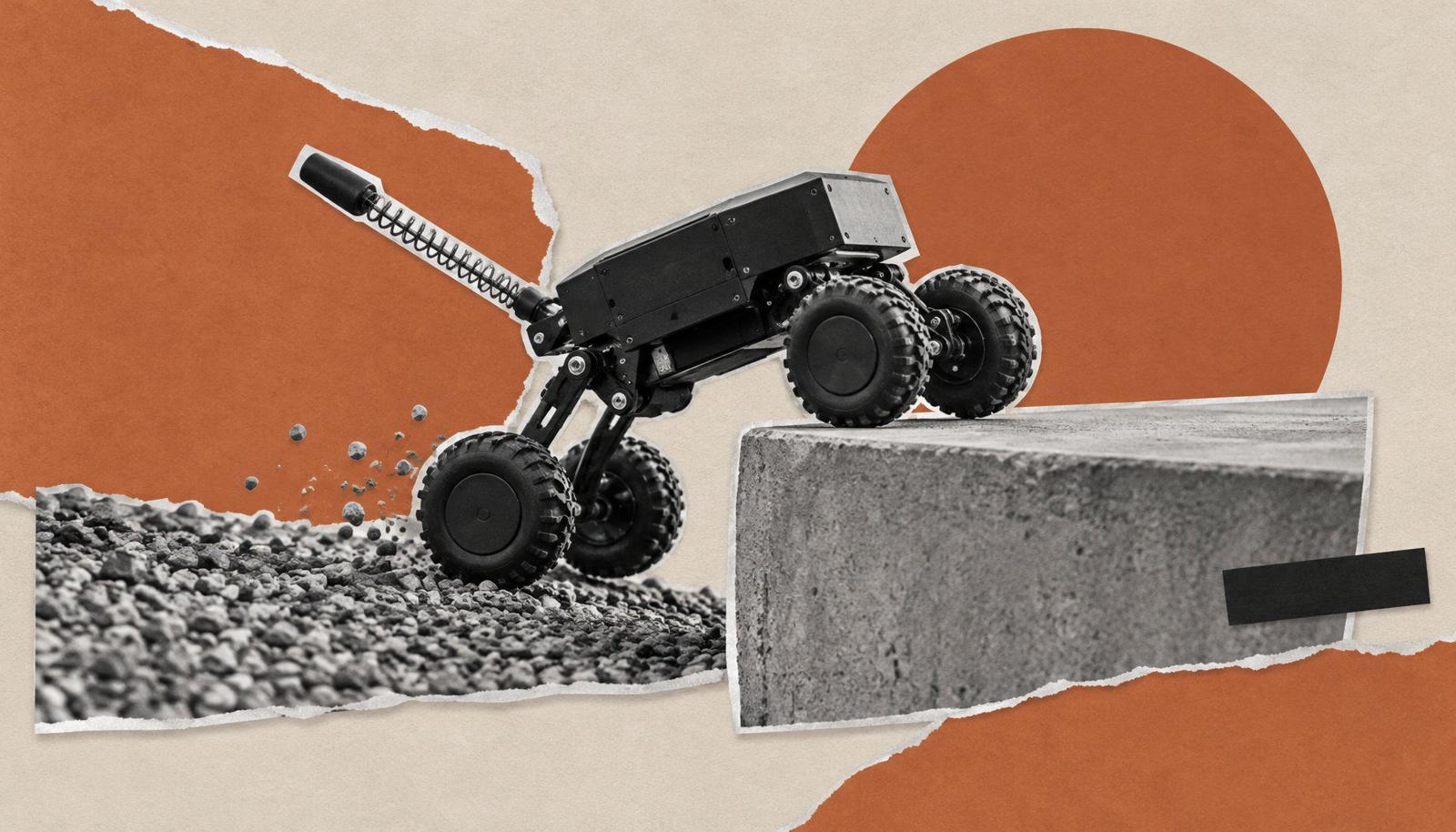
A 125 g robot combines rolling with jumps driven by its wheel actuators and a spring-steel tail. In a teleoperated outdoor demonstration, it jumped from gravel onto a 5 cm ledge that it could not traverse by rolling.
One drive system, two ways to move
A 125 g centimeter-scale robot can switch from rolling to jumping by reversing its wheel drives, and was teleoperated onto a 5 cm ledge from gravel, according to a preprint posted to arXiv on November 17, 2026. The RESCUE Jumper was designed for search-and-rescue settings where small robots may need to move through confined spaces but encounter obstacles they cannot roll over.
The RESCUE Jumper weighs 125 g, measures 6.2 cm wide and has 6.2 cm diameter wheels. Its two wheel actuators serve both for ordinary rolling and for winding the spring-steel tail that launches it. Forward wheel motion drives the robot across the ground; reversing the wheels winds the tail around the body to store energy. When the tail releases, it strikes the ground and pushes the robot into a jump.
Winding speed changes the jump
Changing the tail-winding speed alters jump direction, with the paper reporting a shift from backward to forward jumps as speed increases from 0.75 rad/s to 8.73 rad/s. The authors report launch angles ranging from 45 degrees to -11 degrees relative to the vertical axis, a maximum height of 9.2 cm and a maximum lateral displacement of 11.2 cm.
For the outdoor demonstration, the paper says the robot was teleoperated to jump from gravel onto a 5 cm ledge and then continue rolling. The ledge could not be traversed by rolling alone; the demonstration shows the robot using the tail-driven jump to get onto it.
Model tested across repeated trials
The paper also presents a three-phase model that estimates the robot’s orientation after tail release, its motion as the tail straightens, and its trajectory after liftoff. To test the model, the team used 10 tail-winding speeds, repeating each six times for 60 trials recorded at 1,000 frames per second. The paper reports that all 60 trials were successful and included in the analysis.
For the full model, the reported root-mean-square errors were 21.2 degrees for liftoff direction, 13.5 mm for peak height and 57.2 mm for landing displacement. The model predicted the transition from backward to forward jumps at 1.44 rad/s, while the experimental transition occurred at 4.51 rad/s. The authors say the full model tends to underestimate peak height and overestimate landing distance.
Next steps
The paper identifies a commanded jump direction or landing position, and further testing on sloped and textured ground, as future work. It also proposes changes to the mechanism, including reducing friction and adapting the drive for differential steering.
Sources
- Original source · Preprint RESCUE Jumper: A Centimeter-Scale Rolling and Jumping Robot for Search and Rescue arXiv:2611.23531