The Floor
Paper Describes ReSTEP Dataset of 3,156 Robot Episodes With Frame-Level Error Labels
A paper introduces ReSTEP, a robot dataset of 3,156 manipulation episodes with task-stage and frame-level error annotations, and says the dataset will be publicly released. Its REMORA model reports lower mean absolute error than the SARM baseline on bottle scanning, though SARM has a higher Spearman correlation on that task.
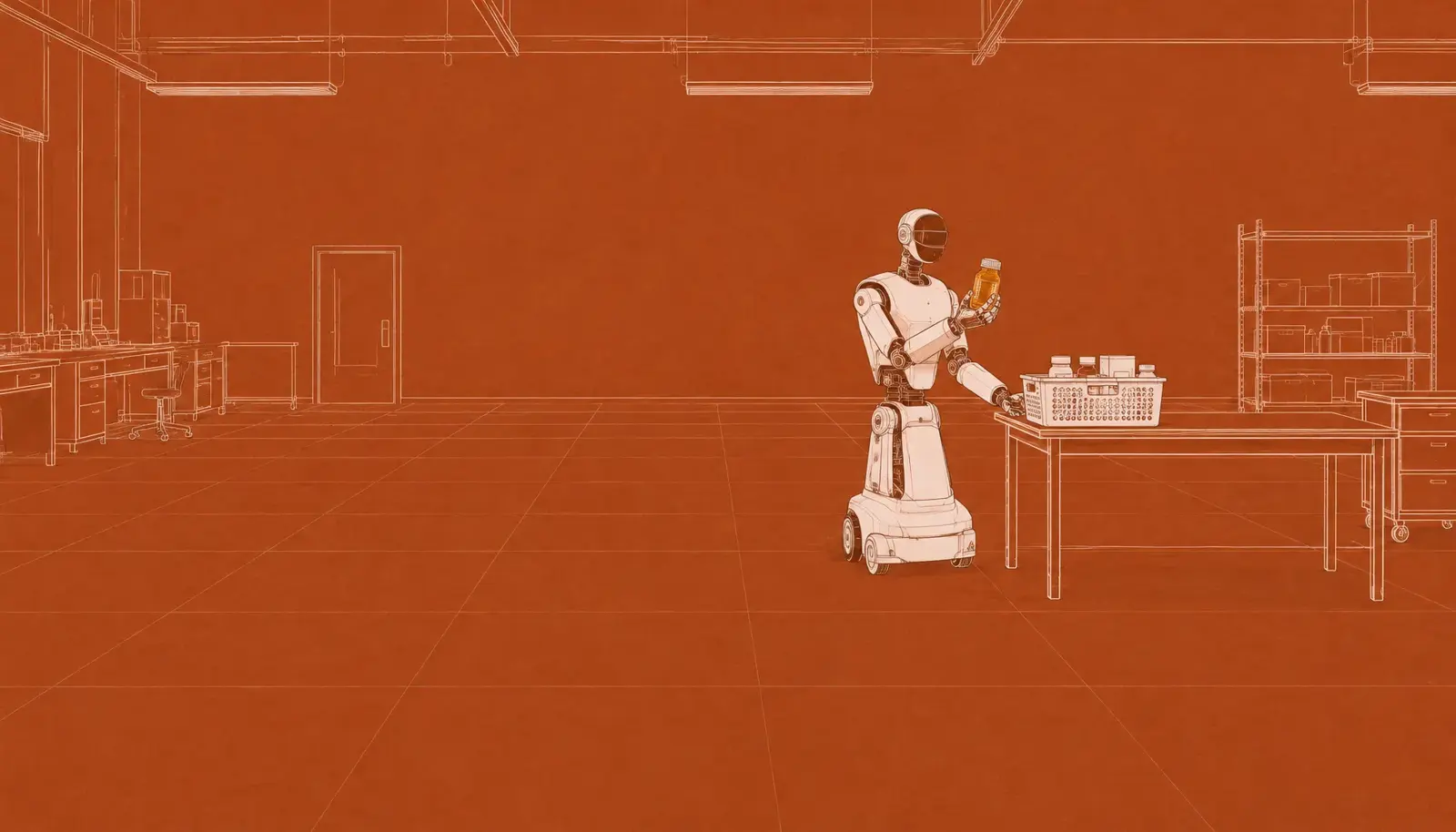
3,156 episodes put mistakes into the progress record
A new paper introduces ReSTEP, a dataset of 3,156 robot manipulation episodes with frame-level annotations of when robots make mistakes. Submitted to arXiv on October 29, 2026, the paper covers parcel handling and medicine-bottle scanning and storage; it says the dataset will be publicly released.
Across the episodes, the dataset contains 1,692,390 synchronized frames, or about 15.7 hours of robot operation. It records task stages as well as errors such as empty grasps and dropped objects, allowing an evaluator to distinguish forward progress from a setback and subsequent recovery.
“ReSTEP supports training and benchmarking progress monitors through successful execution, mistakes, and recovery,” the authors write.
The data were collected on an AgiBot G02, using head and bilateral wrist cameras, robot-state information and actions recorded at 30 hertz.
Parcel handling and bottle scanning supply different errors
The parcel-handling set contains 1,953 expert demonstrations across eight scenarios. The robot may need to center a box or bag, flip it to expose a label, push it away and return to its starting pose; some initial conditions omit stages already satisfied.
The medicine-bottle set combines 959 expert demonstrations with 244 human-in-the-loop episodes. The robot grasps a bottle, turns its QR code toward a head-mounted camera, places it in a neighboring basket and resets. In the human-in-the-loop data, a policy acts autonomously until an operator intervenes to correct it.
In total, 263 episodes have annotated mistakes: 18 in parcel handling and 245 in the bottle task. The paper identifies 18 error intervals in parcel handling and 400 in bottle scanning, including errors spanning multiple frames. Every episode in the dataset ends in successful task completion, so the collection covers mistakes followed by recovery rather than unresolved failures.
REMORA tracks progress without flattening setbacks
Alongside the dataset, the authors introduce REMORA, an online estimator designed to judge whether a task is advancing, stalled or moving backward. It keeps a recurrent visual memory of earlier observations and predicts a distribution over possible progress values instead of collapsing ambiguous visual evidence into a single average.
A causal peak-selection step uses the preceding estimate to choose among plausible progress values. That can preserve continuity between frames while still allowing the estimate to fall when the robot makes a genuine mistake. The authors say stage and error annotations shape training targets; those labels are not needed when the estimator runs.
On the bottle task’s 120-episode test set, the table reports mean absolute error, A, in units of 10⁻²: REMORA’s value of 3.307 corresponds to an MAE of 0.03307, compared with SARM’s 3.470, or 0.03470. On the more error-heavy test set, peak selection reduces reported error by 45.3% compared with a median-distribution readout and improves Spearman rank correlation from 0.870 to 0.959.
One robot platform limits the claim
The results are not uniformly better on every measure. On the bottle task, SARM records a higher Spearman correlation than REMORA—0.978 against 0.959—even as REMORA scores better on mean absolute error and temporal smoothness measures. On parcel handling, the test set contains only one episode with an annotated mistake, making it a thinner test of error recovery than the bottle set, which contains 25.
The authors also identify limits to the study: ReSTEP covers two task types on one robot platform, and the method depends on task-specific annotations. The paper says the dataset will be publicly released, while code is slated for release upon acceptance. Whether the benchmark expands to other robots and tasks, and whether progress estimates can help a robot recover without human intervention, remain open questions.
Sources
- Original source · Preprint arXiv arXiv:2610.39125
Related stories
- Georgia Tech Preprint Tests Seven Robot Policies on a New Generalization Benchmark; Best Averages 52%
- Hsu and Stone Introduce ELA Preprint for Learning Robot Policies from Video Demonstrations
- VICTR Preprint Reports 23.8% Success on Unseen Out-of-Domain Real-World Robot Tasks
- ExRL learns when to replan robot actions, researchers report
- UniLatent preprint tests robot-to-robot transfer in simulation and on arms