The Floor
Rhoda AI Reports Higher Robot Benchmark Scores With Larger Video Models
Rhoda AI says larger video models and longer pre-training improved performance on a real-robot bearing-unpacking benchmark. The study reports an 84.7% at-speed completion rate for its largest model, while noting that the experiments cover one task and one robot setup.
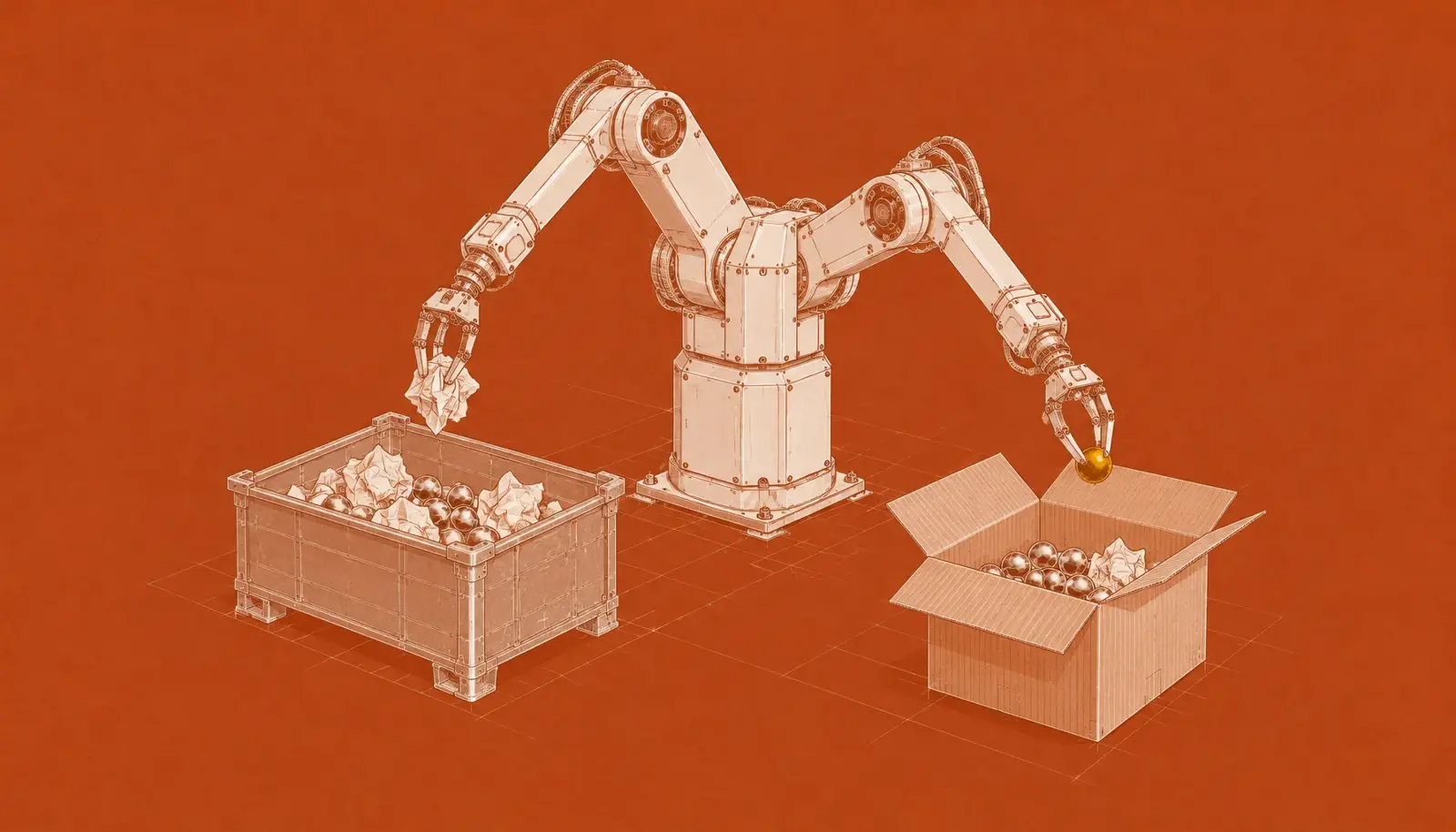
Rhoda AI reports that larger video models pre-trained on general web video performed better on a real-robot industrial task after being trained on robot demonstrations. In the company’s scaling study, its largest tested model completed the bearing-unpacking task within the defined requirements and time limit in 94 of 111 trials, an 84.7% rate.
The research post, titled “Does Scaling Web-Video Pre-training Help Real Robots Do Real Work?”, examines whether changing model size and pre-training compute affects performance on the same task. Rhoda says it ran more than 200 hours of real-robot evaluations. The benchmark was not a factory-wide deployment test: the study evaluates one task on one robot setup.
A benchmark built around unpacking bearings
The task requires a robot to unpack bearings and sort the packaging into separate bins. The boxes weigh 10 kilograms, and the procedure includes opening packaging, removing materials, transferring the bearings to a tote and sorting the waste. Rhoda describes the customer task as a long sequence of manipulation steps, with challenges such as handling a transparent plastic bag and retrieving paper that can get caught among the bearings.
Rhoda scored a trial as successful only if the robot met every task requirement without human intervention and finished in under 100 seconds. The company says it chose the time limit to distinguish model results; it is stricter than the customer’s requirement. A trial that missed either the completion or time condition counted as a failure.
Larger models scored higher in the tested setup
Rhoda compared four video-model sizes, labeled XS, S, M and L. Their reported at-speed completion rates were 3.7% for XS, 65.0% for S, 75.3% for M and 84.7% for L. The largest model’s result was 94 successful trials out of 111; the medium model completed 195 of 259 trials at speed.
The company also held model size fixed and varied pre-training compute for its M model. At the lowest tested compute budget, 0.08 times the full run, the at-speed completion rate was 57.8% across 59 of 102 trials. At the full budget, the rate was 75.3%, or 195 of 259 trials. Rhoda reports that increased compute improved results at each tested amount of robot demonstration data, with the largest gains when that data was limited.
In the study, the video model is first pre-trained on general web video, then post-trained on robot demonstrations for the bearing task. Rhoda describes its pre-training videos as containing no actions. A separate inverse-dynamics model converts predicted video frames into robot actions, and the evaluation holds that model and the task setup fixed.
“We find that at-speed completion is a more discriminative metric than average cycle time or a plain task completion rate.”
— Rhoda AI Team, the research post’s authors, write
Results have limits
The study’s model-size comparison does not isolate model size from training compute: Rhoda says larger models in that sweep also saw more video and used more compute. The company lists this as a limitation and says the results combine those effects. It also reports one training run per condition, so the study does not measure variation across repeated training runs.
Rhoda cautions that the results apply to the tested setup: one task, one embodiment and one evaluation arrangement. The company says further tasks would require additional robot trials, which were scarce in this study. The benchmark offers measured results for bearing unpacking under a stated speed and intervention threshold; it does not establish performance across other tasks, robots or production facilities.
Sources
- Original source Rhoda AI Research rhoda.ai
Related stories
- Foundry Robotics Raises $100M for Its Emeryville Assembly Factory
- BMW and Embotech Pass One Million Driverless Factory Moves
- AgiBot Reports G2 Robot’s Store-Task Success Stabilized at 85.7%
- Hsu and Stone Introduce ELA Preprint for Learning Robot Policies from Video Demonstrations
- Georgia Tech Preprint Tests Seven Robot Policies on a New Generalization Benchmark; Best Averages 52%