The Floor
Study Finds Robot Inertia Makes Behavior Cloning Less Reliable
A simulation study found that behavior-cloning policies were less reliable when a robot was heavier than the object it manipulated. The researchers also found that lower-inertia demonstrations improved imitation in two simulated tasks.
A robot’s inertia can make a learned manipulation policy harder to imitate, even when the robot can still solve the task. In a paper submitted to arXiv on November 2, Younghyo Park, Antonia Bronars and Pulkit Agrawal report that behavior cloning becomes less reliable as the robot’s inertia rises relative to the object. Their controlled experiments also find that reinforcement learning succeeds across a broad range of robot-and-object mass combinations.
Behavior cloning pays for a heavier robot
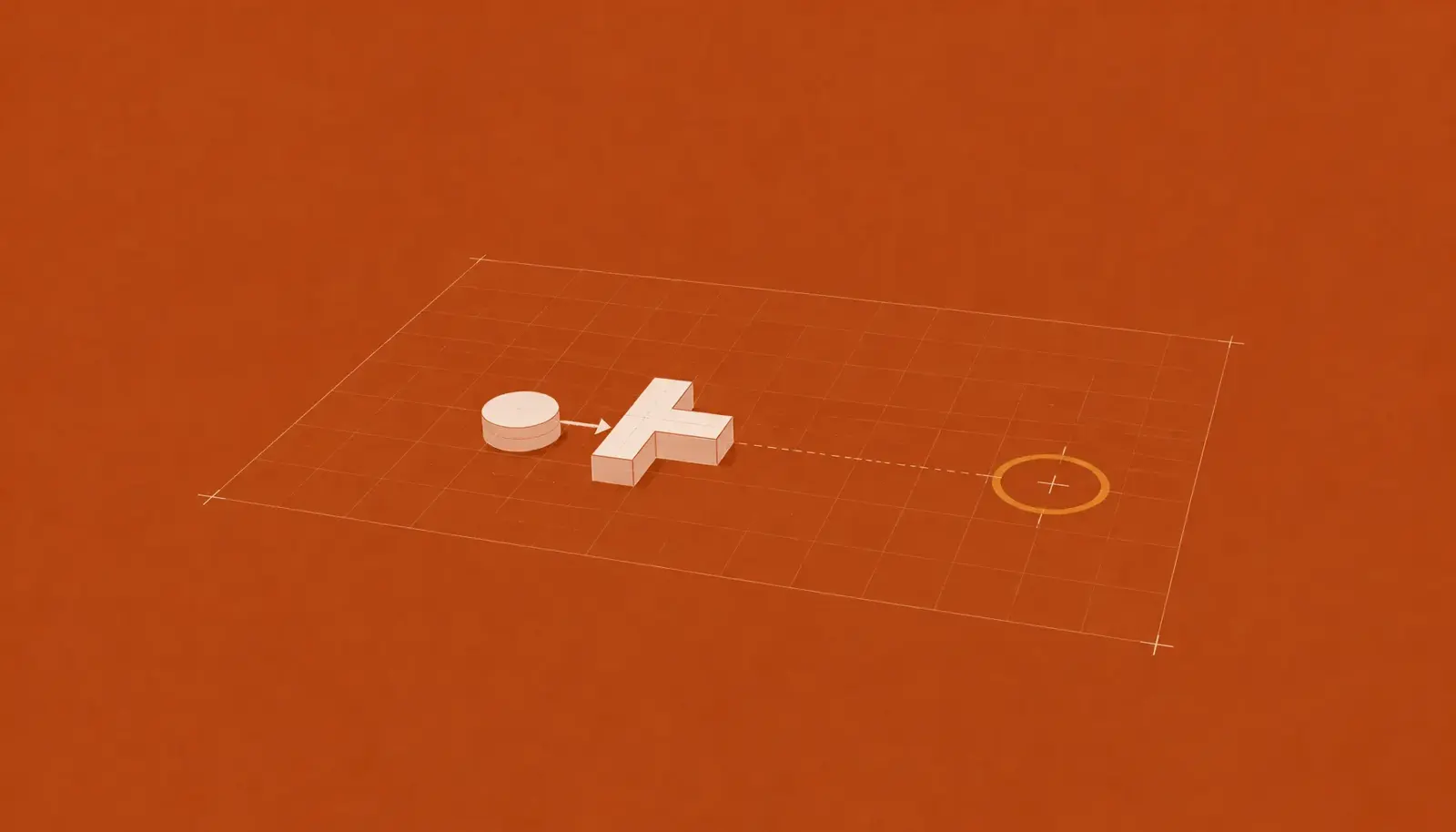
The researchers first studied a simulated point-mass robot pushing a T-shaped object toward a target. They varied the robot and object masses from 0.1 to 5 kilograms and matched the controllers’ nominal free-space response, allowing them to examine differences during contact. Reinforcement learning found successful strategies across the tested mass combinations, including cases where the robot outweighed the object.
Behavior cloning showed a different pattern. Policies trained on 200 demonstrations performed best when a lighter robot moved a heavier object, then degraded as the robot grew heavier relative to the object. Adding demonstrations narrowed the performance gap but did not eliminate it: in the paper’s comparison, a heavy robot needed 16 times the demonstrations to match a light robot trained on 100, and a dataset of 6,400 still fell behind a light robot trained on 200.
Motor gearing matters even when arm weight stays fixed
The team then tested a simulated articulated arm, changing the inertia reflected through its motors’ gearing while leaving the arm’s weight unchanged. Behavior-cloning success declined as reflected inertia increased, while the reinforcement-learning expert remained near-perfect across the tested conditions. The paper also reports a smaller, related decline for a simulated dexterous hand as its reflected motor inertia rose.
That distinction matters because an articulated arm does not present the same inertia in every posture. The authors explain that a robot’s configuration changes the effective mass an object encounters at contact, even when the hardware itself stays the same.
We find that reinforcement learning succeeds across a broad range of mass combinations, while behavior cloning learns more reliable policies when a lighter robot manipulates a heavier object, and more data narrows the resulting gap without closing it.
Younghyo Park, Antonia Bronars and Pulkit Agrawal, authors of the paper
Moving the task can improve imitation
The researchers tested whether a team could reduce contact inertia without replacing the robot. In one simulated T-pushing experiment, they raised the workspace from ground level to 0.40 meters, changing the arm’s configuration while keeping the arm itself the same. The lower-inertia placement improved behavior-cloning success across all 36 evaluated settings, without a consistent improvement in the policy’s error on held-out actions.
In another simulation, an expert was steered toward lower-inertia ways of reorienting a cube with a tool on a Franka arm. Behavior-cloning policies trained on those demonstrations achieved better task success than policies trained on higher-inertia demonstrations, despite having higher action error during training. The result suggests that a closer match to the demonstrator’s individual actions does not necessarily produce the more successful closed-loop policy.
The findings remain simulation results
The paper’s tests are controlled simulations, not demonstrations of improved learning on a physical robot. The authors identify whether the behavior-cloning advantage extends to sim-to-real transfer as an open question. They also point to retargeting human demonstrations and designing teleoperation interfaces that encourage lower-inertia motions as directions for further study.
Sources
- Original source · Preprint arXiv arXiv:2611.03501
Related stories
- Hsu and Stone Introduce ELA Preprint for Learning Robot Policies from Video Demonstrations
- VICTR Preprint Reports 23.8% Success on Unseen Out-of-Domain Real-World Robot Tasks
- ExRL learns when to replan robot actions, researchers report
- UniLatent preprint tests robot-to-robot transfer in simulation and on arms
- Researchers Demonstrate a Bistable Origami Robot for Multimodal Motion and Grasping in Nonuniform Magnetic Fields