The Floor
RoboTeam Tests AI Agents on Up to 16 Robot Arms
A new simulated benchmark tests AI agents on coordinated jobs with as many as 16 robot arms while the environment keeps running. In the authors’ tests, the top adaptive setup completed 28 of 36 tasks, but a typical task took hours and required repeated retries.
A benchmark for teams of arms
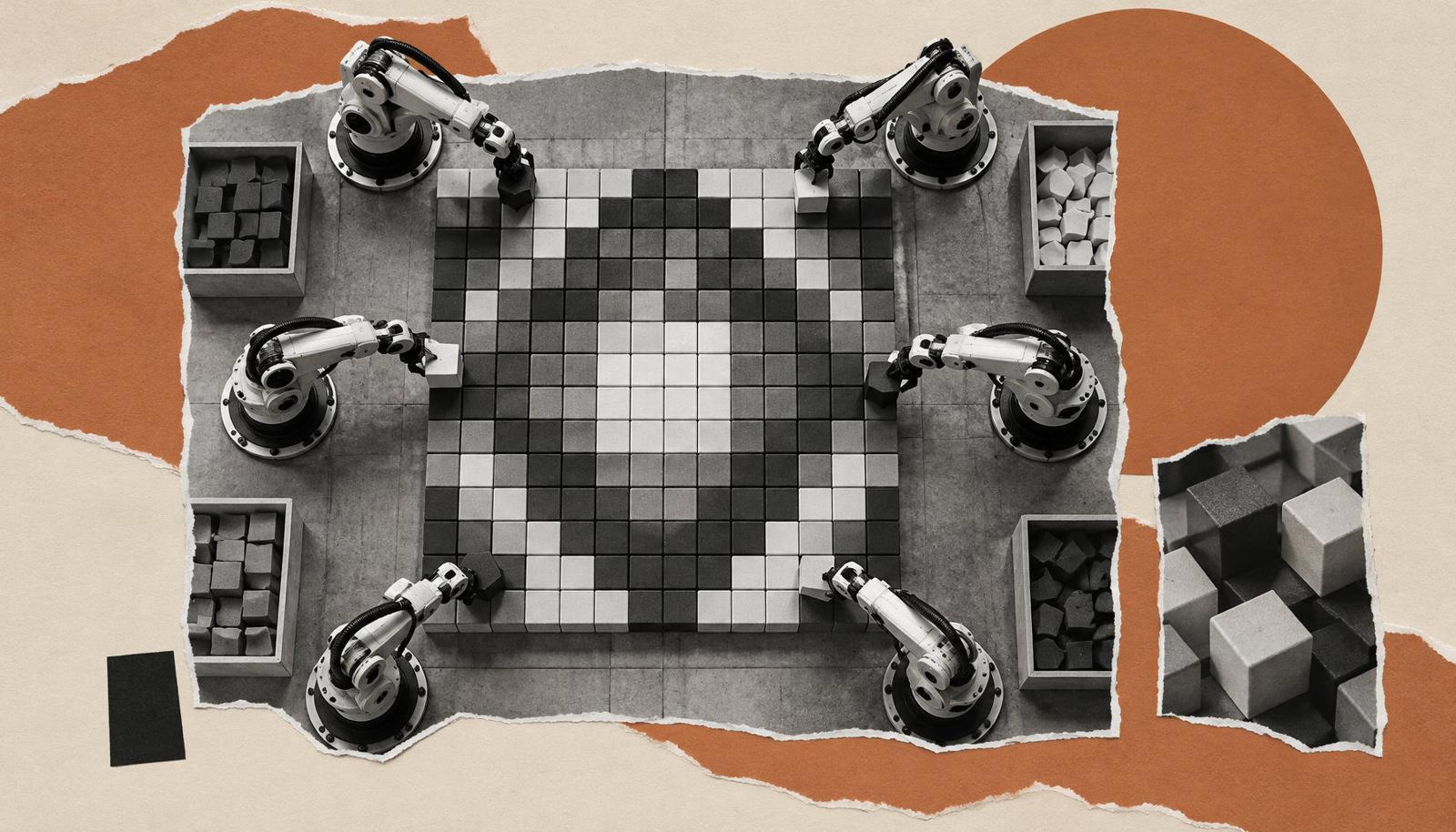
A multimodal agent completed 28 of 36 tasks in a new simulation benchmark that assigns AI systems as many as 16 robot arms and keeps the environment running while they think, according to a paper submitted to arXiv on November 17. The RoboTeam benchmark tests whether agents can coordinate long jobs using camera images rather than supplied object positions. Its authors say the results also expose the time, token use and failed actions involved in completing those jobs.
The benchmark covers four kinds of coordinated work: delivering parts to targets, building a picture from colored cubes, passing long timbers between arms and turning spring-loaded knobs. Each task type has three team sizes and three difficulty levels, for 36 tasks in all. In the timber relay, arms must pass the part in the air, and a dropped timber has to be picked up again. In the mosaic tasks, the arms place cubes into a pattern whose cells become harder to identify at higher difficulty levels.
Images, tools and a moving world
The simulated world runs in MuJoCo, with physics advancing in 2-millisecond steps rather than pausing for an agent’s response. Agents receive RGB images from fixed cameras and information about the arms, but not object positions, depth or contact data. Depending on the task, the setup uses 14 to 69 cameras, including views near each arm, scene-wide views and close-ups; the cameras render images at 1280 by 800 pixels.
Agents move the arms through a shared robot tool with commands to move an arm or operate its gripper. In most conditions, they can also use code tools, including Python, to estimate object positions from images. A sandbox blocks access to the simulator and hidden task information. The study tested six models using four agent structures: a single agent controlling every arm, a hierarchy with one worker per arm, a decentralized team, and an adaptive system that can create delegates and assign them arms during a task.
Completion came with high costs
Under the adaptive system, gpt-6.1-sol completed 28 tasks and opus-5.5 completed 27; the other four models completed no more than three, the authors report. A typical gpt-6.1-sol task took 3.5 hours and used 218 million input tokens. The authors also measured failures at the level of individual task steps: 34% failed at least once and had to be retried.
Across the four agent structures, gpt-6.1-sol completed between 27 and 29 tasks. The hierarchical and decentralized systems ran faster than the adaptive setup but used 1.9 and 1.7 times as many tokens, respectively. The single-agent system used fewer tokens but took 1.6 times as long overall. On tasks completed by both a single-agent and hierarchical setup, the median task took 22 hours for the former and 5.5 hours for the latter on the largest teams.
Vision and image-processing tools affected completion too. With ground-truth object positions, the paper’s single-agent reference condition completed all 36 tasks. When gpt-6.1-sol had to rely on camera images, removing its code tools reduced completed tasks from 28 to 13; lowering image resolution reduced the count to 14. The authors conclude that no tested model or agent structure was simultaneously fast, inexpensive and reliable.
Sources
- Original source · Preprint RoboTeam: Benchmarking Vision-Based Multi-Agent Control of Many Robot Arms in Real Time arXiv:2611.22138
Related stories
- DOBB preprint reports lower collision failures in navigation tests
- Researchers Present Multi-Agent Reinforcement Learning for Planar Tangram Assembly
- DreamFAR preprint reports real-time robot-world simulation
- HandUMI records bimanual demonstrations without a robot
- Hub releases first 10,124 hours of skilled-work video for robot learning