The Floor
Simulated tag trains humanoid controllers to dodge and dive
Researchers used a simulated pursuit game to train humanoid locomotion controllers through competitive self-play. Their preprint reports emerging strategies but does not test the controller on physical robots.
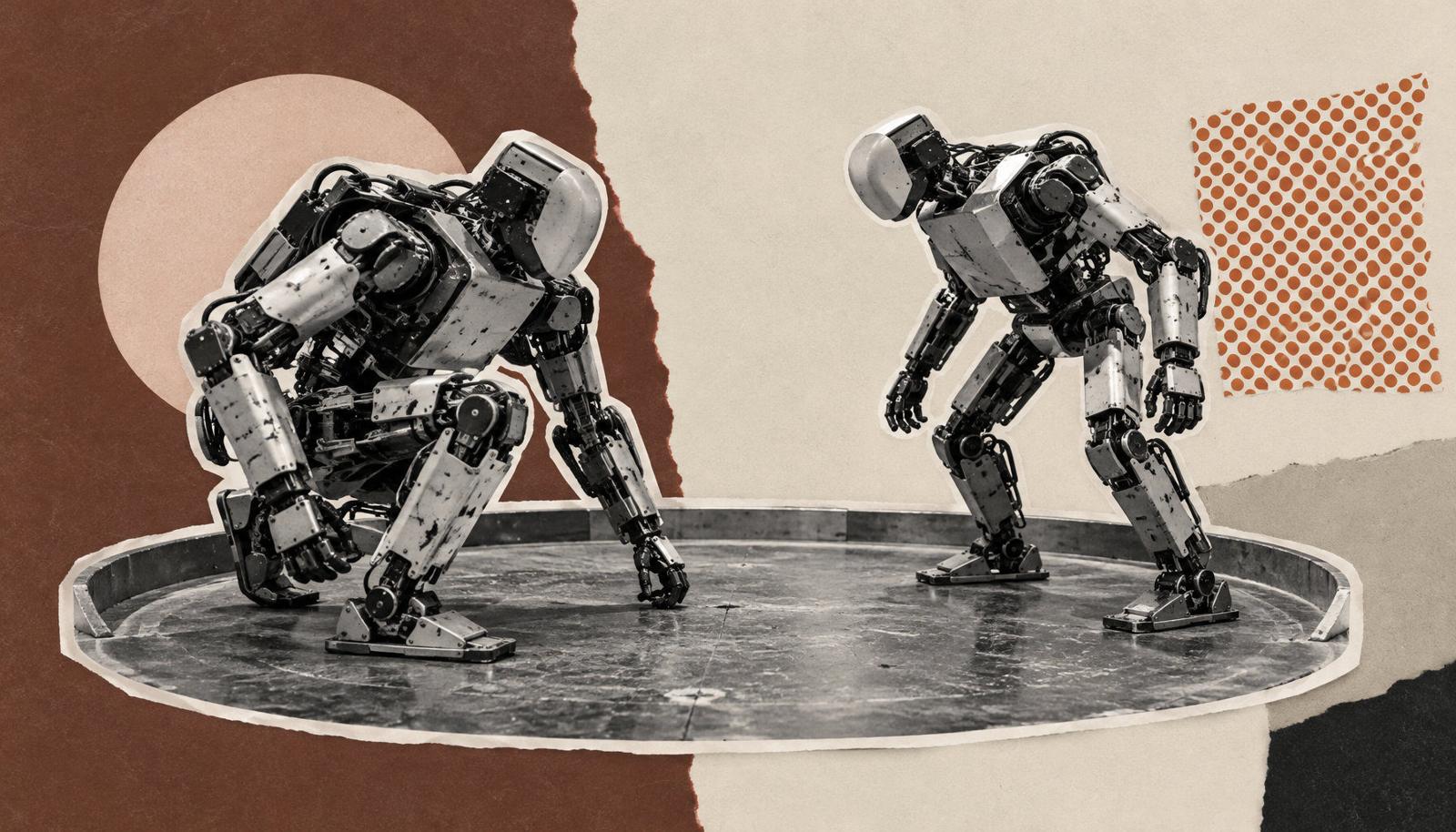
A simulated game of tag trained humanoid locomotion controllers to lunge, dodge and dive as they competed against earlier versions of themselves, researchers report in a new preprint. The work introduces MJTag, a pursuit-and-evasion task suite designed to study whether competitive self-play can produce new movement strategies.
Source arxiv.org
Researchers at Loyola University Chicago trained the controllers in a physics simulator, not on physical robots. The work was submitted to arXiv on November 24.
Training through pursuit
Each simulated arena contains two Unitree G1 humanoids: a pursuer and an evader. The same model can play either role because its policy is conditioned on the role it has been assigned.
A tag occurs when the agents come within 0.5 meters of each other in the horizontal plane; it does not require physical contact. Falls and exits from the arena also end an episode and carry a penalty for the agent involved.
The controller receives feedback from the game outcome alongside weak, dense reward shaping. The researchers contrast this with controllers trained to track predetermined motions or maximize carefully shaped rewards for locomotion.
A changing league
During training, the online model competes against saved, frozen versions of itself. Every 2,500 training epochs, a new copy enters a league that also includes a scripted policy producing zero actions as a passive baseline.
The league holds 32 checkpoints, and opponents are sampled using a method that weights them according to the learner's empirical win rate against them. The training system also adjusts how often the learner plays each role, responding to the imbalance between pursuing and evading.
The researchers report that playing the pursuer is much easier than playing the evader, and that training becomes unstable without the role-sampling mechanism. In their comparison, the pursuer's skill rose much faster without role sampling, eventually producing consistent wins.
What the results show
The team evaluated progress using Elo ratings calculated from game outcomes against the league's own saved checkpoints. Each saved checkpoint played 4,096 deterministic games, with roles assigned randomly.
The researchers observed a sharp rise in the rating over approximately the first 5,000 iterations, followed by a level near 1,200. They also report strategy changes after the rating leveled off, with later pursuers or evaders beating earlier opponents in the other role.
The authors caution that the rating measures strength relative to prior checkpoints, not agility as a separately defined metric.
Limits beyond the game
The team did not deploy the controller on hardware. The preprint identifies differences in contact and friction, repeated falls, collisions and estimating an opponent's state from onboard sensing among the challenges for transfer.
Some unusual movements may be exploits of the simulator's contact model, the researchers say; they have not yet separated those from other behavior. They also note that skills outside the game's reward, including stair climbing, carrying loads and a natural gait, would still require reward shaping or imitation.
Sources
- Original source · Preprint An Adversarial Multi-Agent Pursuit Game for Locomotor Agility Pretraining arXiv:2611.33407
Related stories
- Depth gaps erase gains for simulated manipulation policies, preprint finds
- Skeptic cuts false impossibility judgments in simulated robot tasks, study finds
- RoboJackVR turns simulated robot tasks into a VR game
- DexEngine preprint maps human demonstrations to two-arm robot data
- DexLink preprint reports robot skills without object-specific demos