The Floor
Skill-JEPA preprint reports higher success on distant robot goals
A preprint reports that planning over learned action skills raised average success on goals 80 steps away from 42% to 62%. Its simulation results cover five tasks and compare the method with raw-action planning.
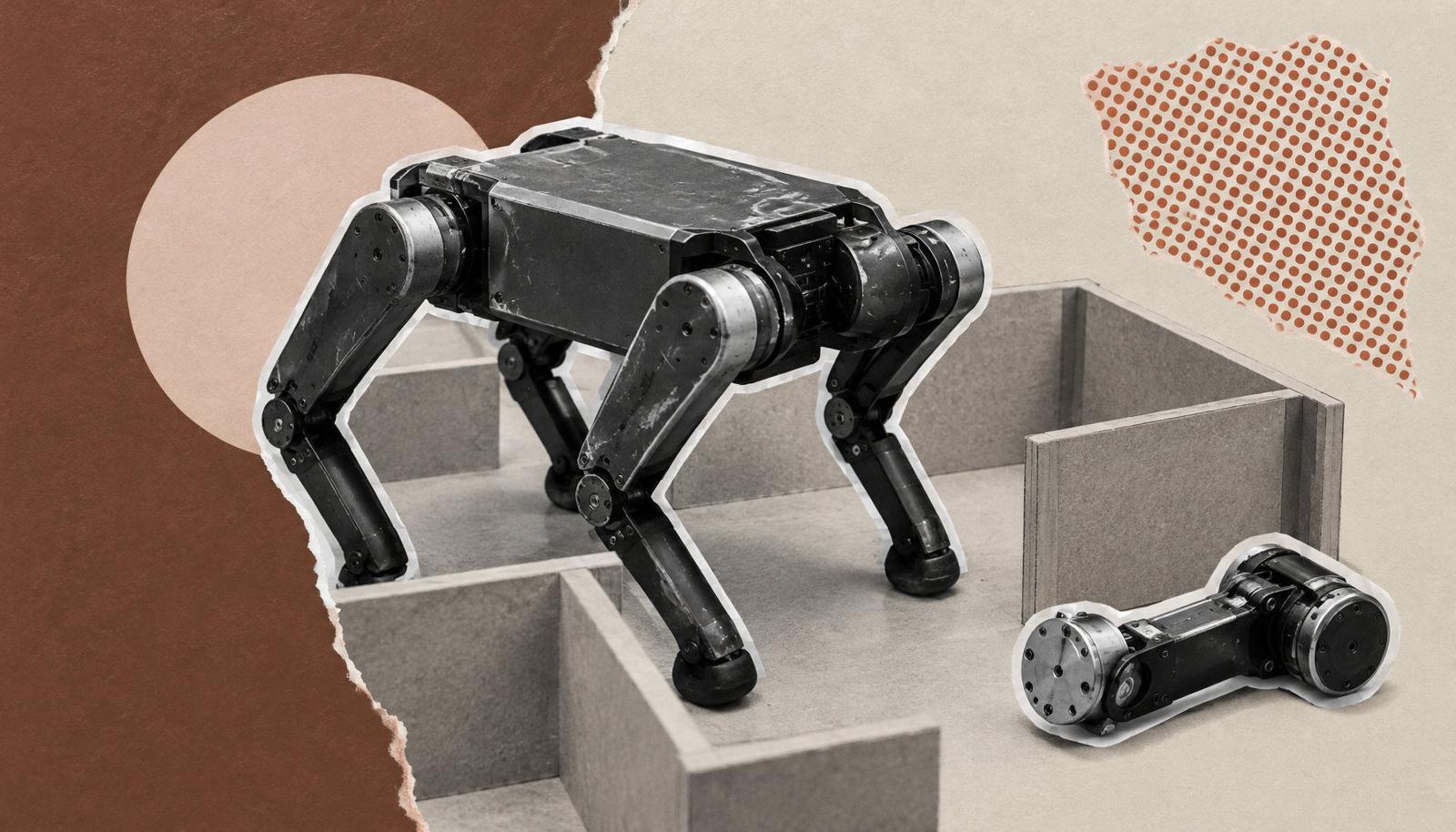
A robot planner using Skill-JEPA reached goals 80 steps away with 62% average success, compared with 42% when planning over raw actions, according to a preprint submitted to arXiv on November 19, 2026. The work tests a learned action representation intended to make a world model’s training data more compatible with the candidates a planner explores.
Skills as the planning interface
Joint-Embedding Predictive Architecture, or JEPA, world models predict the effects of actions in a learned latent space. The paper describes a mismatch in standard planning: planners draw candidate actions from a Gaussian distribution, while the model has been trained on structured actions that vary with the robot’s state.
Skill-JEPA adds a variational autoencoder conditioned on the current state. It compresses short action sequences into latent skills and decodes those skills into actions; the world model predicts what a skill will do, and the planner searches over skills drawn from the same standard Gaussian prior used in training. The planner itself is unchanged, and the method does not add subgoals, a hierarchy or hand-designed skills.
Five benchmark tasks
The authors tested the method on five tasks using three JEPA world models: LeWorldModel, Planning with a Latent Dynamics Model, and the Sensori-Motor World Model. The four standard tasks were Two-Rooms navigation, Push-T and OGBench-Cube manipulation, and Reacher control with a two-link arm. The fifth, OGBench-AntMaze, uses a quadruped with eight actuated joints.
For the four standard tasks, comparisons used goals 20, 40, 60 and 80 steps away. The baseline and skill-based models shared their data, encoder and predictor architectures, regularizer, and four-step action chunk length; the action representation was the main difference. The researchers report success rates over 100 evaluation episodes per model, task, distance and seed, using three training seeds.
Reported gains at longer distances
Across the four standard tasks and three models, the authors report that average success with raw actions fell from 87% at 20 steps to 42% at 80 steps. With learned skills, it declined from 92% to 62%; the reported gap between the approaches grew from five percentage points at 20 steps to 20 points at 80 steps.
On AntMaze, average success for raw-action planning was 49% at one maze cell and 0.4% at two, with no successes beyond that distance. With skills, the reported rates were 83% at one cell, 38% at two and 21% at three; the method also recorded 6% success at four cells. The authors say gains held across four planners: CEM, iCEM, MPPI and Predictive Sampling.
Scope and limitations
Ablation tests found that skills learned without the VAE’s KL regularization term did not improve planning, according to the paper. The authors link the term to aligning the distribution of skills seen during training with the distribution from which the planner initially samples.
The paper’s analysis covers the planner’s first candidates and a single prediction step, and does not directly establish what happens as a planner refines its search. The authors also say the experiments were limited to simulation, a fixed skill length, raw-action baselines and planners that start from a Gaussian.
Sources
- Original source · Preprint arXiv arXiv:2611.26825
Related stories
- Monte Carlo planner beats baselines in simulated robot tasks
- Actus planner corrects robot commands using action uncertainty
- Preprint proposes robot planning with explicit, reusable safety rules
- JEPA Dots separates language goals from robot world prediction
- DreamFAR preprint reports real-time robot-world simulation